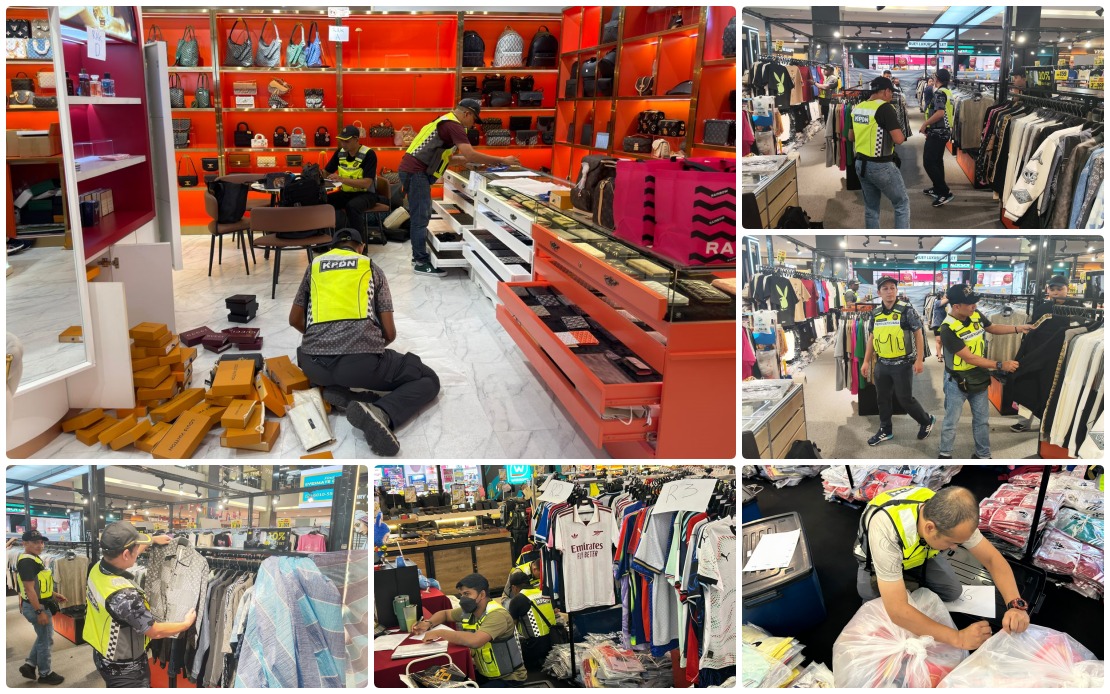
Malaysia's Ministry of Domestic Trade and Cost of Living (KPDN) has dismantled a significant counterfeit goods distribution operation in Johor, confiscating merchandise valued at RM600,000 following simultaneous raids on three premises in Johor Bahru on June 15. The enforcement action, executed by the ministry's Putrajaya Enforcement Division, targeted retailers dealing in replica products bearing trademarks of established international brands without authorisation from legitimate trademark proprietors. The operation underscores intensifying scrutiny of illicit trade in branded merchandise across Malaysian consumer markets.
Enforcement director-general Datuk Azman Adam detailed the scope of the crackdown, revealing that investigators had conducted approximately one month of surveillance prior to executing the raids. The intelligence gathering identified traders operating through prominent supermarket channels while simultaneously functioning as distributors supplying other merchants. This distribution architecture suggests a sophisticated smuggling network designed to maximise market penetration whilst obscuring the source of counterfeit inventory. The identification of such networks demonstrates how illicit trademark infringement operates as a layered enterprise rather than isolated retail deception.
The confiscated inventory encompassed a diverse array of consumer products, including apparel, leather goods such as handbags and wallets, accessories including belts, and fragrance products. Investigators also secured relevant business documentation and records associated with the trading operations. The broad product range indicates that trademark counterfeiting in Malaysia has evolved beyond simple fashion forgeries to encompass multiple consumer categories where brand reputation commands premium pricing. This diversification reflects the commercial rationality underlying counterfeit production—counterfeiters target product categories where consumer demand for branded goods remains robust regardless of authenticity concerns.
The legal framework governing these prosecutions derives from the Trademark Act 2019 (Act 815), specifically Section 102(1)(c), which criminalises the possession, custody, or control of goods bearing wrongfully applied trademarks with intent to trade them. Initial verification procedures conducted jointly with complainant representatives established reasonable grounds for believing such offences had occurred. This collaborative verification process reflects established protocol where trademark owners themselves participate in confirming that seized items infringe their registered intellectual property rights.
Four individuals associated with the premises—including proprietors and caretakers—have been detained to support ongoing investigations into operational management and supply chain coordination. Their detention suggests authorities are pursuing not merely retail-level actors but those orchestrating broader distribution arrangements. Understanding the administrative and logistical dimensions of counterfeit operations proves crucial for dismantling organised networks rather than merely disrupting temporary retail manifestations.
The penalties prescribed under Malaysian trademark law escalate substantially based on offence severity and recidivism. For individuals committing initial offences, statutory liability encompasses fines reaching RM10,000 per counterfeit item or imprisonment of up to three years, with courts possessing discretion to impose both penalties concurrently. Repeat offenders face enhanced consequences, including fines escalating to RM20,000 per item or extended imprisonment to five years. Corporate entities confront steeper liability structures, with initial offences attracting fines of RM15,000 per item and recidivist offences RM30,000 per item. This penalty asymmetry reflects policy intent to deter corporate participation more severely than individual involvement.
The RM600,000 valuation of confiscated goods provides insight into the economic magnitude of individual counterfeit operations. Scaled against national enforcement capacity, this single operation removal represents substantial resources diverted from legitimate commerce into illicit trademark infringement. For Malaysian consumers, such operations undermine product authenticity expectations and expose purchasers to potential health and safety risks, particularly concerning fragrance and personal care products lacking regulatory oversight or quality assurance mechanisms.
From a regional perspective, Malaysia's enforcement efforts against counterfeit goods address a persistent challenge affecting Southeast Asian economies. Johor's geographical proximity to Singapore and proximity to international shipping routes creates particular vulnerability to counterfeit supply chains. The state functions simultaneously as potential transshipment hub for regional counterfeiting networks and as consumer market where illicit branded goods command strong demand. KPDN's focus on Johor reflects strategic prioritisation of enforcement resources toward commerce corridors most vulnerable to trademark infringement.
Datak Azman Adam reaffirmed institutional commitment to intensifying enforcement operations against counterfeit distribution networks, emphasising that KPDN would pursue systematic crackdowns against parties engaged in trademark infringement. This declarative commitment suggests that the Johor operation represents component of broader countrywide enforcement strategy rather than isolated prosecutorial action. The ministry's positioning indicates recognition that consumer confidence in brand authenticity represents essential element of market integrity.
The intellectual property dimensions of counterfeit enforcement extend beyond trademark law enforcement into considerations of consumer protection and market fairness. Counterfeit goods impose externalities affecting legitimate retailers competing against illicit traders operating without authentic trademark licensing costs. They simultaneously deceive consumers regarding product provenance and quality standards. From economic development perspective, tolerating counterfeit distribution undermines incentives for innovation and brand development, ultimately constraining Malaysia's transition toward higher-value manufacturing and commerce.
The operation's emphasis on identifying distribution networks rather than solely targeting retail points reflects sophisticated enforcement strategy. By targeting premises functioning as wholesaler-distributor hubs, KPDN disrupts supply chains rather than merely displacing retail activity. This approach acknowledges that counter-trafficking strategies prove more effective when targeting upstream supply operations rather than pursuing endless retail enforcement at individual point-of-sale locations. The month-long intelligence phase preceding enforcement indicates recognition that effective anti-counterfeiting operations require patient investigative groundwork preceding enforcement action.
Moving forward, the implications of this enforcement action extend across multiple stakeholder constituencies. For legitimate trademark owners, the operation demonstrates that Malaysian authorities possess capacity and willingness to prosecute trademark infringement, potentially encouraging greater reporting and cooperation with enforcement bodies. For importers and retailers of branded goods, such enforcement actions reinforce market conditions favouring authenticity over counterfeiting. For consumers, the operation underscores institutional efforts to protect marketplace integrity, though ongoing vigilance remains necessary given counterfeiters' adaptation to enforcement measures.

%22%2F%3E%3C%2Fpattern%3E%3C%2Fdefs%3E%3Crect%20width%3D%22100%25%22%20height%3D%22100%25%22%20fill%3D%22url(%23ph2hy9vg)%22%2F%3E%3Crect%20width%3D%22100%25%22%20height%3D%22100%25%22%20fill%3D%22url(%23ph2hy9vp)%22%2F%3E%3Ctext%20x%3D%2250%25%22%20y%3D%2250%25%22%20text-anchor%3D%22middle%22%20dominant-baseline%3D%22central%22%20fill%3D%22rgba(255%2C255%2C255%2C0.95)%22%20font-family%3D%22Georgia%2C%20'Times%20New%20Roman'%2C%20serif%22%20font-weight%3D%22700%22%20font-size%3D%22272%22%20letter-spacing%3D%22-0.02em%22%3EAnwar%3C%2Ftext%3E%3C%2Fsvg%3E)