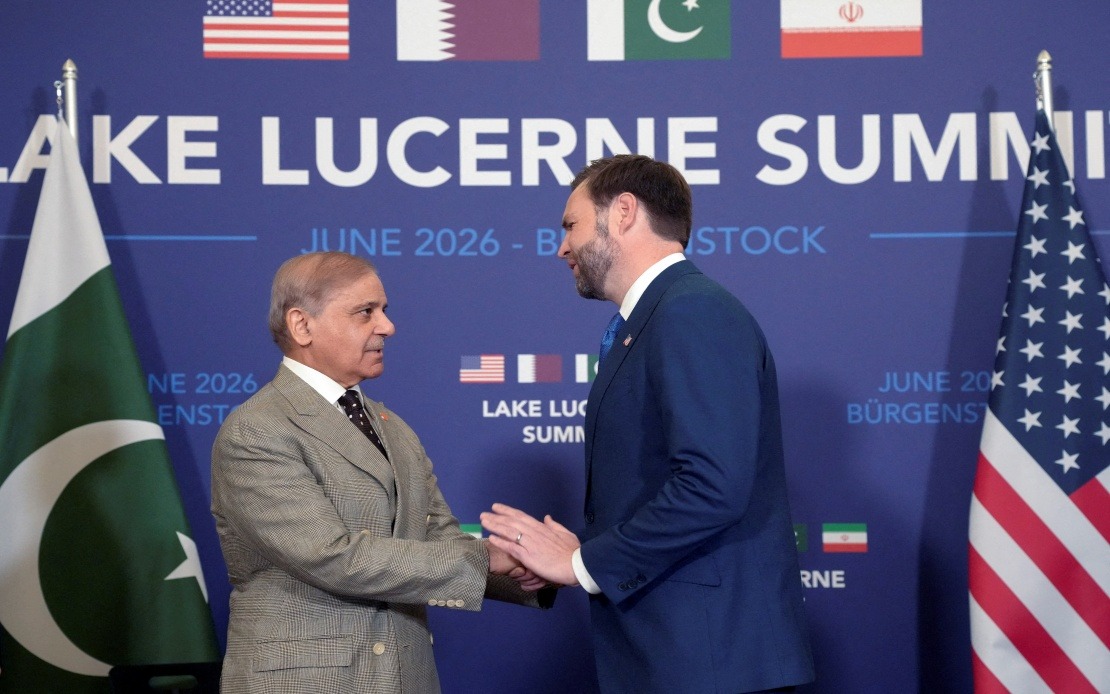
Vice President JD Vance, alongside White House special envoys Steve Witkoff and Jared Kushner, convened with Pakistan's Prime Minister Shehbaz Sharif and Pakistan Army Chief Field Marshal Asim Munir at the Burgenstock resort in Switzerland on Sunday, marking the commencement of significant diplomatic engagement between Washington and Islamabad. The meeting, disclosed by White House press officials, represents a crucial moment of bilateral coordination as broader international negotiations on Middle Eastern tensions unfold in the Alpine setting.
The timing of this US-Pakistan encounter carries particular weight given its connection to parallel technical discussions between the United States, Iran, Pakistan, and Qatar—all occurring simultaneously at the same venue. These working-level negotiations are being conducted with strict confidentiality, reflecting the sensitivity of ongoing efforts to establish a stable framework for resolving the military hostilities that have defined US-Iran relations since late February. The convergence of these separate but related diplomatic channels suggests a coordinated international strategy to address multiple dimensions of regional instability.
Pakistan's central positioning in these negotiations underscores its evolved diplomatic standing in Western strategic calculations. As both a mediating party and a principal participant in direct talks with American leadership, Islamabad has leveraged its historical relationship with Tehran and its strategic importance to Washington. The presence of Prime Minister Sharif and Field Marshal Asim Munir, Pakistan's most senior military leader, indicates that these discussions extend beyond routine diplomatic courtesy to encompass substantive matters affecting regional security and Pakistan's own strategic interests.
The broader context involves a recently concluded preliminary agreement that provides the foundational framework for further substantive negotiations. In a development that occurred in the days preceding the Burgenstock gathering, Iran and the United States executed a memorandum of understanding that commits both nations to terminating the military conflict initiated on February 28. This document establishes concrete timelines for key elements of any eventual settlement, including American withdrawal of its naval blockade against Iran and Iranian restoration of maritime traffic through the critically important Strait of Hormuz, a waterway whose disruption carries immediate implications for global energy markets and Southeast Asian shipping routes.
The memorandum also addresses nuclear dimensions of the US-Iran dispute, with Iran committing to refrain from pursuing nuclear weapons acquisition. However, the technical details of Iran's nuclear programme remain subject to separate negotiations, with participating nations agreeing to complete these discussions within a sixty-day window. This bifurcated approach allows the military conflict resolution to proceed on a faster timeline while giving specialized nuclear experts adequate time to develop comprehensive agreements addressing proliferation concerns that have complicated US-Iran relations for decades.
For Iran, the ultimate prize in these negotiations is the comprehensive lifting of international sanctions that have severely constrained its economy since the American withdrawal from the Joint Comprehensive Plan of Action in 2018. The prospect of sanctions relief represents not merely an economic gain but a restoration of Iran's capacity to engage in normal international commerce and investment relationships. Conversely, for the United States, the achievement of a verifiable commitment to nuclear non-weaponization coupled with maritime stability constitutes the primary objective driving American participation in these negotiations.
Pakistan's participation in this diplomatic architecture reflects several overlapping strategic considerations. As a nuclear-armed nation with extensive ties to both Iran and the Gulf states, Pakistan has significant interest in preventing prolonged military confrontation that could destabilize the broader region and threaten Pakistan's own security. Furthermore, the involvement of Pakistani officials at the highest levels signals Washington's desire to ensure that any regional settlement enjoys the support of influential Muslim-majority nations whose endorsement carries weight with other regional actors.
The Burgenstock location itself carries symbolic importance, as Switzerland has long served as neutral ground for sensitive international negotiations. The Alpine resort provides the discrete, secure environment necessary for candid exchanges on matters that both American and Pakistani officials would prefer to discuss away from public scrutiny and media pressure. The physical separation from Washington and Islamabad allows negotiators to explore creative solutions without immediate domestic political constraints.
For Malaysian and Southeast Asian observers, these developments merit careful attention for several reasons. The stability of the Strait of Hormuz directly affects regional energy security and maritime commerce patterns throughout the Indian Ocean and beyond. Additionally, any lasting settlement in the US-Iran dispute carries implications for broader patterns of great power competition in Asia, potentially affecting the strategic space available to ASEAN nations as they navigate relationships with both Washington and Beijing. The success or failure of these Burgenstock negotiations may influence American strategic priorities in Asia and the resources Washington can dedicate to maintaining its regional partnerships and commitments.
The convergence of American, Pakistani, Iranian, and Qatari negotiators at Burgenstock represents a rare moment of multilateral diplomatic intensity focused on conflict resolution. Whether these technical-level discussions can translate momentum from the preliminary memorandum into comprehensive, implementable agreements remains uncertain. The sixty-day timeline for nuclear negotiations and the parallel pursuit of maritime and sanctions issues suggest ambitious scheduling that will test the patience and creativity of all parties involved.
The involvement of senior military and political leadership from Pakistan indicates that negotiations extend beyond routine diplomatic matters to encompass issues with direct implications for regional military balances and strategic positioning. The discussions likely address not only the immediate mechanics of conflict termination but also longer-term frameworks for preventing renewed escalation and establishing mechanisms for sustained engagement between the United States and Iran through the mediation of trusted regional interlocutors.