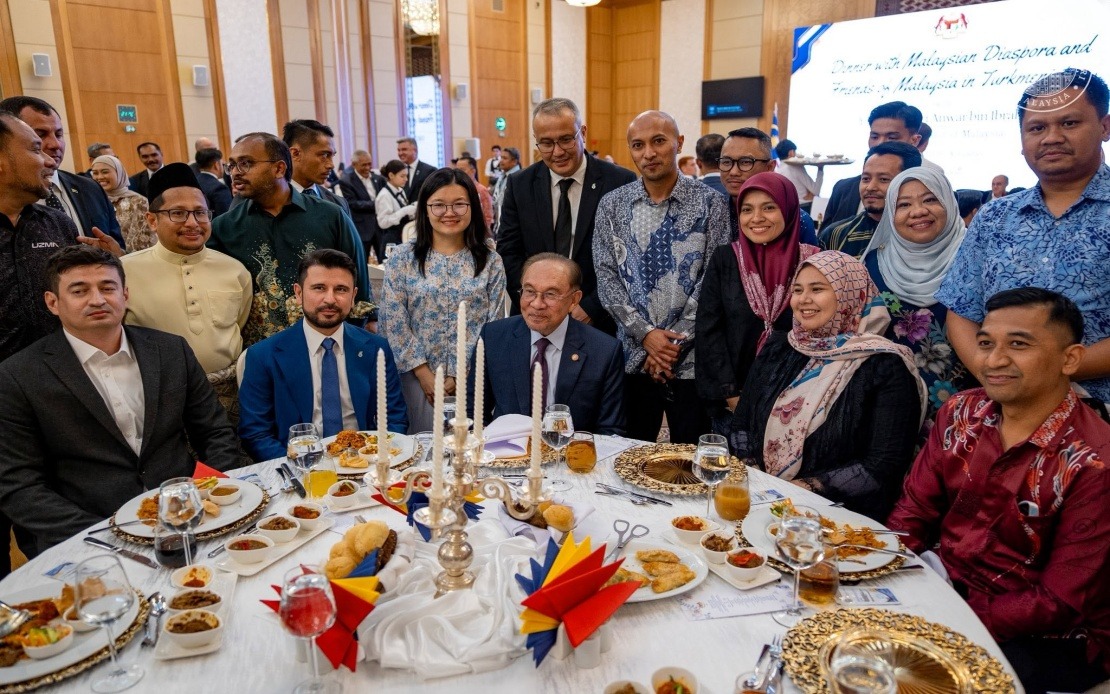
Prime Minister Datuk Seri Anwar Ibrahim used his official visit to Turkmenistan to connect with members of the Malaysian diaspora in Ashgabat, demonstrating the MADANI Government's commitment to maintaining meaningful engagement with citizens abroad. The encounter highlighted how the administration views overseas Malaysians as vital components of the nation's diplomatic and cultural outreach strategy, particularly in regions where Malaysia's presence is relatively modest. By prioritising such interactions during high-level state visits, the government signals that it recognises the contributions these individuals make to Malaysia's international standing.
During the meeting, Anwar encouraged the diaspora community to remain connected to Malaysia and to stay informed about the country's developmental progress. His message reflected a broader strategic concern: ensuring that Malaysians scattered across the globe maintain emotional and informational ties to home, thereby sustaining their investment in national affairs despite geographical distance. This approach acknowledges that diaspora communities can serve as informal networks that amplify Malaysia's soft power and cultural influence in their adopted countries.
The Prime Minister characterised these overseas Malaysians as unofficial ambassadors, emphasising their role in crafting and promoting Malaysia's international image. Rather than viewing the diaspora as citizens who have abandoned their roots, the government frames them as active participants in advancing the nation's reputation, expanding its networks, and enhancing its standing on the world stage. This framing has practical implications: diaspora members who feel valued and connected are more likely to speak positively about Malaysia to their peers, invest in Malaysian enterprises, and facilitate business or educational exchanges.
Anwar's visit to Turkmenistan itself carries significance beyond the diaspora engagement component. The two-day official trip marks his first visit to the Central Asian nation, reciprocating Turkmenistan President Serdar Berdimuhamedov's visit to Malaysia in December 2024. Such reciprocal visits are customary diplomatic protocol, yet they also signal mutual interest in deepening bilateral relations and exploring new avenues for cooperation. For Malaysia, engaging with Central Asian nations helps diversify its foreign policy engagement and reduces over-reliance on traditional Southeast Asian and Western partnerships.
The Prime Minister articulated that the Turkmenistan visit encompassed objectives well beyond conventional trade and investment discussions. Instead, Anwar positioned the engagement as part of a broader effort to cultivate friendship, deepen mutual understanding, and identify cooperation areas that benefit both nations. This language reflects a diplomatic philosophy that values relationship-building and long-term trust alongside immediate economic gains. For a country like Turkmenistan, which sits at the crossroads of Central Asia with significant energy resources, Malaysia's outreach could eventually open doors to new economic partnerships or collaborative initiatives in sectors ranging from energy to technology.
For Malaysian readers and policymakers, Anwar's engagement with the diaspora underscores an important reality: as globalisation disperses talent, capital, and knowledge across borders, maintaining connections with overseas citizens becomes strategically imperative. Countries that nurture diaspora relationships often reap rewards in the form of investment flows, knowledge transfer, and enhanced international networks. Malaysia, with its significant overseas communities across the Middle East, Europe, North America, and Asia, has considerable potential to leverage these connections for national development.
The Ashgabat meeting also illustrates how high-level state visits can serve multiple diplomatic functions simultaneously. While the primary agenda involves bilateral discussions between governments, incorporating diaspora engagement transforms such visits into opportunities for personal connection with citizens abroad. This dual-purpose approach maximises the political and diplomatic value of international travel, particularly important for a Prime Minister whose time is constrained by domestic obligations.
Central Asia itself represents an underexplored region for many Southeast Asian nations, including Malaysia. Turkmenistan, with its strategic location and substantial natural gas reserves, could become an important partner as Malaysia diversifies its energy sources and explores new markets. The diaspora presence in Ashgabat, though perhaps modest compared to larger Malaysian communities elsewhere, nonetheless provides a foothold for cultural and economic exchange. These individuals can facilitate introductions, explain local business practices, and serve as reliable intermediaries for Malaysian enterprises seeking to establish operations in the region.
Anwar's emphasis on the diaspora's role as reputation-builders reflects a sophisticated understanding of soft power in the modern era. Traditional diplomacy conducted by government officials remains important, but it is increasingly complemented by the everyday interactions and networks that private citizens maintain. When Malaysians abroad speak positively about their country, support Malaysian cultural events, or facilitate business connections, they contribute to a favourable international perception that no amount of government marketing can entirely replicate.
Looking ahead, the visit suggests that the MADANI Government intends to maintain active engagement with overseas communities as a consistent policy priority. This could involve expanding consular services, facilitating investment by diaspora members in Malaysian ventures, or creating platforms for knowledge sharing between overseas Malaysians and domestic institutions. Such initiatives require sustained commitment and resources, but the long-term returns in terms of enhanced international networks and strengthened national identity among diaspora communities can be substantial.
The Turkmenistan engagement also demonstrates Malaysia's pragmatic approach to bilateral relations. Rather than restricting diplomatic activity to established partners, the country continues to explore connections with diverse nations across different regions. This expansionism, guided by the principle of maintaining mutual benefit, reflects Malaysia's role as a middle power seeking to amplify its influence through strategic partnerships and engagement with underutilised markets and relationships.
Ultimately, Anwar's interaction with Malaysian citizens in Ashgabat embodies a fundamental principle of contemporary statecraft: that governments must actively cultivate relationships with their diaspora communities to harness their potential as assets in pursuing national objectives. As Malaysia navigates an increasingly complex global environment characterised by economic competition, geopolitical shifts, and rapid technological change, the contributions of its overseas citizens to the nation's prosperity and international standing will likely become ever more significant.