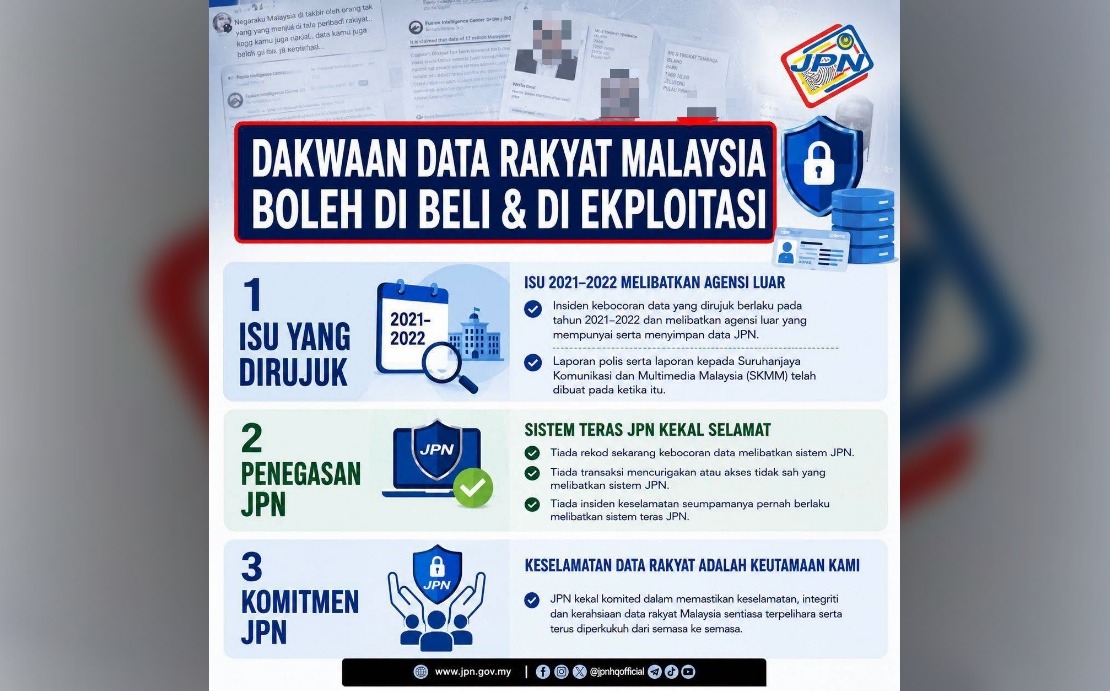
Malaysia's National Security Council has moved to dampen concerns about a data leak spreading across social media, attributing the breach to older cybersecurity incidents predating 2022 rather than compromised contemporary systems. The clarification, issued through the National Cyber Security Agency (NACSA), addresses public anxiety surrounding the circulation of personal information online and underscores authorities' efforts to contain and investigate the matter.
According to NACSA, the data now being shared without authorisation originated from unlawful cyber intrusions that targeted various systems more than two years ago. The information's resurfacing on online platforms appears to represent a redistribution of previously stolen materials rather than evidence of fresh breaches affecting current infrastructure or digital platforms. This distinction carries significant implications for users concerned about the security of their personal details held by government and private-sector organisations today.
Malaysian law explicitly prohibits the sharing, dissemination, or provision of access to unlawfully obtained information, regardless of whether the services hosting such data operate from within or outside the country's borders. NACSA has emphasized this legal framework to discourage participation in the spread of leaked materials, framing engagement with such information as complicity in cybercrime. The council's statement reflects a broader effort to educate the public about the legal and security consequences of accessing or distributing compromised data.
Response measures have already commenced, with NACSA collaborating alongside MyNIC and the Personal Data Protection Department to engage international service providers for removing the affected websites from public access and blocking user connectivity to these platforms. Simultaneously, the National Cyber Security Agency is coordinating with the Royal Malaysia Police to conduct digital forensic examinations aimed at identifying the individuals responsible for the current distribution and bringing them before the courts. This twin-track approach combines technical containment with criminal investigation.
The incident arrives at a moment when Malaysia is intensifying its cybersecurity legislative framework. Parliament is poised to receive the Cyber Crime Bill, which introduces substantially expanded provisions and enhanced penalties across multiple categories of digital offences. The proposed legislation specifically criminalises unauthorised access to or damage of computer systems and programmes undertaken without lawful authority or legitimate justification. Additionally, it defines identity theft—the unauthorised use of another person's identity to perpetrate crime—as a distinct criminal offence, reflecting growing concern over personalised cybercrime tactics.
Beyond legislative proposals, the Cyber Security Act 2024, which entered force in August of the previous year, establishes binding requirements for entities classified as National Critical Information Infrastructure to deploy comprehensive safeguards. These mandates encompass adherence to codes of practice, execution of risk assessments, and conduct of recurring security audits designed to reinforce the nation's collective cyber resilience. The framework targets industries where security lapses carry systemic consequences, such as energy, finance, and telecommunications.
MyDigital ID, which has surpassed 16 million active registrations across Malaysia, has faced scrutiny amid the data leak discussions, prompting authorities to clarify the platform's actual function and security architecture. The system operates not as a centralised repository storing personal information but rather as an identity verification mechanism that authenticates users directly against records maintained by the National Registration Department. This design approach reduces the concentrated risk associated with keeping vast databases of sensitive personal data in single locations, thereby lowering the attack surface for potential breaches.
The widespread integration of MyDigital ID across government agencies and private-sector applications—spanning telecommunications companies and financial institutions—is expected to strengthen the security of digital transactions conducted by Malaysians. By providing a reliable means of verifying user authenticity, the platform aims to mitigate identity fraud and reduce opportunities for criminals to impersonate legitimate users during financial or administrative transactions. This expansion represents a policy bet that authentication security will progressively replace traditional methods as the digital economy deepens.
The council has reiterated the government's foundational commitment to enabling Malaysians to benefit from digital transformation while maintaining robust protections against evolving cybersecurity threats. This positioning reflects recognition that Malaysia's digital economy—spanning e-commerce, fintech, digital government services, and remote work infrastructure—depends fundamentally on public confidence in the security of online transactions and data handling. Without sustained investment in defensive capabilities and legislative tools, adoption of digital services risks stalling as trust erodes.
For Malaysian citizens and businesses, the NACSA advisory against obtaining or utilising services offering access to unlawfully acquired information carries both ethical and practical weight. Beyond legal consequences, engaging with such services perpetuates the economic incentives underlying cybercrime and contributes to the normalisation of data theft as a commercial activity. Authorities have signalled that enforcement will target both the original distributors of leaked materials and downstream users who knowingly access or benefit from compromised information.
Regionally, Malaysia's response demonstrates an approach balancing technical intervention, criminal investigation, and legislative modernisation—a model increasingly adopted across Southeast Asia as digital economies expand and cross-border cybercrime proliferates. The coordination between NACSA, the police force, and international service providers reflects the transnational character of modern data theft, where stolen information rapidly disperses across jurisdictions through networks difficult for any single country to control unilaterally.
Looking forward, the successful passage and implementation of enhanced cyber legislation, combined with strengthened enforcement capabilities, will substantially determine Malaysia's capacity to manage future incidents of comparable scale. The current episode, while attributed to older breaches, underscores that cybersecurity remains a dynamic challenge requiring continuous evolution of both technical defences and legal frameworks to match adversaries' advancing techniques and changing tactics.