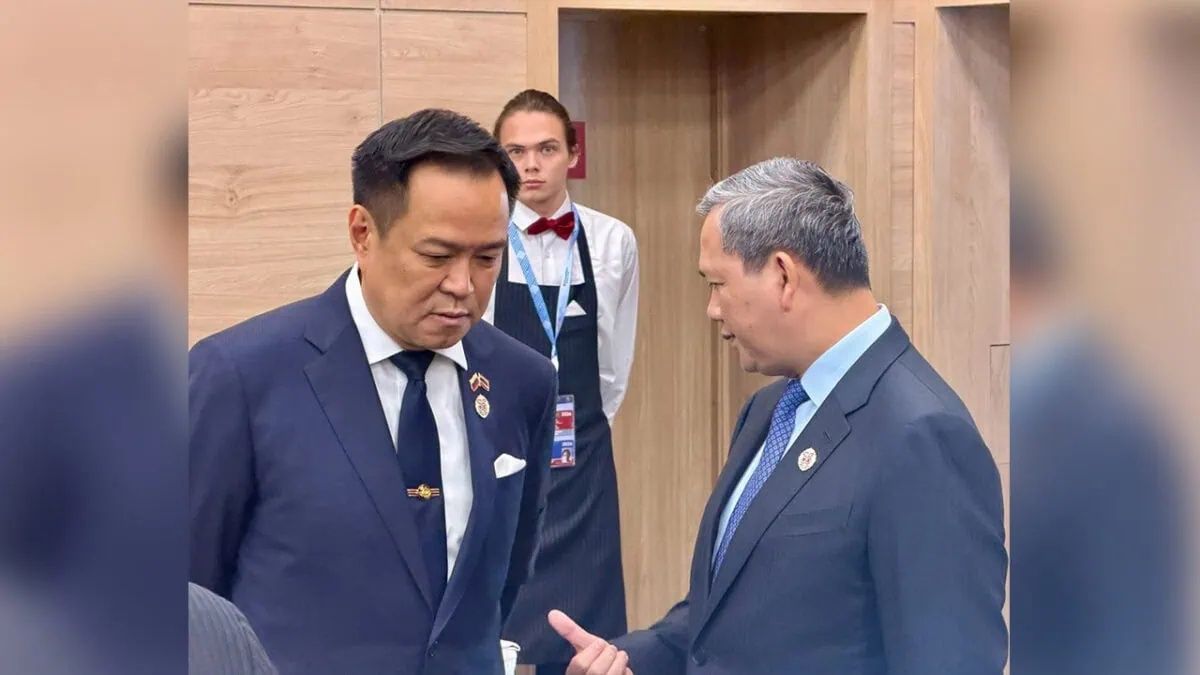
Cambodia's leadership has stepped up pressure on Thailand to move forward with critical administrative steps that would unlock progress on their contested maritime and land boundaries. Prime Minister Hun Manet made the appeal during a brief encounter with Thai counterpart Anutin Charnvirakul at an Asean-Russia engagement forum in Kazan, Russia, signalling that Phnom Penh views the appointment of Thailand's Joint Boundary Commission chief as a prerequisite for substantive bilateral boundary work to resume.
The timing of Manet's comments, disclosed via social media on Friday (June 19), reflects mounting frustration in Cambodia over the pace of progress on border issues that have simmered unresolved for decades. By coupling his appeal for Thailand to name a JBC chief with an explicit reference to the December 27, 2025 joint statement, Manet has placed the burden squarely on Bangkok to demonstrate concrete commitment to the agreed framework. This measured but firm messaging suggests Phnom Penh views Thailand's inaction as a potential obstacle to unlocking progress on the land boundary demarcation process, which has stalled without active leadership on both sides.
Cambodia's border strategy operates on two parallel tracks that reflect the complexity of the disputes. On maritime matters, both nations remain engaged in a compulsory conciliation process under the United Nations Convention on the Law of the Sea (UNCLOS), a mechanism that provides structured dispute resolution outside bilateral negotiations. For land boundaries, however, Phnom Penh has consistently favoured the traditional bilateral route through the JBC and existing agreements, viewing this approach as more amenable to direct negotiations between the two neighbouring governments. Manet's reaffirmation of this preference demonstrates Cambodia's commitment to institutional frameworks rather than ad-hoc diplomatic intervention.
Thailand's public response, delivered through Prime Minister Anutin, adopted a measured tone that largely mirrored Cambodia's emphasis on peaceful cooperation. Anutin characterised the Kazan exchange as a fleeting informal discussion, likening it to "pulling each other aside by the elbow" amid the margins of the larger forum. This rhetorical framing suggests Thailand may be conscious of domestic sensitivities around border negotiations and wishes to downplay any impression of concessions or intensive bilateral bargaining. His account nonetheless confirmed that both leaders reiterated opposition to conflict and mutual commitment to the various institutional mechanisms available for resolving boundary disputes.
The Thai premier's response to questions about reopening border checkpoints proved particularly revealing about the domestic political constraints shaping Bangkok's negotiating posture. By dismissing the notion with humour while simultaneously noting that "Thai people would be furious," Anutin effectively signalled that any reopening of border crossings remains off the table for now, regardless of Cambodia's position. This suggests that reopening borders—which would carry symbolic and practical implications for bilateral relations—requires a much higher degree of public and political consensus in Thailand than technical boundary work. For Malaysian and regional observers, this indicates that visible political reconciliation between the neighbours remains distant, even as technical cooperation progresses.
Thailand's declared commitment extends across the full institutional repertoire governing bilateral relations, encompassing UNCLOS, the JBC, and the General Border Committee (GBC). By publicly reaffirming adherence to these multiple frameworks, Bangkok has signalled that it views boundary disputes as susceptible to management through established channels rather than through confrontation or unilateral action. This institutional pluralism creates some redundancy and potential for forum-shopping, but it also provides flexibility in how disputes are addressed depending on their character—maritime versus terrestrial, technical versus political. For the broader region, Thailand's emphasis on structured dialogue aligns with Asean's general preference for peaceful resolution of maritime and terrestrial disputes.
The divergence in how the two leaders publicly framed their brief encounter deserves careful analysis. While both emphasised peaceful resolution and commitment to bilateral mechanisms, Cambodia's emphasis fell on Thailand's specific obligation to appoint a JBC chief and commence surveys, placing Cambodia in the role of urging compliance. Thailand's framing, by contrast, stressed that both sides had reaffirmed their opposition to conflict and willingness to engage, positioning the country as a cooperative partner but with less emphasis on specific actionable steps. This rhetorical distinction, subtle though it may be, reveals Cambodia's perception that more pressure is needed to move Bangkok toward substantive implementation of existing agreements.
For Malaysia and other Asean members with their own maritime boundary complexities—including the ongoing South China Sea disputes and bilateral arrangements with Indonesia and Thailand—the Cambodia-Thailand dynamic offers lessons in persistence and institutional design. Both nations have invested substantially in creating legal and diplomatic frameworks for boundary management, and both have publicly committed to avoiding confrontation. Yet the slow pace of progress, particularly on the land boundary demarcation that has languished for years, underscores how difficult it remains to operationalise these frameworks, especially when domestic political sensitivities intersect with technical requirements. The appointment of a single JBC chief, which should be a routine administrative matter, has taken on outsized importance precisely because it signals a nation's readiness to proceed with implementation.
The reference to existing agreements, particularly the December 27, 2025 joint statement, provides a legal anchor for Cambodia's demands and distinguishes this pressure campaign from ad-hoc diplomatic appeals. By grounding his call for action in specific, signed commitments rather than aspirational statements about cooperation, Manet has narrowed the scope for Thailand to defer or reinterpret obligations. This legalistic approach reflects Cambodia's broader strategy of embedding border management within international legal frameworks, whether through UNCLOS for maritime disputes or bilateral agreements for terrestrial matters. It also signals Cambodia's confidence that formal commitments remain binding regardless of political headwinds in either capital.
The broader geopolitical context surrounding this exchange merits consideration as well. The Asean-Russia engagement in Kazan occurred amid evolving strategic alignments in Southeast Asia, with both Cambodia and Thailand maintaining complex relationships with great powers. By addressing border issues within an Asean framework setting, rather than in isolation or under external mediation, both leaders have reinforced the principle that regional disputes should be managed through regional mechanisms. This approach serves the interests of both nations and aligns with the long-standing Asean position that external powers should not be drawn into intra-regional disputes. For the broader region and particularly for Malaysia, which has its own stakes in peaceful boundary resolution, the Cambodia-Thailand model of pursuing institutional solutions offers a framework worth studying and potentially adapting.
Looking ahead, the success of Cambodia's pressure campaign on Thailand will likely depend on whether Bangkok perceives genuine momentum toward broader bilateral improvements that would justify the domestic political costs of advancing border work. Thailand's appointment of a JBC chief, though procedurally simple, carries symbolic weight that extends beyond the technical necessity of having a bilateral contact point. It would signal Bangkok's readiness to move beyond a holding pattern on border issues and toward substantive engagement on demarcation—a process that carries both technical complexities and potential for political complications. Whether Thailand's current government possesses the political stability and capital to undertake such work remains an open question, particularly given the domestic pressures Anutin referenced regarding border matters.

%22%2F%3E%3C%2Fpattern%3E%3C%2Fdefs%3E%3Crect%20width%3D%22100%25%22%20height%3D%22100%25%22%20fill%3D%22url(%23ph2hy9vg)%22%2F%3E%3Crect%20width%3D%22100%25%22%20height%3D%22100%25%22%20fill%3D%22url(%23ph2hy9vp)%22%2F%3E%3Ctext%20x%3D%2250%25%22%20y%3D%2250%25%22%20text-anchor%3D%22middle%22%20dominant-baseline%3D%22central%22%20fill%3D%22rgba(255%2C255%2C255%2C0.95)%22%20font-family%3D%22Georgia%2C%20'Times%20New%20Roman'%2C%20serif%22%20font-weight%3D%22700%22%20font-size%3D%22272%22%20letter-spacing%3D%22-0.02em%22%3EAnwar%3C%2Ftext%3E%3C%2Fsvg%3E)