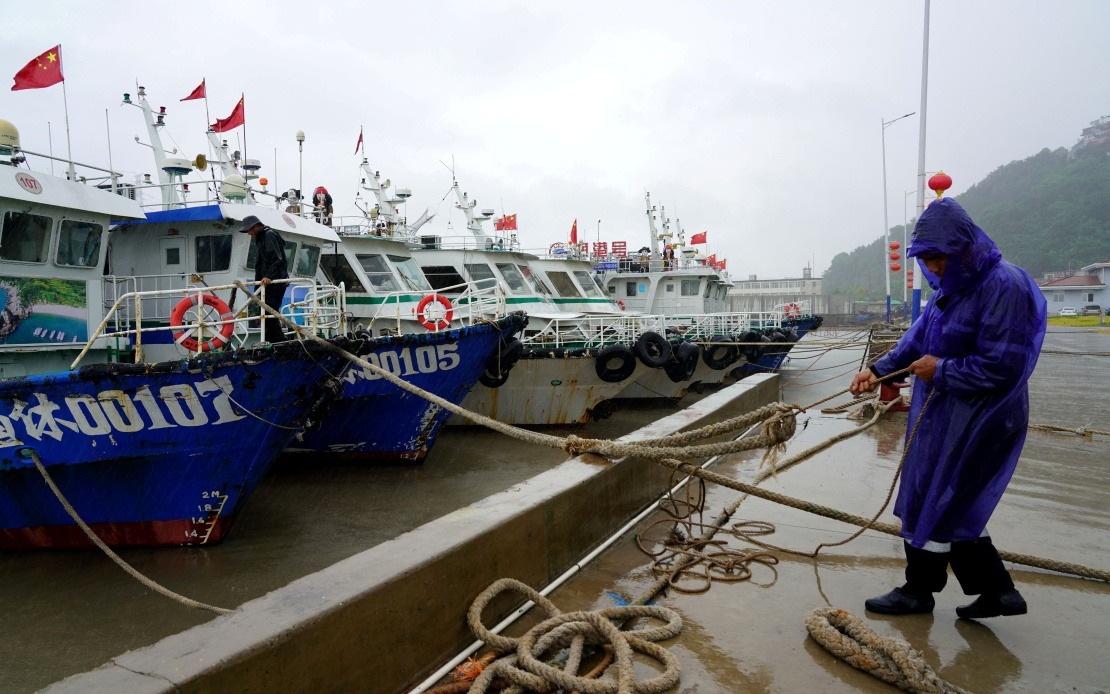
Zhejiang Province in eastern China has significantly escalated its preparedness posture for Typhoon Dolphin, advancing emergency response protocols from Level IV to Level III at midday on Friday. The decision reflects the growing threat posed by the 13th typhoon to impact the country this year as the system tracks toward China's densely populated eastern seaboard. Meteorologists at the Zhejiang Meteorological Observatory confirmed the storm's position at approximately 763 kilometres east of Wenling as of Friday morning, with westward movement projected at 15 to 20 kilometres per hour.
The intensity outlook carries particular concern for regional planners and officials. Current meteorological assessments suggest Typhoon Dolphin will maintain its current strength or potentially intensify as it approaches land, characteristics that amplify the hazard profile for one of China's most economically vital regions. The National Meteorological Centre issued a yellow-level alert on Thursday evening, pinpointing the expected landing zone as somewhere along the coastline connecting Shanghai and Fuqing in Fujian Province, with landfall anticipated during the Sunday-Monday window. This timeframe provides a compressed window for final preparations across vulnerable jurisdictions.
The geographic positioning of Zhejiang—sandwiched between Shanghai and Fujian—places it squarely in the direct path, according to Lou Xiaofen, the chief forecaster at the Zhejiang Meteorological Observatory. Her assessment emphasises a heightened probability of the typhoon making direct landfall within provincial territory, a scenario that could unleash considerable destruction across urban, industrial, and agricultural zones. The precise track uncertainty inherent in tropical cyclone forecasting means that communities spanning a several-hundred-kilometre coastal stretch remain under active threat evaluation, with contingency plans activated across all administrative levels.
The scope of maritime disruption already underway illustrates the scale of the preventative response mobilised by provincial authorities. All 162 passenger ferry services operating throughout Zhejiang have been suspended, effectively isolating island communities and halting routine coastal transit. Simultaneously, work at 193 offshore infrastructure projects—likely encompassing energy installations, aquaculture facilities, and marine industrial operations—has been halted to prevent equipment damage and worker exposure. The maritime sector has proven particularly responsive, with 474 construction vessels called to shelter in protected harbours, removing personnel and assets from direct environmental hazard.
Coastal defence infrastructure has shifted into active operational stance. High-powered tugboats capable of executing emergency rescues and salvage operations remain on continuous standby, positioned to respond rapidly should distressed vessels require assistance or infrastructure suffer damage during the storm passage. The maritime authority network has already distributed 86,000 early warning notifications to affected stakeholders and completed detailed inspections of 24,000 registered vessels, a systematic effort designed to identify and mitigate pre-existing mechanical vulnerabilities that might prove catastrophic under extreme wind and wave conditions.
The Level III response framework mandates comprehensive monitoring, forecasting, and public communication throughout the event's duration. Municipal and county-level administrators face binding obligations to execute population evacuations from exposed coastal settlements, particularly those in flood-prone low-lying areas, while simultaneously furnishing continuous situational updates to the general public. This multi-layered approach seeks to collapse the interval between meteorological detection and community protective action, reducing the window during which individuals and assets remain exposed to the typhoon's most destructive forces.
For Southeast Asian observers and particularly Malaysian readers, the unfolding Zhejiang response offers instructive perspective on typhoon preparedness protocols in a major regional economy. China's coordinated activation of maritime restrictions, construction halts, and vessel management demonstrates how integrated command systems can rapidly reconfigure operational schedules across multiple economic sectors in response to meteorological threats. The early warning network spanning tens of thousands of notifications reflects communication infrastructure investments that many developing nations are still establishing. The systematic vessel inspection preceding the event represents preventive risk management rather than reactive crisis response—a distinction that can prove decisive in limiting fatalities and economic losses.
The projected heavy rainfall extending northward from the landfall site introduces secondary hazard considerations beyond wind damage. Zhejiang's dense population, complex hydrological systems, and concentrated industrial zones mean that precipitation exceeding predicted thresholds could trigger flooding, landslides, and contamination events affecting water supplies and agricultural productivity. The topography and existing drainage capacity constraints in certain regions may amplify runoff dynamics, requiring parallel activations of flood management protocols alongside typhoon-specific precautions.
The timing of Typhoon Dolphin's approach during the peak summer monsoon season carries climatological significance. The atmospheric environment supporting the storm's maintenance and potential intensification reflects broader seasonal patterns that make late July and August historically peak periods for western Pacific typhoon activity affecting China's coast. The convergence of warm ocean temperatures, atmospheric moisture availability, and steering wind patterns that position the system toward landfall rather than sending it on a recurvature toward Japan creates conditions that meteorologists must treat with heightened vigilance. Zhejiang's preparations unfold against this backdrop of seasonal normalcy for typhoon impacts, suggesting well-rehearsed response architectures built through decades of cumulative experience managing tropical cyclones.
Looking forward, the provisional forecast track indicates that the storm's eventual impact zone will encompass some of China's most densely settled and economically productive geography. Hangzhou, the provincial capital and major commercial hub, lies sufficiently inland to escape the most severe direct wind impacts but remains within the heavy rainfall zone. Manufacturing hubs, port facilities, and agricultural regions throughout the Yangtze River Delta face the prospect of disruption lasting from Saturday through midweek depending on actual storm progression and system velocity. The early elevation of alert status to Level III effectively signals provincial administrators and the public that this is no longer a distant meteorological curiosity but an imminent operational reality requiring active engagement and resource commitment across all governance levels.

