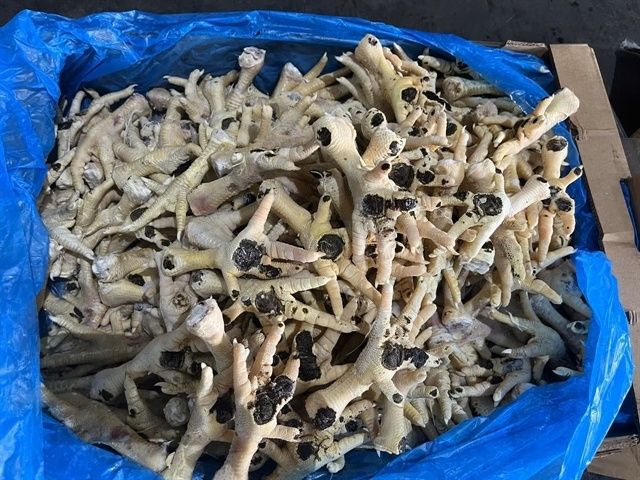
Hanoi police have filed smuggling charges against two women at the centre of an elaborate scheme involving hundreds of containers of frozen chicken feet imported from nations with active poultry outbreaks. The investigation, concluded on Friday, June 19, revealed that the executives deliberately contravened import regulations by bringing in the contaminated products under false declarations and then distributing them throughout Vietnam's domestic food market rather than honouring their legal obligation to re-export the goods. The total contraband value exceeded US$13 million, with authorities estimating the imported stock at more than VNĐ347 billion while no customs duties were paid on the shipments.
The two accused are Nguyen Thi To Loan, aged 47, who served as direct manager of ABF Food Import-Export JSC based in Ninh Binh Province, and Trang Tuyet Ngoc, 45, who held the position of head of the assistant department at An Binh Group. Both individuals have reportedly admitted to all charges brought against them. Police records indicate that Loan orchestrated the illegal distribution network, instructing Ngoc to place the chicken feet on the open market in violation of stringent health protocols governing poultry product imports.
The operation spanned a critical three-year window from 2023 through 2026, during which ABF systematically imported 339 containers of frozen chicken feet under customs declarations falsely characterizing the goods as materials intended solely for processing and subsequent re-export. Vietnamese law explicitly prohibits the domestic sale of poultry products sourced from countries experiencing active disease outbreaks; such imports may only enter Vietnamese territory under strict processing and re-export conditions designed to protect domestic food supplies and consumer health. By circumventing these protections, the defendants knowingly exposed the Vietnamese population to potentially contaminated food products.
Instead of adhering to legal requirements, Loan directed Ngoc to distribute the smuggled chicken feet across a sprawling network encompassing multiple provinces and cities. Investigators documented sales to numerous food-service establishments throughout Hanoi, Cao Bang, Ninh Binh, Quang Ninh, and additional provinces, with the total volume of illegally distributed products exceeding 10,000 metric tonnes. The breadth of the distribution underscores the systematic nature of the operation and the significant public health risk posed by such widespread dissemination of potentially contaminated poultry products.
Law enforcement conducted comprehensive raids on cold-storage facilities connected to the smuggling ring, uncovering substantial quantities of frozen chicken feet in various states of deterioration. The An Viet 2 freezer facility located in Hanoi's Quang Minh Industrial Zone yielded over 1,000 metric tonnes of the product, including approximately 260 metric tonnes that had visibly expired, displaying mold growth and offensive odours yet remained staged for distribution. This discovery suggests the perpetrators possessed knowledge of the products' contamination and continued circulating them despite obvious health hazards.
A subsequent search at the THL cold-storage warehouse situated in Lang Son province in northern Vietnam yielded an additional 1,030-plus metric tonnes of frozen chicken feet. The discovery of such extensive stockpiles across multiple storage facilities indicates a well-established distribution infrastructure designed to facilitate large-scale commercial operations rather than isolated smuggling incidents. The scale and sophistication of the network point to a carefully planned scheme rather than opportunistic wrongdoing.
Vietnam's legal framework treats such violations with considerable gravity. Both defendants have been formally charged under Article 188 of the 2015 Penal Code, which addresses smuggling offences. The charges carry significant legal consequences, reflecting the seriousness with which Vietnamese authorities treat violations of food safety protocols and customs regulations. Beyond the immediate criminal liability facing the two primary suspects, the ongoing investigation seeks to identify additional parties involved in the conspiracy.
Investigators are expanding their inquiry to establish the roles of other individuals and organisations potentially implicated in the smuggling network. The complexity of distributing 10,000 metric tonnes across multiple provinces suggests a far larger operation than two individuals could manage independently. Law enforcement officials are tracing financial flows, examining transportation records, and identifying retailers and food-service operators who may have knowingly purchased and distributed the contaminated products to consumers. Each party's level of culpability and knowledge regarding the products' origins will determine appropriate charges.
This case carries important implications for regional food safety governance and demonstrates vulnerabilities in customs enforcement across Southeast Asia. The three-year operational window before detection reveals gaps in monitoring systems designed to track imports from disease-endemic regions. For Malaysian importers and food retailers, the case underscores the critical importance of stringent verification procedures when sourcing poultry products from neighbouring countries. The substantial volumes involved and the extent of domestic distribution before discovery highlight how contaminated products can penetrate supply chains and reach consumers despite regulatory frameworks ostensibly designed to prevent such breaches.

%22%2F%3E%3C%2Fpattern%3E%3C%2Fdefs%3E%3Crect%20width%3D%22100%25%22%20height%3D%22100%25%22%20fill%3D%22url(%23ph2hy9vg)%22%2F%3E%3Crect%20width%3D%22100%25%22%20height%3D%22100%25%22%20fill%3D%22url(%23ph2hy9vp)%22%2F%3E%3Ctext%20x%3D%2250%25%22%20y%3D%2250%25%22%20text-anchor%3D%22middle%22%20dominant-baseline%3D%22central%22%20fill%3D%22rgba(255%2C255%2C255%2C0.95)%22%20font-family%3D%22Georgia%2C%20'Times%20New%20Roman'%2C%20serif%22%20font-weight%3D%22700%22%20font-size%3D%22272%22%20letter-spacing%3D%22-0.02em%22%3EAnwar%3C%2Ftext%3E%3C%2Fsvg%3E)