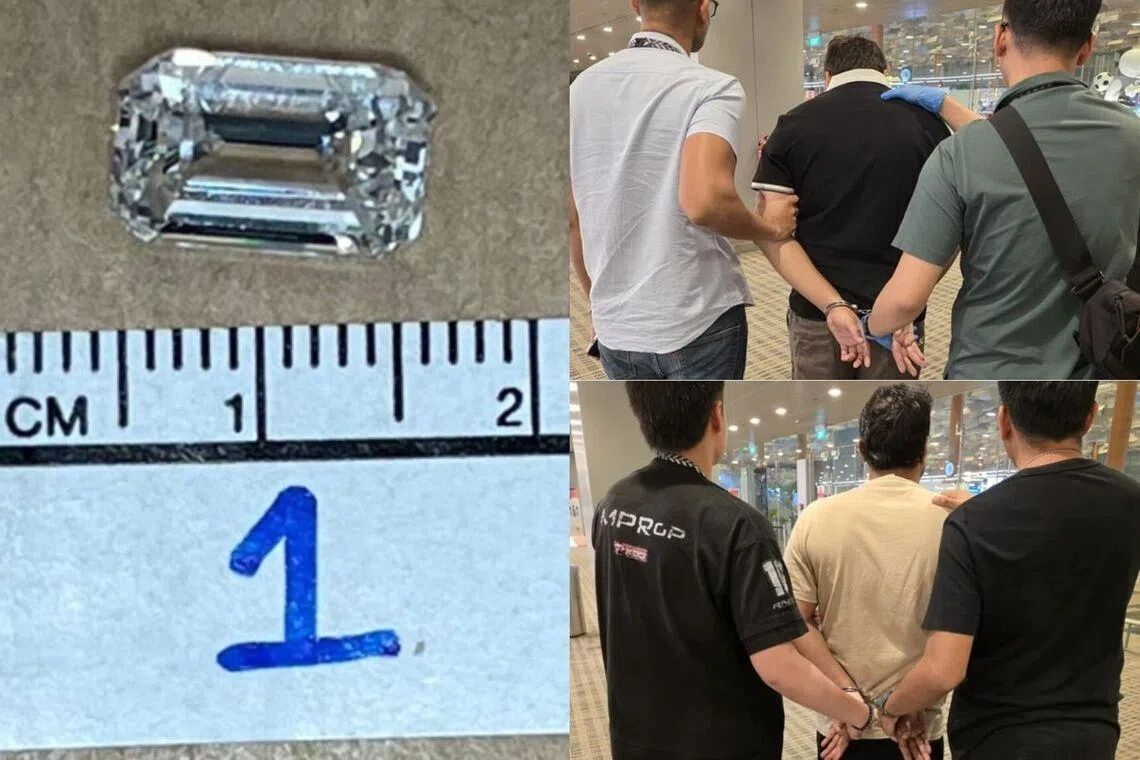
Singapore police have arrested two men in connection with the theft of a high-value diamond from a jewellery store in Chinatown, marking another case of organised jewellery theft in the city-state. The suspects, aged 30 and 42, were apprehended at Changi Airport Terminal 3 on Friday, June 19, just hours after the heist occurred on Kreta Ayer Road. The diamond, valued at over S$235,000 (approximately RM710,000), was recovered during the arrest and is now held as evidence.
Police received word of the theft at 3.40pm that afternoon when the jewellery store alerted authorities to the missing stone. The Central Police Division and Police Operations Command Centre launched an immediate investigation, deploying multiple investigative tools to track down the perpetrators. Officers analysed CCTV footage from the store and surrounding areas, cross-referenced police camera recordings, and conducted extensive ground enquiries to establish the suspects' identities and movements. The speed of the arrest—occurring the same day as the offence—reflects the sophistication of Singapore's surveillance infrastructure and rapid response capabilities.
According to preliminary findings, the two men had entered the store with the apparent intention of purchasing jewellery, specifically showing sustained interest in the diamond in question. This calculated approach suggests premeditation rather than opportunistic theft. While the shop assistant was presenting the stone to them for examination, the suspects executed a sleight-of-hand manoeuvre, exchanging the genuine diamond with a counterfeit replica. The substitution was executed with sufficient skill to initially escape notice, but the shop assistant's diligence in conducting a verification check after the men departed without completing a purchase proved crucial to uncovering the crime.
The behaviour of the suspects ultimately aroused suspicion. In legitimate retail transactions, customers typically complete their purchase after the sales associate has allowed them to examine merchandise. The pair's sudden departure without buying anything—combined with their earlier enthusiasm—prompted the assistant to scrutinise the stone more closely. The discovery of the fake diamond triggered an immediate alert to police, setting in motion the investigation that would culminate in their capture within hours. This incident underscores the importance of trained retail staff in spotting irregular customer behaviour patterns.
The modus operandi employed in this case is not new to Singapore's jewellery retail sector. The technique of switching genuine gems with counterfeits while examining items is a well-documented criminal method that targets the trust inherent in high-end retail transactions. Jewellery stores traditionally allow customers to handle and inspect expensive pieces as part of the sales process, creating inherent vulnerability to such schemes. The sophistication of modern counterfeit gemstones means that visual inspection under normal lighting conditions may not immediately reveal the substitution, giving thieves a window of opportunity to escape before the theft is discovered.
The nationality of the two men has not been disclosed by Singapore police, though the coordinated nature of the heist and their apparent familiarity with jewellery retail practices suggest this may not have been their first such operation. International criminal networks specialising in jewellery theft often employ transient operatives who move between jurisdictions, making them particularly difficult to apprehend. The fact that they were intercepted at the airport before departure indicates that police movements were swift enough to prevent them from leaving Singapore with either the stolen diamond or any proceeds from selling it.
Both men now face charges of theft in dwelling with common intention, a serious offence under Singapore law that carries a maximum penalty of seven years imprisonment and a fine. The use of "common intention" in the charges reflects the coordinated nature of their actions, with both individuals playing complementary roles in executing the theft. If convicted, each could spend up to seven years behind bars, a substantial deterrent that reflects the severity with which Singapore treats theft of high-value items.
Singapore police have issued a formal alert to all luxury goods retailers, particularly those dealing in jewellery, diamonds, watches, and other high-value merchandise. The advisory urges shop owners to implement heightened vigilance protocols and remain alert to the specific modus operandi demonstrated in this case. This includes training staff to recognise suspicious customer behaviour, establishing verification procedures for high-value items, and potentially implementing enhanced security measures such as detailed examination of merchandise before and after customer contact. The police statement emphasised that such proactive measures are essential given that professional jewellery thieves continuously refine their techniques.
For Malaysian readers and business operators in the region, this case carries particular relevance given the porous nature of Southeast Asian travel and commerce. Malaysian jewellery retailers operating near border regions or in tourist-heavy areas face similar risks from transnational theft rings. The incident demonstrates that even in a highly developed city-state with world-class surveillance and law enforcement capabilities, organised jewellery theft remains a persistent challenge. Retailers across Southeast Asia should consider whether their staff training, security protocols, and customer verification procedures are sufficiently robust to counter such sophisticated schemes.
The incident also highlights the critical role of modern surveillance technology in solving jewellery thefts. The combination of CCTV footage, police camera networks, and rapid analytical capability allowed Singapore authorities to move from incident report to arrest within hours. Many Malaysian and Southeast Asian retailers may lack access to such integrated surveillance systems, potentially placing them at greater disadvantage when confronting organised criminal groups. This suggests that retail associations and chambers of commerce in the region might usefully promote shared learning about effective security protocols and best practices in jewellery retail.
The recovery of the stolen diamond within the same day represents a success for Singapore police, though it also underscores that such thefts do occur despite sophisticated security environments. The case serves as a reminder that determined and skilled criminals can exploit the fundamental tension in luxury retail between customer access and security. Shop owners must balance the need to present merchandise attractively and allow genuine customer examination against the imperative to prevent theft, a balance that organised criminal networks deliberately target.


%22%2F%3E%3C%2Fpattern%3E%3C%2Fdefs%3E%3Crect%20width%3D%22100%25%22%20height%3D%22100%25%22%20fill%3D%22url(%23ph2hy9vg)%22%2F%3E%3Crect%20width%3D%22100%25%22%20height%3D%22100%25%22%20fill%3D%22url(%23ph2hy9vp)%22%2F%3E%3Ctext%20x%3D%2250%25%22%20y%3D%2250%25%22%20text-anchor%3D%22middle%22%20dominant-baseline%3D%22central%22%20fill%3D%22rgba(255%2C255%2C255%2C0.95)%22%20font-family%3D%22Georgia%2C%20'Times%20New%20Roman'%2C%20serif%22%20font-weight%3D%22700%22%20font-size%3D%22272%22%20letter-spacing%3D%22-0.02em%22%3EAnwar%3C%2Ftext%3E%3C%2Fsvg%3E)