Southern Thailand's security crisis deepened on Friday as militants conducted two coordinated bombing attacks within hours, wounding eleven police personnel and intensifying concerns about the persistence of insurgent activity in the ethnically divided border region. The twin assaults underscored the ongoing volatility of Yala and Pattani provinces, where decades of separatist violence continue to claim lives despite government counterinsurgency operations.
The first strike occurred at 8.10am when unidentified assailants detonated an explosive device targeting a teacher protection unit comprised of border patrol police officers. The blast ripped through the Ban Pulo Saniyae–Ban Sakai road in Moo 4 of Ban Rae sub-district, Thanto district, Yala province, leaving six officers injured. The attack's timing—during morning patrols—suggested operational knowledge of police movements and security protocols in the area, a pattern consistent with insurgent cells' intelligence-gathering capabilities.
Among the half-dozen wounded, two officers sustained life-threatening injuries that would dominate medical responses for the next several hours. Corporal Kittisak Saksang absorbed shrapnel wounds to his face and head, while Corporal Poraphat Wongruaydee suffered traumatic chest injuries that caused severe respiratory distress and partial paralysis. The severity of Wongruaydee's condition demanded urgent surgical intervention; Yala Regional Hospital subsequently announced he needed immediate operations to drain accumulated blood from his pleural cavity and repair lung tissue damaged by blast trauma. Medical staff issued an emergency appeal for blood donations of all types to support transfusions for the gravely wounded officer.
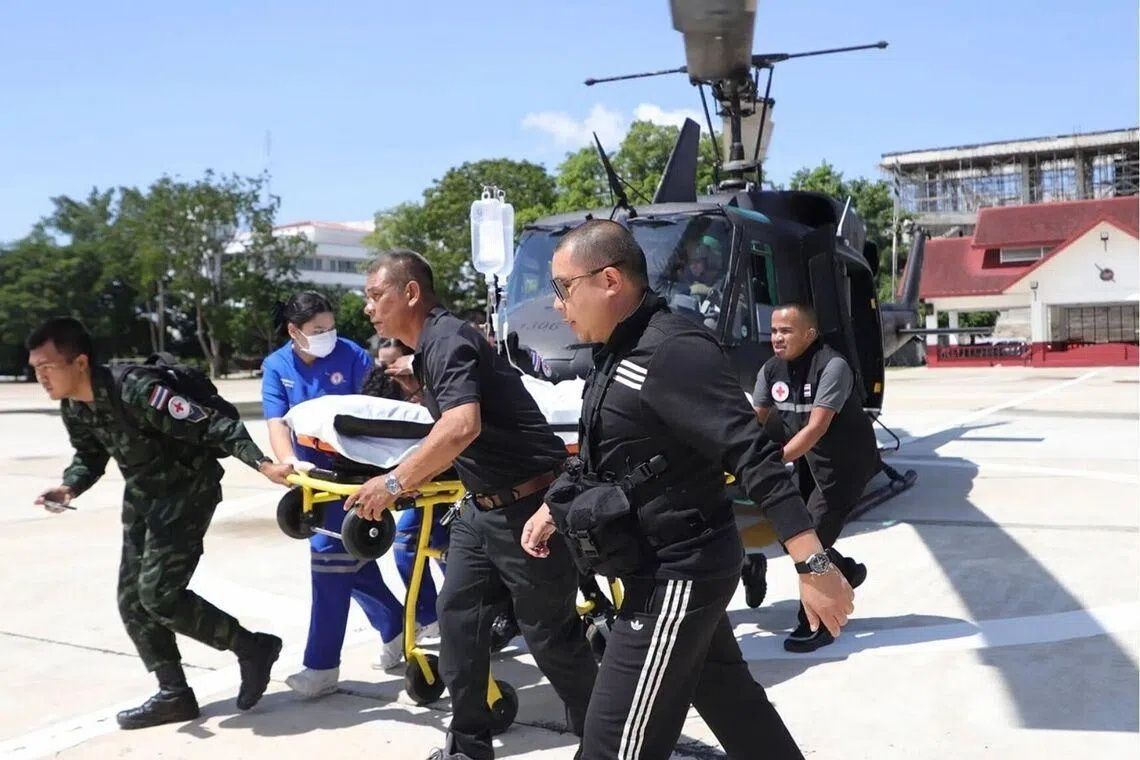
Initial emergency response protocols saw all six injured officers transported to Thanto Hospital, yet the precarious condition of Saksang and Wongruaydee necessitated helicopter evacuation to the higher-capacity Yala Hospital, where advanced trauma and surgical facilities could manage their injuries. This medical cascade highlighted the resource constraints facing provincial healthcare systems when managing mass casualty incidents in Thailand's restive south. Forensic teams and explosive ordnance disposal specialists subsequently descended on the attack site to preserve evidence and conduct technical investigations.
The second bombing, occurring just three hours later at 11.30am, reinforced suspicions that militant groups had synchronized their operations to maximize impact and stretch police resources thin across multiple jurisdictions. This attack targeted personnel from the Pattani Police Special Operations unit at Ban Khuan Yi in Moo 3 of Pado sub-district, Mayo district, Pattani province. The assault transpired as officers were returning from establishing a security checkpoint, suggesting the attackers possessed advance awareness of patrol schedules and operational movements—a tactical advantage that underground networks cultivate through community infiltration and informant networks.
Five officers sustained injuries in the Pattani explosion, all experiencing chest trauma consistent with blast wave effects. Sergeants Anuchit, Bunyawat, Wisitphon, Aphisit and Sumit were transported to Mayo Hospital, where physicians assessed their conditions as non-critical compared to injuries sustained in Yala, though all required hospitalization and continued monitoring for potential internal injuries that might develop over subsequent hours.
From a strategic perspective, the twin attacks illustrate how militant factions continue executing coordinated strikes despite increased military and police presence in southern Thailand. The synchronization—separated by a brief three-hour window across two provinces—demonstrates operational sophistication and suggests coordination among cell members who maintain secure communication channels and pre-established plans. Such coordinated activity contradicts occasional government assertions that militant networks had been substantially degraded, instead revealing resilient organizational structures capable of executing complex operations.
For Malaysia, these incidents carry particular significance given the geographical proximity of Yala and Pattani to the Malaysian border and the documented history of militant operatives transiting across the Kelantan-Narathiwat boundary. Malaysian authorities maintain heightened border vigilance partly because instability in Thailand's deep south creates sanctuary spaces and cross-border recruitment opportunities for regional insurgent networks. The pattern of attacks on police personnel specifically suggests militant groups remain focused on targeting security forces rather than civilian infrastructure, a distinction that shapes counterterrorism response calculus.
The incidents also underscore resource allocation challenges within Thai law enforcement. Border patrol and special operations units tasked with maintaining security checkpoints and protecting teachers represent front-line personnel bearing disproportionate casualty burdens in the protracted southern insurgency. Repeated targeting of these units suggests enemies seek both immediate tactical advantage and psychological impact—demonstrating capacity to strike protected personnel within heavily policed zones.
Authorities have cordoned off both blast sites and initiated investigations focused on identifying perpetrators and uncovering operational details. Security officials have announced intensified efforts to apprehend those responsible and bring them before courts, though previous prosecutorial records demonstrate mixed success given the clandestine nature of militant networks and evidentiary challenges in southern Thailand's complex security environment. The investigation will necessarily involve forensic analysis of explosive devices, examination of scene evidence, and intelligence gathering from local communities whose cooperation remains essential yet sometimes constrained by fear or sympathies toward militant groups.
The bombing cycle—two major attacks within hours—typically precedes either a period of reduced violence as networks conduct recovery operations and reassess tactics, or sustained campaigns designed to test security force responses and public resolve. Historical patterns in Yala and Pattani suggest these incidents will likely prompt official security reviews, possible reinforcement of police checkpoints, and renewed calls for intelligence sharing between Thai and Malaysian border authorities—standard reactive measures that address symptoms rather than underlying drivers of insurgent grievances.