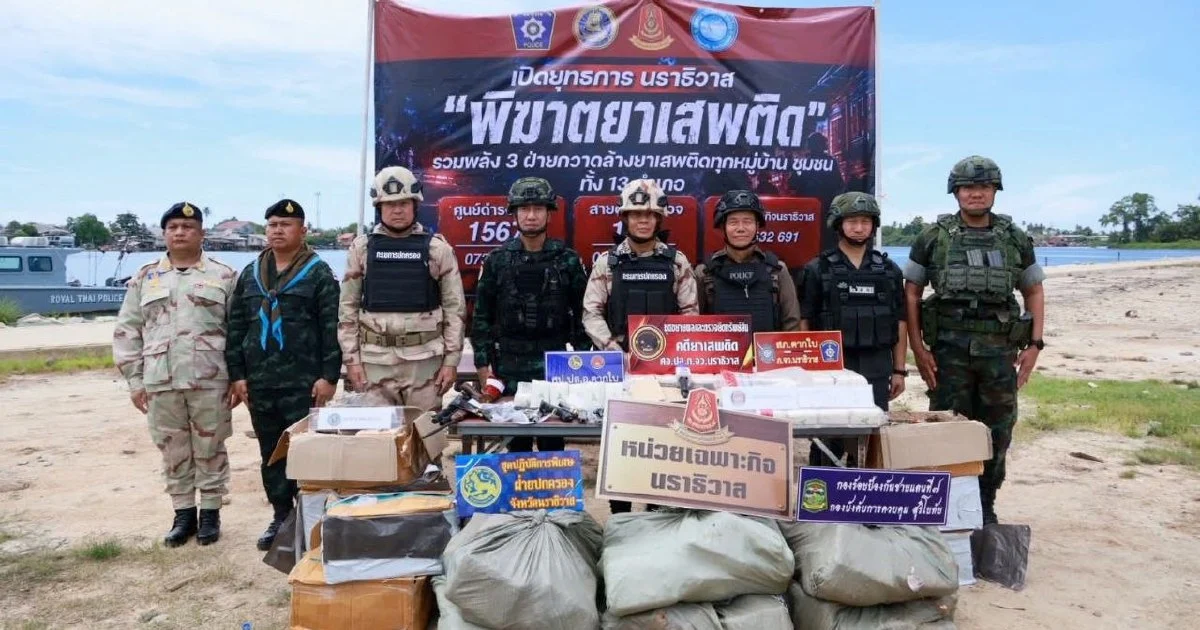
Thai law enforcement has scored a significant victory against organised drug trafficking, dismantling a major smuggling network that authorities believe channelled illegal narcotics through Malaysian territory. The crackdown, conducted across Narathiwat province in southern Thailand, resulted in the arrest of 233 suspected members of trafficking syndicates operating in the strategically sensitive border region. Security officials have indicated that several of those detained maintain active connections to Malaysian-based traffickers, underscoring the cross-border nature of the illicit drug trade plaguing Southeast Asia.
The operation, which unfolded over a month-long period, represents a concentrated effort by Thai authorities to dismantle criminal infrastructure in one of the region's most volatile trafficking corridors. Narathiwat, situated along Thailand's southern frontier, has historically served as a transshipment hub for narcotics destined for Malaysia, Singapore, and broader regional markets. The scale of the roundup—involving nearly a quarter-thousand suspects—signals the magnitude of trafficking activity that authorities had been tracking, and the complexity of dismantling networks that often operate with sophisticated coordination and resource networks.
Among the contraband seized during enforcement operations was a substantial drug haul valued at approximately RM1.2 million, which investigators determined was bound for Malaysian distribution points. The narcotics intercepted included multiple controlled substances, though specific details regarding drug types and quantities remain under investigation. Seizures of this magnitude typically involve coordination between multiple trafficking cells and suggest that the dismantled network possessed significant capital resources and logistical capabilities required to move large quantities across international boundaries.
The cross-border dimension of this case reflects a persistent challenge facing regional law enforcement agencies. Drug trafficking networks operating in the Thailand-Malaysia border zone benefit from rugged terrain, porous border crossings, and established smuggling routes refined over decades. Criminal syndicates exploit jurisdictional boundaries, often fragmenting their operations to evade detection and complicate prosecution. Malaysian authorities have repeatedly emphasised that controlling narcotics flows requires continuous intelligence sharing and coordinated enforcement actions with neighbouring countries, particularly Thailand and other ASEAN partners.
The alleged connections between arrested Thai suspects and Malaysian-based traffickers highlight how criminal enterprises have evolved into genuinely transnational organisations. Rather than operating within national boundaries, contemporary drug trafficking networks treat the Malaysia-Thailand border region as an operational zone, with specialised units handling cultivation, processing, transshipment, and distribution across political frontiers. This structural adaptation presents enforcement challenges, as prosecution frameworks typically operate on a national basis, while criminal organisations function seamlessly across borders.
Narathiwat province has witnessed intensified drug enforcement efforts in recent years, reflecting both the province's strategic importance in trafficking routes and the spillover consequences of narcotics activity into adjacent regions of Malaysia. Communities in Malaysian border towns have experienced elevated gang violence, addiction-related social decay, and strain on public health resources directly attributable to trafficking flows originating from the Thai side of the frontier. Success in disrupting Thai-based supply chains consequently carries direct benefits for Malaysian citizens and communities combating drug-related harms.
The timing of the crackdown underscores broader regional efforts to address narcotics challenges identified as priority concerns at ASEAN forums and bilateral security dialogues. Both Thailand and Malaysia maintain formal cooperation frameworks focused on combating transnational crime, though resource constraints, varying institutional capacities, and competing security priorities sometimes complicate coordinated action. Operations like the Narathiwat crackdown demonstrate that when individual nations commit sufficient enforcement resources, meaningful disruption of trafficking infrastructure becomes achievable, at least temporarily.
Investigators are now examining financial records, communication networks, and supply chain relationships among the detained suspects to map the broader structure of trafficking organisations. Understanding how narcotics sourced from production areas eventually reach Malaysian end-users remains critical for disrupting entire supply chains rather than simply arresting individual actors. Thai authorities are reportedly cooperating with Malaysian counterparts in this analytical phase, sharing intelligence regarding suspects' connections to Malaysian-based associates and distribution networks.
The incident illustrates why Malaysian policymakers maintain focus on regional security cooperation mechanisms and why law enforcement agencies prioritise cross-border intelligence sharing. Drug trafficking represents one of the most visible and consequential manifestations of transnational crime affecting the nation. The RM1.2 million seized would have generated substantial criminal profits while causing significant social harm across communities in Malaysia's northern border states and beyond. Each successful enforcement action, whether executed domestically or through coordinated regional effort, incrementally reduces traffickers' operational capacity and raises their operational costs.
Looking forward, sustaining effectiveness against organised trafficking requires consistent resource allocation, technical capacity development, and institutional commitment from both Thailand and Malaysia. Trafficking networks respond to disruption by adapting routes, methods, and organisational structures; law enforcement must maintain equivalent adaptive capacity and operational tempo. The Narathiwat arrests represent progress, but regional experts caution against viewing isolated successes as indication of long-term trafficking suppression. The underlying drivers of narcotics production, demand, and profitable smuggling remain substantially unchanged, meaning both nations must sustain enhanced enforcement efforts to prevent rapid reconstitution of dismantled networks.

