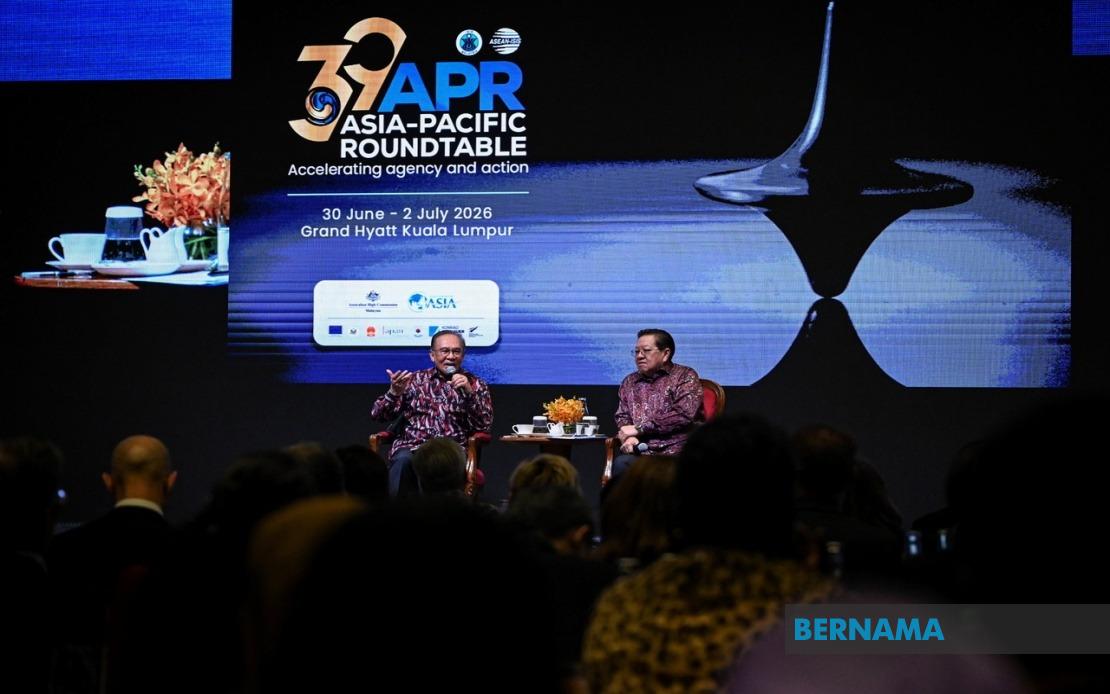
Prime Minister Datuk Seri Anwar Ibrahim has placed domestic institutional strengthening at the centre of his government's agenda, declaring that Malaysia must first establish robust governance frameworks before pursuing ambitious roles on the world stage. Speaking at the 39th Asia-Pacific Roundtable in Kuala Lumpur, Anwar articulated a governance-first philosophy that reflects a pragmatic reassessment of Malaysia's priorities, suggesting that credible international advocacy flows naturally from the successful transformation of domestic institutions and social systems.
The Prime Minister outlined a multi-faceted reform programme targeting four interconnected challenges: institutional governance, systemic corruption, structural inequality, and equitable access to essential services. By clustering these priorities, Anwar signalled an understanding that corruption undermines institutional legitimacy, which in turn perpetuates inequality and constrains the delivery of education and healthcare. This integrated approach moves beyond piecemeal policy interventions towards a comprehensive realignment of state capacity and purpose, reflecting lessons learned from Malaysia's experience with previous reform cycles.
Anwar emphasised that Malaysia's international credibility depends fundamentally on demonstrating that a Muslim-majority democracy can authentically uphold pluralistic governance, moderate discourse, and inclusive institutions. This positioning addresses a longstanding strategic vulnerability—the perception in some international forums that Islamic-majority nations struggle to reconcile religious identity with liberal democratic commitments. By anchoring Malaysia's global engagement to the success of domestic democratic consolidation, Anwar has reframed the country's international role as contingent on internal performance, thereby raising the stakes for genuine institutional reform.
The Prime Minister's invocation of Edward Said's concept of a "clash of ignorance" rather than a "clash of civilisations" deserves careful attention for Malaysian readers. This intellectual move rejects deterministic frameworks that treat religious, cultural, or ideological differences as inherently conflictual. Instead, Anwar positioned many contemporary international tensions as products of wilful misunderstanding, prejudice, and inadequate dialogue—conditions that can be ameliorated through sustained engagement and mutual learning. For Malaysia, a nation perpetually navigating religious and ethnic complexities, this philosophical stance carries immediate domestic relevance.
The government's MADANI framework emerges in this context as both a domestic and international statement. By explicitly balancing technological progress with the cultivation of human values, MADANI signals that Malaysia will not pursue development through institutional soullessness or the subordination of ethical considerations to economic metrics. The framework's emphasis on fostering appreciation across racial, religious, and cultural lines positions technological advancement as a tool for deepening pluralism rather than amplifying divisions—a crucial distinction for a nation where digital platforms can either reinforce social fragmentation or facilitate genuine cross-community understanding.
Anwar's reference to the Quranic concept of "li ta'arafu"—often translated as "so that you may know one another"—grounds his pluralism in Islamic theological tradition rather than treating tolerance as an external imposition. This localization of inclusive governance within Malaysia's Islamic heritage carries significant implications. It suggests that institutional pluralism and religious commitment need not be opposing forces, a message that may help reframe domestic political debates that have sometimes positioned religious identity and democratic inclusivity as fundamentally incompatible. For neighbouring Southeast Asian nations with substantial Muslim populations, Malaysia's assertion that these values can be integrated may offer a constructive alternative to polarizing narratives.
The PM's emphasis on "every citizen has the right to basic education and health" reflects awareness that legitimacy in contemporary democracies rests substantially on demonstrable state capacity to deliver tangible improvements in quality of life. Universal education and healthcare access function both as moral imperatives and as practical necessities for economic competitiveness and social cohesion. By elevating these to the status of foundational governance priorities, Anwar has signalled a reorientation toward measurable outcomes in sectors that directly affect citizen welfare, potentially shifting domestic political accountability away from symbolic gestures toward substantive performance metrics.
The strategic decision to foreground domestic reform over international activism also reflects realistic assessment of Malaysia's current capacity and regional constraints. Rather than stretching limited institutional resources across multiple global initiatives, Anwar has advocated for concentrated effort on the nation-building agenda. This approach acknowledges that Malaysia's international influence ultimately derives from the success of its internal institutions and the stability of its society. A country struggling with corruption, inequality, and service delivery deficits inevitably finds its diplomatic voice weakened, regardless of the principled positions it articulates.
For Malaysian readers, the implications extend beyond rhetorical repositioning. The governance agenda outlined by Anwar establishes benchmarks against which his administration can be evaluated. Corruption metrics, inequality indices, educational outcomes, and healthcare accessibility become the practical measures of whether the stated priorities translate into tangible reform. The challenge facing the government involves translating these broad commitments into specific legislative measures, institutional restructuring, and resource allocation decisions—work that often proves more difficult and politically contentious than the articulation of principles.
The regional significance of Anwar's governance-first philosophy should not be underestimated. Throughout Southeast Asia, questions persist about whether democratic institutions can effectively respond to citizen demands, combat entrenched corruption, and deliver equitable development. Malaysia's experience in attempting these simultaneous transformations will be closely observed by other nations navigating similar institutional challenges. Success in this domestic agenda would strengthen Malaysia's capacity to contribute to regional cooperation on governance standards, anti-corruption frameworks, and democratic practice.
Moreover, the emphasis on institutional consolidation before international activism potentially positions Malaysia as a counterweight to great power competition in the region. By demonstrating that a nation can pursue principled positions while prioritizing internal stability and reform, Malaysia may establish itself as a voice for measured, nationally-grounded engagement rather than alignment with external powers pursuing their own strategic interests. This positioning holds particular relevance for smaller and middle-power nations seeking to maintain strategic autonomy while building genuine institutional strength.

