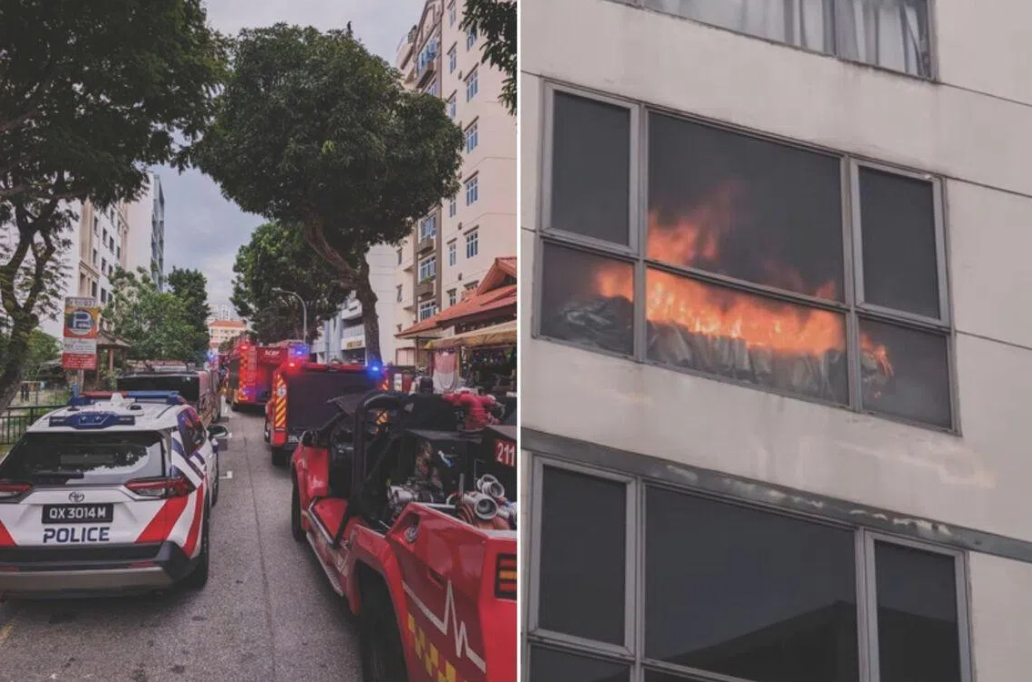
Five residents were forced to evacuate from a condominium in Singapore's Geylang district on Sunday, June 21, after a power-assisted bicycle (PAB) caught fire in an unattended state while being charged. The Singapore Civil Defence Force (SCDF) received an alert at 5.35pm regarding a blaze at 9 Lorong 26 Geylang, which houses the residential complex Casa Aerata. Responding officers swiftly extinguished the flames using a hosereel and compressed air foam backpack, ensuring no injuries occurred despite the rapid spread that threatened nearby units.
The fire originated in a seventh-floor residential unit where the PAB battery had been left plugged in within the living room. Preliminary investigations by the SCDF determined the blaze was of electrical origin, directly linked to the charging PAB itself. The incident underscores a growing concern across Singapore's residential landscape, where the proliferation of active mobility devices has coincided with a rise in battery-related hazards within domestic spaces. The neighbouring units required evacuation purely as a precautionary measure, though the intensity of the fire became evident when heat from the burning unit caused a window to shatter, prompting further safety protocols.
Local Member of Parliament for Bishan-Toa Payoh GRC Cai Yinzhou responded immediately upon observing smoke and hearing emergency sirens, arriving at Casa Aerata to assist authorities. He took action to clear the ground-floor area beneath the affected unit in anticipation of the window breakage and potential falling debris—a critical safety measure that may have prevented injuries to residents below. His rapid response and coordination with emergency services demonstrated the importance of community awareness during such incidents, particularly in densely populated residential settings where evacuation procedures must be executed with precision.
The SCDF has reiterated official guidance emphasizing the dangers of non-original batteries used with active mobility devices. Counterfeit or third-party batteries often lack the safety mechanisms built into manufacturer-supplied components, making them significantly more prone to thermal runaway and combustion. Beyond battery procurement issues, the authority specifically warned against charging PABs and personal mobility devices (PMDs) for extended periods or overnight—practices that can cause battery degradation and increase fire risk substantially. These recommendations come amid a broader public safety campaign across Singapore addressing what appears to be an emerging hazard category.
Statistical data from the first two months of 2025 reveals concerning trends within Singapore's residential fire landscape. The SCDF reported 304 electrical fires at residential premises during this period, of which 34 were attributable to active mobility devices (AMDs)—a category encompassing PABs, PMDs, and personal mobility aids. While the overall number of AMD-related fires decreased from 67 incidents in 2024 to 49 in the same timeframe of 2025, the composition of these fires shifted notably. PMD-specific incidents surged from 25 cases to 31 cases, suggesting that different device types present varying risk profiles and may require tailored prevention strategies.
For Malaysian readers, this incident carries particular relevance given the region's similar adoption patterns of active mobility solutions. With PMDs and PABs increasingly popular in urban areas across Southeast Asia as last-mile transportation alternatives, the safety lessons from Singapore's experience provide instructive guidance. Malaysia's regulatory framework and consumer awareness regarding battery safety for these devices warrant examination, particularly as the devices become more commonplace in cities like Kuala Lumpur, Penang, and Johor Bahru. The correlation between growing adoption rates and fire incidents suggests that proactive safety messaging and stricter enforcement of product standards could prevent similar emergencies.
The Geylang incident also highlights vulnerabilities in residential charging infrastructure across the region. Many apartment and condominium complexes were not originally designed with the electrical loads imposed by mass charging of lithium-ion batteries in mind. Unlike traditional consumer electronics, PAB and PMD batteries represent concentrated energy storage systems capable of releasing tremendous heat rapidly if short circuits or manufacturing defects occur. Residential building management associations throughout Malaysia and Singapore should consider implementing designated charging zones with proper ventilation and fire suppression capabilities rather than allowing haphazard charging throughout common and private areas.
Consumer behaviour represents another critical dimension of this safety challenge. The convenience of overnight charging has become habitual for many urban commuters who rely on PMDs and PABs for daily mobility. However, this practice directly contradicts official safety guidance precisely because extended charging periods stress battery management systems, particularly if devices are used frequently during the day. Educational campaigns must emphasize that the modest time savings gained from overnight charging carry disproportionate fire risk, a message that has not yet penetrated mainstream consciousness in most Southeast Asian cities.
The role of aftermarket batteries in escalating risk cannot be overstated. Cost-conscious consumers often seek cheaper third-party batteries that ostensibly offer compatibility with popular device models. These non-original products frequently bypass quality control standards and lack sophisticated battery management electronics that prevent overcharging and excessive temperature rises. Singapore's emphasis on avoiding non-original batteries should be mirrored through consumer education initiatives in Malaysia, where counterfeit and substandard batteries remain readily accessible through online marketplaces and informal retail channels.
Building safety standards and fire code compliance will require updating across residential developments in major Southeast Asian cities. Fire safety officers and building inspectors must develop expertise in the specific hazards posed by lithium-ion battery installations within residential units, establishing clear protocols for safe charging locations, ventilation requirements, and emergency response procedures. The Geylang incident demonstrates that even in a well-regulated jurisdiction with highly trained emergency services, active mobility device fires can escalate rapidly and endanger multiple households simultaneously.
Looking forward, manufacturers, retailers, regulatory bodies, and residents share responsibility for preventing recurrence of such incidents. Manufacturers must implement robust battery management systems and safety certifications. Retailers should refuse to stock obviously counterfeit products and educate customers about authenticity verification. Regulatory bodies need to establish and enforce standards for battery imports and sales. Residents must adopt safe charging practices and resist the convenience trap of unattended or overnight charging. Until all stakeholders meaningfully address their respective roles, incidents like the Geylang fire will likely continue occurring across the region's rapidly urbanizing landscape where mobile device adoption outpaces safety infrastructure development.