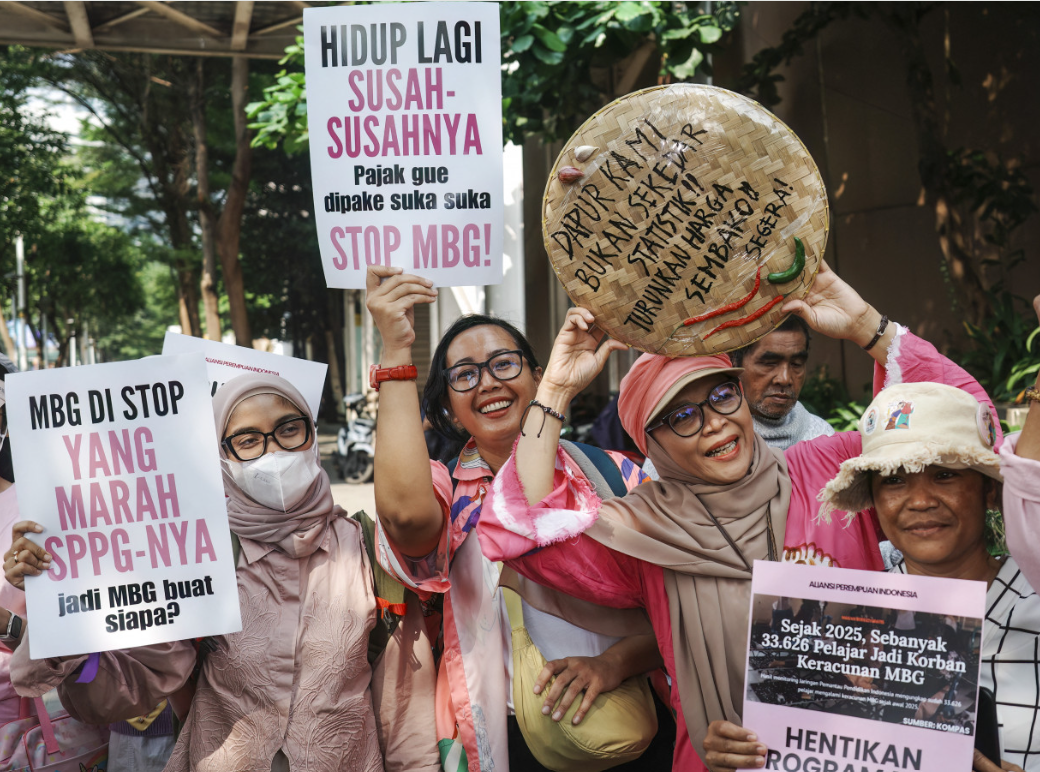
President Prabowo Subianto's centerpiece free nutritious meal programme faces an unprecedented credibility crisis, as mothers who should benefit most from the initiative openly reject the food being served, while demanding either a complete overhaul or termination of the scheme. The mounting public backlash reveals a programme struggling to deliver on its core mission—combating childhood stunting and malnutrition—even as it consumes an eye-watering Rp 335 trillion from the national budget.
The turning point came when a mother from Kediri in East Java exposed what officials were calling nutritious food: an unidentifiable clump of white paste destined for her eight-month-old infant. Nesti Nagari's social media post documenting the meal struck a chord with thousands of Indonesians, attracting more than 11,000 likes within hours. Rather than submit to the programme, she opted to feed the mixture to her chickens and formally declined future meals. Her decision reflected deeper frustration: a woman capable of providing her own child's nutrition saw no reason to accept substandard government assistance when the family's basic needs were already being met.
Nagari's willingness to forgo the meals if it meant forcing systemic improvements speaks to an uncomfortable reality for policymakers—beneficiaries themselves question whether the programme deserves continuation in its current form. When interviewed, she advocated for either a temporary suspension to allow proper evaluation or outright termination, arguing that the enormous budget could be redeployed toward education and healthcare, sectors facing genuine resource shortages. This argument carries particular weight in a country where school infrastructure and primary health services remain underfunded across many regions.
Quality failures extend well beyond a single incident. Diah Farika, a breastfeeding mother in Semarang, Central Java, enrolled in the programme since May, documented a pattern of deterioration in meal standards. Her photographs revealed unripe oranges and portion sizes she considered inadequate for proper nutrition. When she raised concerns with the nutrition fulfillment service unit responsible for meal preparation, her complaints were dismissed rather than addressed. The experience pushed her to decline meals despite being enrolled, and she too joined calls for a programme suspension—but specifically to allow kitchen inspections by the National Nutrition Agency before operations resumed.
Activist groups have amplified these individual voices. In mid-June, the Indonesian Women's Alliance staged a Central Jakarta rally explicitly demanding the government halt and comprehensively review the programme. Their intervention signals that quality concerns transcend personal preference and touch on women's rights and child welfare. The convergence of mother complaints, activist pressure, and beneficiary rejection creates political liability for a programme the president positioned as transformational development policy.
Paradoxically, while beneficiaries demand higher standards or programme termination, those operating the system voice opposite anxieties. A corruption scandal involving former National Nutrition Agency leadership destabilized investor confidence. Dozens of stakeholders, including SPPG kitchen operators, visited agency offices seeking assurances about programme continuity after new leadership halted network expansion. These operators had committed hundreds of billions of rupiah establishing infrastructure around the existing 27,000 kitchens nationwide. Early June funding delays forced some temporary closures, deepening concerns about the programme's financial stability and operators' ability to recover investments if the initiative wound down.
Beyond operational troubles, independent oversight has exposed troubling allocation patterns. The Center of Economic and Law Studies estimated that roughly 34 percent of current beneficiaries—approximately 61 million children and pregnant women—do not represent the most vulnerable populations. Instead, these figures include households already economically secure with adequate nutritional access. This misalignment undermines the programme's stated purpose and fuels public criticism that massive spending fails to reach those most needing government intervention. MBG Watch, a civil society oversight platform, framed the emerging consensus starkly: mounting problems force parents to question what the multi-billion-dollar budget actually serves and whose interests it genuinely advances.
The original Rp 335 trillion budget allocation already faced intense public scrutiny over its implications for education financing. Subsequent trimming to Rp 268 trillion reflected efficiency pressures, yet quality remains compromised even at reduced spending levels. The policy researcher Isnawati Hidayah argues that beneficiary perspectives must anchor any serious evaluation, since recipients best understand their actual needs and immediately experience programme failures. This observation reframes the conversation: those rejecting meals possess crucial knowledge policymakers cannot generate through bureaucratic assessment alone.
In response, the National Nutrition Agency initiated targeted reforms. Leadership began narrowing the beneficiary pool by removing households deemed capable of securing adequate nutrition independently. By mid-June, the agency had eliminated 76 schools across Java from the programme, affecting more than 39,000 recipients. Deputy head Agustina Arumsari characterized this refocusing as essential to effective delivery for those genuinely requiring government support. Simultaneously, the agency implemented austerity measures: ending daily kitchen incentives during non-operational periods and conducting performance reviews of underperforming facilities.
These corrective measures, while acknowledging dysfunction, arrive late for public confidence. The willingness of mothers to forfeit assistance rather than accept poor-quality meals signals something the statistics and budget allocations obscure: a programme can only succeed if beneficiaries believe it serves their children's genuine interests. When quality fails at scale, even massive public investment cannot overcome the fundamental legitimacy deficit. Indonesia's authorities now face a choice sharper than typical policy reform: rebuild the programme through rigorous quality control and transparent accountability, or acknowledge that current structures are so compromised that temporary suspension and wholesale redesign merit serious consideration. Either path demands confronting why a flagship presidential initiative—meant to address childhood stunting across Southeast Asia's largest economy—became a case study in well-funded failure.

%22%2F%3E%3C%2Fpattern%3E%3C%2Fdefs%3E%3Crect%20width%3D%22100%25%22%20height%3D%22100%25%22%20fill%3D%22url(%23ph2hy9vg)%22%2F%3E%3Crect%20width%3D%22100%25%22%20height%3D%22100%25%22%20fill%3D%22url(%23ph2hy9vp)%22%2F%3E%3Ctext%20x%3D%2250%25%22%20y%3D%2250%25%22%20text-anchor%3D%22middle%22%20dominant-baseline%3D%22central%22%20fill%3D%22rgba(255%2C255%2C255%2C0.95)%22%20font-family%3D%22Georgia%2C%20'Times%20New%20Roman'%2C%20serif%22%20font-weight%3D%22700%22%20font-size%3D%22272%22%20letter-spacing%3D%22-0.02em%22%3EAnwar%3C%2Ftext%3E%3C%2Fsvg%3E)