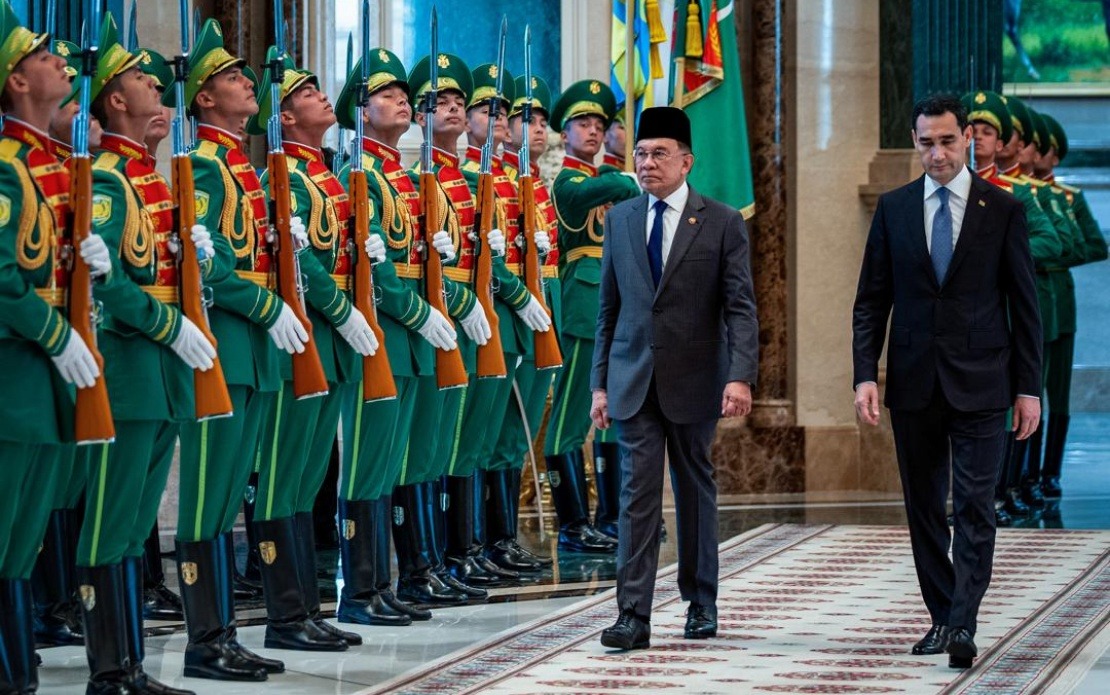
Prime Minister Datuk Seri Anwar Ibrahim was formally received at the Turkmenistan Presidential Palace in Ashgabat on June 19, in a ceremony that underscores Malaysia's expanding diplomatic footprint across Central Asia. The reception, complete with a full guard of honour and the playing of both nations' national anthems, marked the opening act of the prime minister's two-day visit to the resource-rich former Soviet republic.
Turkmenistan President Serdar Berdimuhamedov personally greeted Anwar upon his arrival at the palace, reflecting the significance both countries place on strengthening bilateral ties. The ceremonial welcome, a standard diplomatic protocol reserved for visiting heads of government, signalled Turkmenistan's readiness to deepen engagement with Malaysia across multiple sectors.
Following the formal reception, protocol demanded that Anwar be introduced to members of Turkmenistan's Cabinet and other senior government figures. The prime minister then presented members of the Malaysian delegation to President Berdimuhamedov, establishing the foundation for subsequent technical and ministerial discussions that would shape the substance of the two-day engagement.
The diplomatic agenda moved quickly into substantive discussions, with Anwar and Berdimuhamedov conducting a private bilateral meeting before expanding into broader talks involving both delegations. These conversations were designed to explore avenues of mutual cooperation and address issues of shared concern between Kuala Lumpur and Ashgabat. The format of separate one-on-one discussions followed by fuller bilateral meetings allowed the two leaders to establish personal rapport before tackling complex policy matters.
This visit represents Anwar's first official trip to Turkmenistan since his appointment as Malaysia's 10th Prime Minister in November 2022. The timing of the visit, some seven months into his tenure, suggests a deliberate effort to expand Malaysia's diplomatic presence in regions historically less prominent in the country's foreign policy calculations. Central Asia, with its vast energy resources and strategic position bridging Europe and Asia, holds considerable economic and geopolitical interest for Malaysia's long-term development strategy.
Turkmenistan's invitation to the prime minister reflects the country's own interest in diversifying its international partnerships. As one of the world's largest natural gas exporters and a nation sitting astride critical regional trade routes, Turkmenistan represents both a market opportunity and a potential strategic partner for Malaysia. The energy sector, in particular, offers significant scope for collaboration, given Malaysia's experience in hydrocarbon extraction and refining.
The visit occurs within a broader context of Malaysia seeking to enhance its presence across Asia's lesser-known frontiers. While Southeast Asia remains the primary focus of Malaysian foreign policy, the government has increasingly recognised the importance of engaging with partners in South Asia, the Middle East, and Central Asia to secure long-term economic and strategic advantages. A visit to Turkmenistan signals confidence in Malaysia's ability to project influence beyond traditional spheres of activity.
From a regional perspective, this engagement carries implications for how Southeast Asian nations are positioning themselves in the evolving global order. Malaysia's diplomatic outreach to Central Asia complements broader efforts by several regional states to reduce dependence on traditional Western security guarantors and develop more autonomous foreign policies. The visit may also facilitate potential connections between Turkmenistan and the Association of Southeast Asian Nations more broadly, creating opportunities for regional cooperation frameworks.
The two-day format of the visit, commencing June 18, was structured to allow time for high-level discussions, potential signing of agreements, and cultural exchanges that reinforce people-to-people connections. Such extended visits typically result in tangible outcomes, whether in the form of memoranda of understanding on trade, investment protocols, or cultural cooperation agreements. The private bilateral meeting format suggests the two leaders intended to address sensitive issues that might benefit from confidential discussion before any public announcements.
For Malaysian observers, the significance of this visit lies in what it reveals about the government's strategic vision for the nation's international role. By accepting Turkmenistan's invitation and conducting a full state visit, Anwar demonstrates Malaysia's commitment to diversifying partnerships and exploring new economic frontiers. This approach reflects lessons learned from Malaysia's own development experience and a recognition that long-term prosperity requires engagement across multiple regions and with diverse partners.
%22%2F%3E%3C%2Fpattern%3E%3C%2Fdefs%3E%3Crect%20width%3D%22100%25%22%20height%3D%22100%25%22%20fill%3D%22url(%23ph3n7zyg)%22%2F%3E%3Crect%20width%3D%22100%25%22%20height%3D%22100%25%22%20fill%3D%22url(%23ph3n7zyp)%22%2F%3E%3Ctext%20x%3D%2250%25%22%20y%3D%2250%25%22%20text-anchor%3D%22middle%22%20dominant-baseline%3D%22central%22%20fill%3D%22rgba(255%2C255%2C255%2C0.95)%22%20font-family%3D%22Georgia%2C%20'Times%20New%20Roman'%2C%20serif%22%20font-weight%3D%22700%22%20font-size%3D%22320%22%20letter-spacing%3D%22-0.02em%22%3EKTMB%3C%2Ftext%3E%3C%2Fsvg%3E)