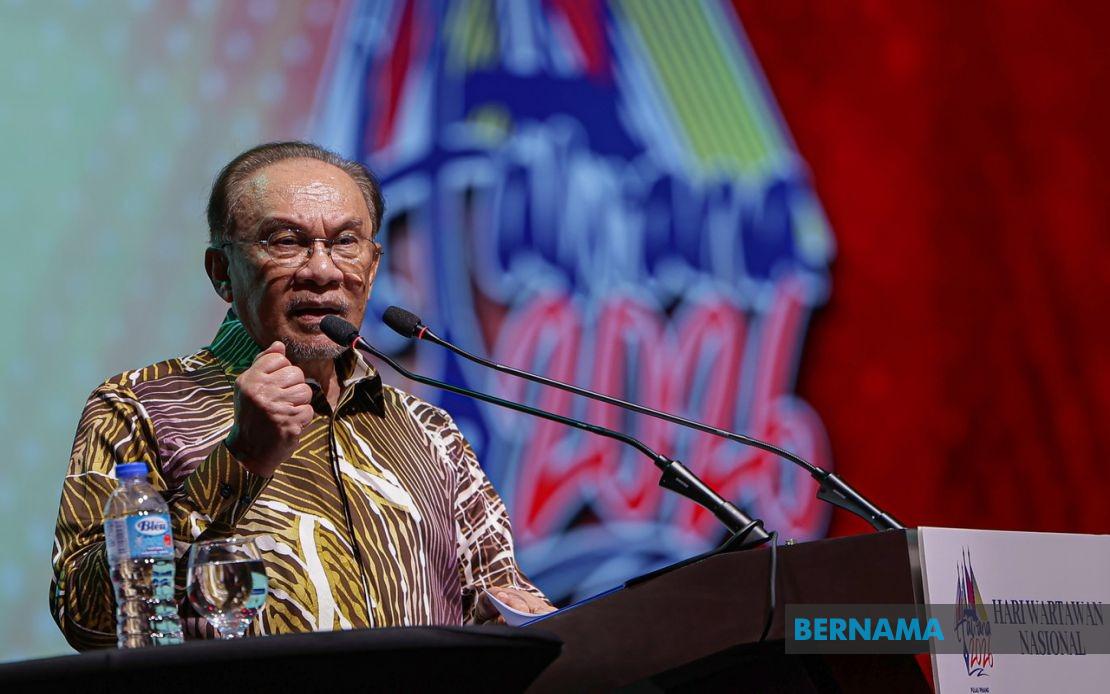
Prime Minister Datuk Seri Anwar Ibrahim has thrown his weight behind the appointment of former Federal Court judge Tan Sri Nallini Pathmanathan as chairman of the Malaysian Media Council, signalling that the government views her legal pedigree as instrumental in rehabilitating the institution's reputation among the public. Speaking at the National Journalists' Day celebration in Butterworth on June 20, Anwar underscored that Nallini's distinguished background in the judiciary and her personal integrity would help the council project a renewed image capable of winning back public confidence following years of controversy around media regulation and freedom in Malaysia.
The appointment carries particular significance in the context of Malaysia's evolving media landscape, where questions about regulatory independence and the boundaries between government oversight and editorial autonomy remain contested. By nominating someone with Nallini's judicial credentials rather than a political figure or media industry veteran, the government appears to be attempting to insulate the council from accusations of political interference. This approach reflects a broader recognition that media councils in democracies derive their legitimacy not from proximity to power but from demonstrable institutional independence and the perceived impartiality of their leadership.
Nallini's credentials are formidable. Her tenure as a Federal Court judge positioned her at the apex of Malaysia's judicial hierarchy, an experience that has exposed her to complex questions about rights, accountability and institutional governance. These qualifications apparently convinced the MMC board, which unanimously endorsed her nomination during a meeting held on May 26. The unanimous support suggests that even among board members representing diverse stakeholder interests—likely including industry figures, civil society representatives, and government appointees—there existed consensus that her appointment would strengthen rather than weaken the council's standing.
The timing of this leadership transition coincides with the formal establishment of the Malaysian Media Council under the Malaysian Media Council Act 2025, legislation that underwent parliamentary scrutiny before enactment. The new statutory framework tasks the council with multiple responsibilities spanning journalistic standards enforcement, public complaint adjudication, promotion of ethical media practices, and protection of media freedom as a democratic cornerstone. Nallini's appointment thus comes at a crucial moment when the institutional architecture itself is being renewed, creating an opportunity to align leadership with the council's elevated mandate and expanded scope.
For Malaysian journalists and media organisations, Nallini's background in constitutional law and judicial reasoning may offer some reassurance about how the council will interpret its regulatory authority. Judges trained in common law traditions typically emphasise procedural fairness, reasoned decision-making, and deference to established principles—qualities that could translate into complaint adjudication processes perceived as transparent and non-arbitrary. However, this enthusiasm must be tempered by the reality that chairing a media council involves navigating stakeholder interests that judicial training alone cannot fully prepare one for, including industry pressures, government expectations, and demands from civil society advocates.
Communications Minister Datuk Fahmi Fadzil's presence at the Butterworth event alongside Anwar signals cabinet-level commitment to the council's new direction. The joint appearances by the Prime Minister, Penang Chief Minister Chow Kon Yeow, and the Communications Minister suggest that Nallini's appointment enjoys cross-party and intergovernmental backing, a political consensus that could provide her with necessary latitude as she navigates the inevitable controversies that media regulation generates in any society committed to democratic values.
The Malaysian Media Council's self-regulatory mandate distinguishes it from purely governmental censorship apparatus, at least in principle. Self-regulation requires that industry players accept accountability to peers and public scrutiny through a body with sufficient autonomy to make unpopular decisions. Nallini's background may enhance this body's credibility with editors and publishers sceptical of government-dominated media governance, particularly given Malaysia's historical experience with media restrictions. Yet her success will ultimately depend on whether she can establish decision-making processes that stakeholders across the political spectrum view as fair, and whether the council can act decisively on legitimate complaints without appearing to suppress legitimate journalistic inquiry.
From a regional perspective, Malaysia's investment in strengthening its media council through senior judicial appointments mirrors similar efforts elsewhere in Southeast Asia to establish regulatory frameworks that can accommodate economic integration, digital transformation, and evolving public expectations around media accountability. Thailand, Indonesia, and the Philippines have all grappled with questions about how to regulate media without undermining press freedom, and the appointment of respected judicial figures to relevant positions has been a recurring strategy to build institutional legitimacy.
The broader context of Nallini's appointment extends to questions about media freedom indices and Malaysia's international reputation for respecting journalistic autonomy. International rankings regularly assess countries partly on the basis of whether media regulation appears independent, and appointments of this calibre signal to international observers that Malaysia is attempting to professionalise and depoliticise media governance. This dimension matters for Malaysia's positioning within global media and business communities, where perceptions of regulatory predictability influence investment and operational decisions by international news organisations.
As Nallini assumes her role, she will inherit a council tasked with strengthening journalistic standards in an era of fragmented information environments, misinformation, and declining trust in institutions generally. The council must address legitimate public concerns about media accuracy and bias while resisting pressure to use regulatory authority to silence critical reporting. Nallini's judicial background may position her to articulate these distinctions clearly, though the ultimate test will be whether her decisions command respect from journalists, the public, and the government simultaneously—a balance that no media regulator has yet perfected anywhere in the world.
%22%2F%3E%3C%2Fpattern%3E%3C%2Fdefs%3E%3Crect%20width%3D%22100%25%22%20height%3D%22100%25%22%20fill%3D%22url(%23ph25143g)%22%2F%3E%3Crect%20width%3D%22100%25%22%20height%3D%22100%25%22%20fill%3D%22url(%23ph25143p)%22%2F%3E%3Ctext%20x%3D%2250%25%22%20y%3D%2250%25%22%20text-anchor%3D%22middle%22%20dominant-baseline%3D%22central%22%20fill%3D%22rgba(255%2C255%2C255%2C0.95)%22%20font-family%3D%22Georgia%2C%20'Times%20New%20Roman'%2C%20serif%22%20font-weight%3D%22700%22%20font-size%3D%22320%22%20letter-spacing%3D%22-0.02em%22%3ETV3%3C%2Ftext%3E%3C%2Fsvg%3E)