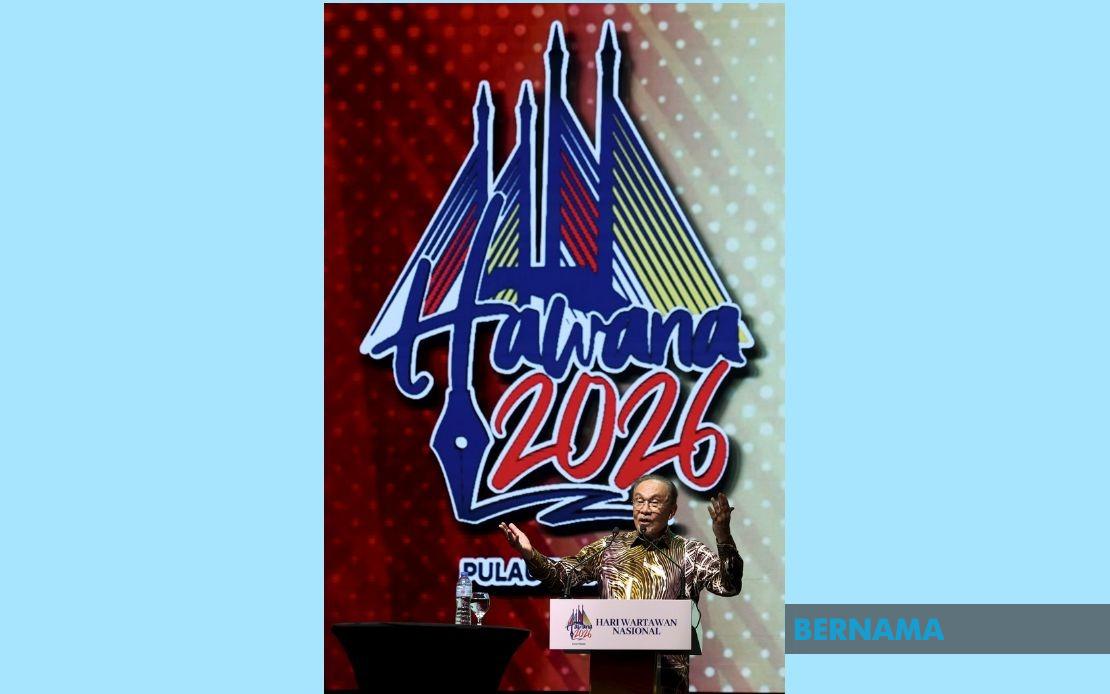
Prime Minister Datuk Seri Anwar Ibrahim committed an extra RM1 million to bolster assistance for Malaysia's media workers during the National Journalists' Day celebration in Butterworth today, signalling the government's deepening investment in the journalism sector's social safety net. The announcement came as Anwar, who concurrently holds the Finance Ministry portfolio, formally opened the HAWANA 2026 main event at PICCA Convention Centre@Butterworth Arena, bringing together over a thousand media professionals from Malaysia and neighbouring countries including Timor-Leste, Cambodia and Laos.
The fresh injection represents a tangible expansion of the Tabung Kasih@HAWANA, a welfare mechanism established three years ago during the 2023 HAWANA commemoration to provide financial relief and medical support to journalists facing hardship. Since inception, the fund has distributed RM2.26 million across 773 media practitioners nationwide, demonstrating meaningful uptake and the prevalence of economic vulnerability within the profession. This expansion underscores official recognition that journalism—despite its critical role in democratic institutions—remains a financially precarious occupation for many practitioners.
The welfare fund's scope extends beyond emergency cash transfers, encompassing medical expense coverage, family support assistance and other tailored relief mechanisms. Such breadth reflects an understanding that media workers face multifaceted challenges: job insecurity, irregular income streams, occupational health hazards and the psychological toll of reporting in increasingly polarised environments. By broadening the fund's reach, the government acknowledges these structural vulnerabilities rather than treating media welfare as peripheral charity.
The timing of this allocation carries particular significance for Southeast Asia's media landscape. As disinformation proliferates and news organisations face shrinking advertising revenues, journalist welfare has become increasingly intertwined with editorial independence and credibility. Countries that fail to support their media workforce risk brain drain, declining journalistic standards and reduced accountability journalism. Malaysia's commitment, however modest in absolute terms, demonstrates recognition that media sustainability requires systemic support.
The HAWANA 2026 event itself proceeded under the theme 'Media Integrity Strengthens Credibility', a declaration that resonates across the region where trust in institutions has eroded significantly. Penang Chief Minister Chow Kon Yeow and Communications Minister Datuk Fahmi Fadzil's presence signalled cross-party and ministerial alignment on media support—a noteworthy consensus in Malaysia's often fragmented political landscape. Communications Ministry officials and leadership from Bernama, the national news agency, reinforced the state's institutional commitment to the journalism profession.
The RM1 million addition follows a period of economic pressure on Malaysian newsrooms. Print circulation has declined, digital advertising competition from global technology platforms has intensified, and many outlets have implemented redundancy programmes. Freelancers and multimedia journalists—increasingly common across the industry—typically lack employment benefits available to permanent staff. The welfare fund provides a critical bridge for these precarious workers, though questions remain whether RM1 million annually adequately addresses systemic industry challenges.
For Malaysian readers and media consumers, this policy carries indirect implications. Well-supported journalists are more likely to invest time in investigative work, fact-checking and contextual analysis rather than prioritising speed and sensationalism to maximise engagement metrics. By reducing financial desperation among reporters, the welfare fund theoretically enables more principled editorial decision-making and resistance to advertiser or partisan pressure. Economic security for journalists correlates with institutional resilience.
The Bernama chairman, chief executive and editor-in-chief's participation highlighted the national news agency's role as a model employer and thought leader within Malaysia's media ecosystem. Bernama's own labour practices and editorial standards often set benchmarks for commercial outlets, making its leadership's endorsement of government support mechanisms influential among industry peers. Strategic partners attending the event included various media organisations, suggesting broader industry buy-in for the welfare initiative.
Regionally, Malaysia's approach invites comparison with neighbouring countries' media support mechanisms. Thailand, Indonesia and Vietnam have experimented with different regulatory and financial frameworks for journalism, with varying success in maintaining credibility. Malaysia's emphasis on welfare provision rather than regulatory tightening signals a softer, incentive-based approach to media governance—one that potentially sustains editorial pluralism more effectively than punitive measures.
The fund's expansion also reflects Malaysia's positioning within global press freedom rankings and international media discourse. While domestic factors heavily influence editorial independence, international observers increasingly scrutinise how governments treat journalists economically and legally. Visible welfare provision provides evidence of good faith support, even as critics note that economic support alone cannot guarantee editorial freedom without complementary legal and institutional protections.
Moving forward, the sustainability of this welfare model depends on consistent annual allocations, simplified application processes, and transparent administration to prevent politicisation. Media practitioners must perceive the fund as equitable and apolitical; any perception that assistance flows preferentially to allied outlets would undermine its legitimacy and effectiveness. The fund's credibility therefore rests partly on Communications Ministry administration and oversight structures.
The HAWANA 2026 celebration represented a convergence of government, industry and international media actors around shared commitments to journalistic professionalism and institutional sustainability. While RM1 million constitutes modest support relative to the sector's total economic needs, it signals official acknowledgement that viable journalism requires systemic investment. For Malaysian media workers facing uncertain career trajectories, this allocation provides tangible relief while addressing a profession-wide anxiety about long-term viability.
%22%2F%3E%3C%2Fpattern%3E%3C%2Fdefs%3E%3Crect%20width%3D%22100%25%22%20height%3D%22100%25%22%20fill%3D%22url(%23ph25143g)%22%2F%3E%3Crect%20width%3D%22100%25%22%20height%3D%22100%25%22%20fill%3D%22url(%23ph25143p)%22%2F%3E%3Ctext%20x%3D%2250%25%22%20y%3D%2250%25%22%20text-anchor%3D%22middle%22%20dominant-baseline%3D%22central%22%20fill%3D%22rgba(255%2C255%2C255%2C0.95)%22%20font-family%3D%22Georgia%2C%20'Times%20New%20Roman'%2C%20serif%22%20font-weight%3D%22700%22%20font-size%3D%22320%22%20letter-spacing%3D%22-0.02em%22%3ETV3%3C%2Ftext%3E%3C%2Fsvg%3E)