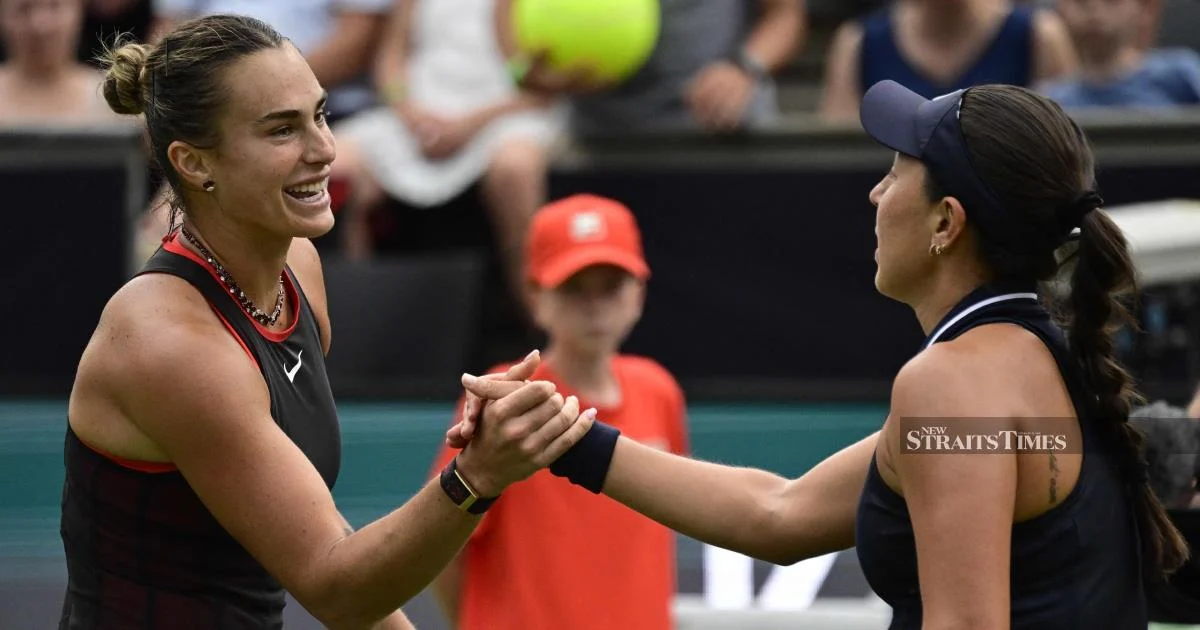
Jessica Pegula has powered into the final of the Berlin WTA grass-court championship, dismissing top-ranked Aryna Sabalenka with a stellar performance that saw the American claim a 6-2, 6-7 (4-7), 6-0 victory in the semi-finals. The result marks Pegula's second appearance in the tournament's championship match, underlining her growing credentials on the grass surface that has traditionally favoured Europe's elite players.
Pegula's path to the final showcased the kind of aggressive, composed tennis that has gradually elevated her standing in the women's professional game. Beginning with a dominant first set that yielded a 6-2 scoreline, the American demonstrated precise serve placement and aggressive net play that left Sabalenka searching for answers. The world number one, accustomed to dictating terms through her powerful baseline game, found herself pushed backward consistently by Pegula's willingness to finish points at the net rather than engage in extended baseline exchanges.
The second set proved to be the marathon affair that competitive tennis frequently produces when two elite players collide. Sabalenka rallied to force a tiebreak after both players traded service holds, suggesting a potential comeback in the offing. However, in the decisive tiebreak at 4-7, Pegula's pressure tactics and superior execution in critical moments prevailed, denying Sabalenka the opportunity to level the match. This set proved psychologically significant, as momentum swings often determine outcomes in closely contested matches at the professional level.
Having seized control, Pegula closed out the encounter with near-perfect tennis in the third set, delivering a bagel—a 6-0 margin that ranks among the most dominant performances against top-ranked opposition in recent tournaments. This emphatic conclusion underscored not merely technical superiority in that moment, but also mental fortitude. The American had broken through the psychological barrier that often accompanies facing the world's best player, demonstrating that Sabalenka's ranking does not render her unbeatable on every surface.
For Malaysian and Southeast Asian tennis enthusiasts, this victory carries broader significance within the context of women's professional tennis. The emergence of American players willing to engage in grass-court competition represents a shift in the sport's competitive landscape. Historically, grass-court tennis has been somewhat the preserve of European and British players, yet Pegula's performances in Berlin suggest that the American contingent is increasingly comfortable competing on surfaces traditionally requiring different tactical approaches than the hardcourts that dominate the professional calendar.
Sabalenka's defeat, while a single match outcome, raises questions about the Bulgarian champion's adaptability across different playing surfaces. The Belarusian-born player has constructed her game around tremendous baseline power and court coverage, attributes that translate brilliantly on hardcourts and clay. Grass, however, demands different adjustments: points end more quickly, serving accuracy becomes paramount, and the capacity to dictate aggressively from the baseline diminishes. Pegula's victory suggests that specialists on specific surfaces can still pose formidable challenges to all-court players, even those ranked highest in the world.
Pegula's advancement also reflects her broader career trajectory within professional tennis. Ranked consistently within the world's top 10 in recent seasons, she has gradually improved her performance at major tournaments and Masters 1000-equivalent events. The Berlin final represents another significant milestone in establishing herself as a player capable of sustaining excellence across multiple surface types—a prerequisite for genuine elite status in contemporary tennis.
From a strategic perspective, the manner of Pegula's victory deserves examination. Rather than attempting to out-power Sabalenka, she employed court positioning and net control to compress rallies. This tactical flexibility distinguishes genuine championship contenders from merely talented players. The ability to adjust game plans against opponents of Sabalenka's calibre determines success at tennis's highest levels, and Pegula demonstrated precisely this capacity in Berlin.
Looking forward, Pegula's arrival in the final establishes her as a genuine contender for the tournament title. Her opponent will emerge from the opposite semi-final bracket, but momentum and confidence derived from defeating the world number one typically confer significant psychological advantage. The American enters the final as a player peaking at precisely the right moment, having found answers to challenges posed by the tour's most challenging competitor.
The Berlin tournament continues to produce compelling narratives about professional women's tennis evolution. Pegula's semi-final performance reinforces that competitiveness on grass remains achievable for players willing to master the technical requirements the surface demands, challenging the historical perception that certain surfaces belong exclusively to particular regions or playing styles.