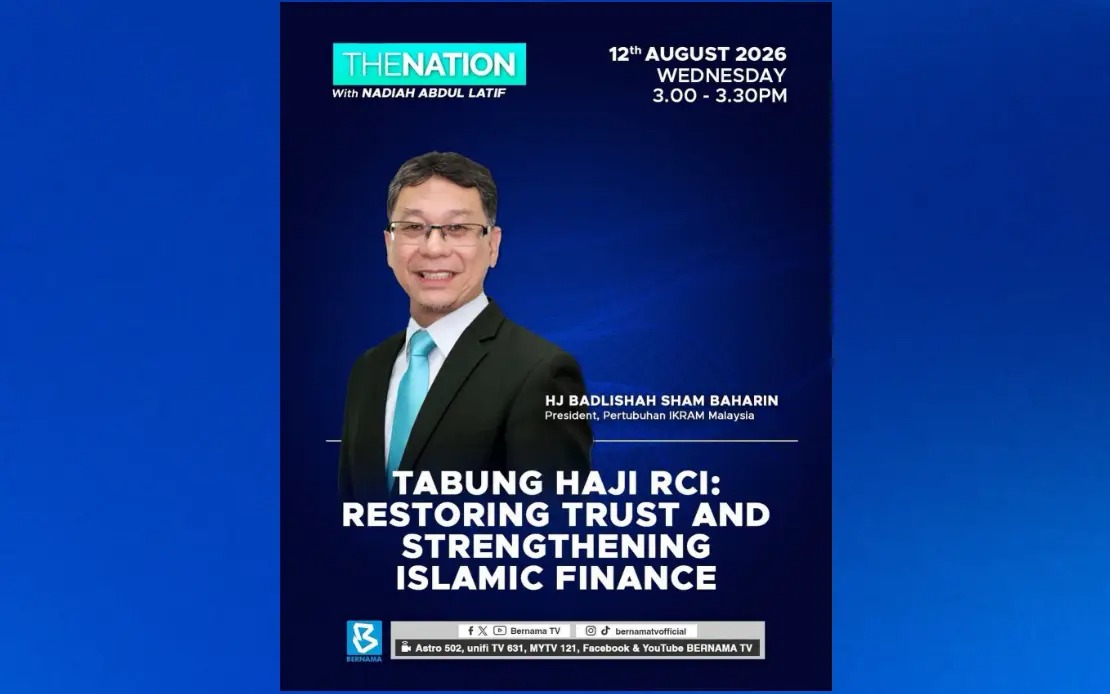
The push for a fresh Royal Commission of Inquiry into Lembaga Tabung Haji (TH) has been rejected by IKRAM, a prominent Malaysian Islamic finance organisation, which contends that current investigations by law enforcement agencies provide sufficient scrutiny without requiring additional formal inquiries. The position, articulated by IKRAM president Badlishah Sham Baharin, reflects broader concerns about the institutional fatigue that can result from repeated commissions of inquiry and the potential dilution of their effectiveness as tools for investigating serious misconduct.
Badlishah Sham's intervention comes as both government and opposition lawmakers have separately called for the government to launch a fresh RCI specifically examining TH's operations during 2021 to 2025, a period falling outside the scope of an existing inquiry that covered 2014 to 2020. The expansion would ostensibly address a temporal gap in oversight, yet the IKRAM leader argues that such proliferation of inquiries tends to erode public confidence in their utility. He emphasised that commissions of inquiry should be reserved exclusively for matters of exceptional national significance rather than deployed as routine investigative instruments for corporate lapses or regulatory failures.
The backdrop to this controversy is TH's profound financial deterioration, which has emerged through the recently published RCI report released on July 29. Between 2014 and 2020, the pilgrimage fund incurred losses totalling nearly RM13 billion through a portfolio of 14 investment decisions that proved deeply flawed. Of particular gravity, seven of these investments resulted in 100 percent losses, annihilating shareholder value entirely. The scale of mismanagement is underscored by the requirement for a government bailout executed through Urusharta Jamaah Sdn Bhd in 2018, which absorbed RM10.2 billion of the total losses. Additional impairment provisions of RM2.6 billion were subsequently recognised between 2018 and 2025 for investments still nominally under management, indicating that the full damage may not yet be apparent.
Finance Minister II Datuk Seri Amir Hamzah Azizan provided Parliament with granular details of the deterioration, identifying the Al-Rawda transaction as the largest single loss driver among TH's failed ventures. This arrangement involved TH committing 1.4 billion Saudi riyals, equivalent to approximately RM1.5 billion, to acquire leasing rights for four hotels across Makkah and Madinah intended to service Malaysian pilgrims. The structure proved catastrophic when the counterparty ceased rental payments from the first quarter of 2019 onwards, forcing TH to recognise the entire investment as impaired in 2024, resulting in a RM1 billion write-down. This episode exemplifies the type of due diligence breakdown that successive inquiries seem unlikely to prevent absent fundamental institutional reform.
Instead of advocating for yet another RCI, Badlishah Sham threw support behind a proposed multi-agency task force framework designed to conduct enhanced scrutiny of investments exhibiting warning signs of impending losses whilst simultaneously implementing preventive mechanisms. The conceptual shift from post-mortem inquiry toward prospective risk management addresses a critical gap in TH's governance architecture. Investment decisions, he stressed, must be preceded by rigorous due diligence procedures that examine not merely financial metrics but also the ethical dimensions and procedural regularity of proposed deployments of pilgrim savings. The grassroots validation component he referenced suggests a community-level oversight mechanism that could incorporate representative voices from TH's depositor base.
The magnitude of depositor exposure amplifies the stakes in this governance debate. Approximately 10 million Malaysians maintain savings with TH, collectively representing a pool of retirement and religious obligation funds whose protection ought to command legislative attention. The walkout by certain opposition members during the special Dewan Rakyat sitting discussing the RCI report prompted sharp criticism from Badlishah Sham, who characterised such parliamentary conduct as abdicating fundamental representational duties. Opposition figures, he contended, are no less obligated than government backbenchers to scrutinise executive performance and safeguard the interests of this vast depositor constituency, regardless of partisan affiliations.
Badlishah Sham's reproach extended to what he perceived as performative parliamentary engagement, whereby opposition actors prefer to conduct policy critique through social media platforms rather than utilising the Parliament chamber's formal deliberative mechanisms. This critique carries particular resonance in Malaysia's political context, where online discourse increasingly substitutes for substantive legislative engagement. The specific invocation of TikTok as an alternative forum for political debate hints at a generational and institutional disconnect wherein younger parliamentarians view digital platforms as more authentic venues for political expression than Westminster-derived parliamentary procedure.
The RCI report itself, whilst documenting serious institutional failings, revealed that TH management has implemented 75 percent of the 25 formal recommendations contained within the inquiry's findings as of July 30. This relatively robust compliance rate suggests that TH leadership recognises the gravity of past mistakes and has initiated corrective measures, at least on paper. The implementation gap of 25 percent warrants scrutiny, as it may encompass the more structurally demanding or politically sensitive reforms that prove difficult to operationalise within TH's existing governance framework.
The debate ultimately reflects competing approaches to financial sector accountability and remediation in Malaysia. Proponents of a new RCI favour comprehensive formal inquiry with statutory powers of compulsion, viewing it as the most credible mechanism for establishing facts and assigning responsibility. Opponents like IKRAM worry that repeated recourse to such instruments degrades their perceived authority and suggests governmental failure to act decisively on prior findings. The multi-agency task force proposal represents a middle ground, embodying prospective rather than retrospective accountability whilst drawing on consolidated enforcement capabilities across the MACC, Bank Negara Malaysia, and other regulatory bodies.
For Malaysian depositors, the practical consequence of IKRAM's position may be limited. Whether oversight occurs through a new RCI, enhanced task force mechanisms, or existing MACC investigations matters less than whether the underlying governance gaps that permitted the RM13 billion dissipation are genuinely addressed. The concentration of investment authority, inadequacy of independent board oversight, and apparent absence of rigorous counter-party credit assessment all require systemic correction. These issues transcend inquiry modalities and implicate TH's organisational culture, incentive structures, and relationship with political interference.
The controversy also carries implications for broader Islamic finance governance in Southeast Asia, where Shariah-compliant institutions must navigate dual accountability regimes encompassing both financial prudence and religious compliance standards. TH's failures suggest that neither framework adequately protected depositor interests, pointing toward the necessity for integrated governance mechanisms that synthesise financial rigor with Shariah supervision. Other Islamic financial institutions across the region monitoring Malaysia's response to these scandals will calibrate their own risk management protocols accordingly, making the resolution of TH's accountability question consequential for the entire sector's trajectory.

