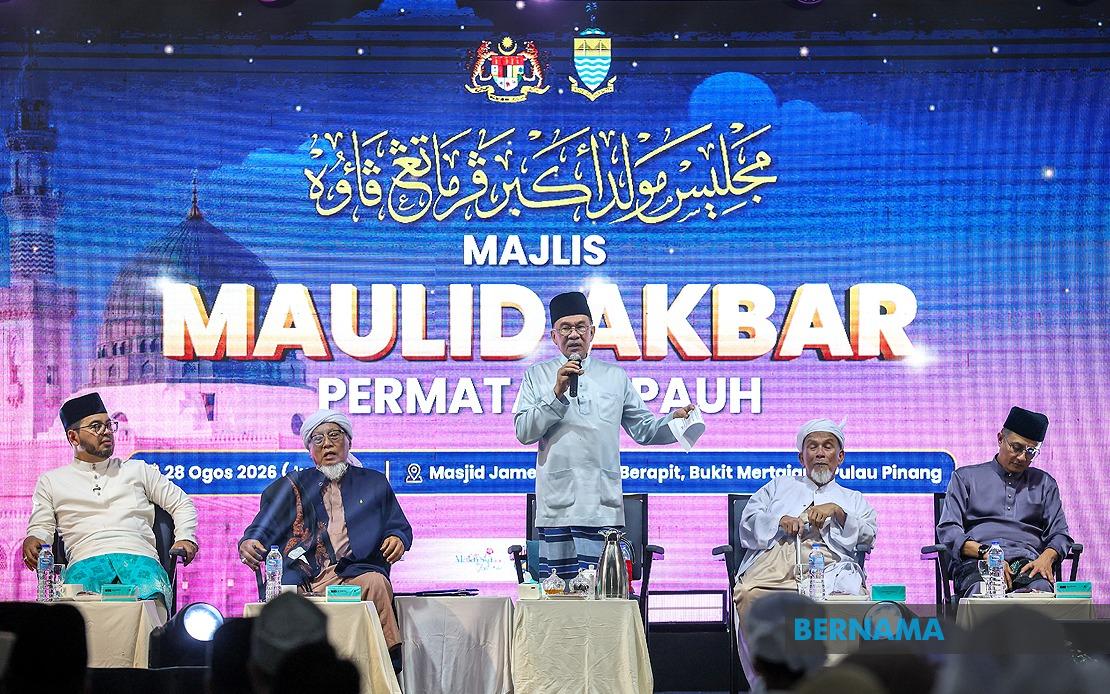
Prime Minister Datuk Seri Anwar Ibrahim has emphasized that Muslims bear a responsibility to earn the respect of society not through rhetoric or institutional authority, but through the consistent demonstration of moral excellence and ethical conduct in their personal and professional lives. Speaking at a Maulid Akbar ceremony held at Masjid Tengah in Bukit Mertajam on August 28, Anwar articulated a vision wherein the Islamic community functions as a moral exemplar, setting standards for integrity that extend beyond religious boundaries and influence the broader national character. His remarks underscored a perspective increasingly prominent in contemporary Malaysian political discourse: that religious identity carries with it an implicit social contract to uphold virtues that benefit the entire nation.
The Prime Minister articulated his argument through concrete behavioral examples, noting that genuine respect flows from observable actions rather than religious affiliation alone. When Muslims demonstrate diligence in their work, honor their commitments, maintain honesty in their dealings, and refrain from exploiting positions of authority for personal gain, they construct a foundation of credibility that commands respect across communal lines. Conversely, Anwar suggested that failures in these domains—whether manifested through corruption, dishonesty, or breach of trust—undermine not only individual standing but also broader Muslim credibility within a diverse, multireligious society such as Malaysia. This framing transforms personal ethical conduct from a private religious obligation into a public, politically significant matter with implications for interfaith relations and national cohesion.
Anwar positioned this call for moral leadership within the broader framework of Malaysia MADANI, the government's aspirational development doctrine that seeks to balance material progress with spiritual and ethical advancement. He articulated a concern that economic policies, technological innovation, and GDP growth, while necessary components of national development, prove insufficient foundations for a sustainable, cohesive society without robust underlying structures of faith, character, and shared values. This perspective reflects a significant strand of Malaysian political philosophy that resists a purely secular-materialist development model, arguing instead that national advancement requires integration of spiritual and moral dimensions throughout governance and civil life.
The Prime Minister employed the metaphor of rootedness to elaborate on this philosophy, suggesting that while Malaysia must aspire toward ambitious goals and embrace modernity, it must simultaneously maintain deep connection to foundational principles. To reach toward the sky—a symbolic reference to technological mastery and economic achievement—requires being rooted in the earth, which Anwar defined in terms of faith, morality, and character preservation. This rhetorical construction attempts to resolve a tension frequently articulated in Malaysian public discourse: how to achieve technological and economic competitiveness characteristic of developed nations while maintaining the religious and moral particularities that define the nation's identity. The metaphor suggests that these aspirations need not conflict; rather, they represent complementary dimensions of enlightened national development.
Anwar's remarks also acknowledged the pluralistic character of Malaysian society, explicitly noting that Islamic teachings encompass messages of compassion and universal welfare applicable to citizens across religious boundaries. He emphasized that Muslims must prioritize the wellbeing and social cohesion of the entire community regardless of racial or religious affiliation. This framing attempts to position ethical Muslim conduct not as sectarian behavior that privileges co-religionists but rather as a universalizing force that benefits society broadly. In doing so, Anwar addresses recurring anxieties within Malaysian minority communities regarding the relationship between Islamic values and inclusive governance, suggesting that proper Islamic conduct necessarily produces inclusive outcomes.
The Prime Minister advocated for a holistic approach to human development that transcends conventional binaries between material and spiritual progress. He argued that Muslims must cultivate knowledge, strengthen faith, develop morality, attend to spiritual development, maintain physical health, and pursue material advancement—presenting these dimensions as integrated rather than competing priorities. This comprehensive framework reflects Islamic intellectual traditions emphasizing balanced personal development, but it also addresses practical Malaysian concerns about social fragmentation, suggesting that individuals who cultivate this multidimensional development naturally become stabilizing forces within communities.
Anwar underscored the importance of sustained engagement with Islamic scholarship and strengthened institutional dialogue between religious scholars and political leaders. He presented these intellectual and institutional relationships as mechanisms through which societies can integrate ethical considerations into governance frameworks and policy formulation. By elevating Islamic scholarship and positioning scholars as contributors to national leadership dialogues, Anwar's comments reflect both a recognition of Muslim constituencies' expectations regarding Islam's role in governance and an attempt to institutionalize moral deliberation within Malaysian state structures.
The presence of Minister in the Prime Minister's Department (Religious Affairs) Dr Zulkifli Hasan at the ceremony underscored the government's formal commitment to integrating religious and ethical dimensions into administrative governance. The conjunction of a Maulid Akbar observance with National Day celebrations signaled the government's positioning of Islamic practice as compatible with, and indeed supportive of, broader national unity and patriotic sentiment. This institutional choreography communicates to both Muslim constituencies and broader Malaysian society that religious observance and national loyalty represent reinforcing rather than contradictory commitments.
For Malaysian readers and regional observers, Anwar's emphasis on Muslim moral leadership carries implications for governance quality, interfaith relations, and the government's capacity to mobilize religious constituencies behind anti-corruption and institutional reform agendas. His framing transforms personal integrity from an individual ethical matter into a politically significant national resource, suggesting that the success of Malaysia MADANI depends substantially on the behavioral choices of Muslims across administrative, commercial, and social sectors. This creates a form of moral pressure on Muslim-majority civil service and business communities, establishing ethical conduct as a prerequisite for legitimate religious authority and community standing.
The commentary also reflects broader regional conversations about Islam's role in governance and development that extend across Southeast Asia. As Muslim-majority nations navigate modernization while maintaining religious identity, the tension Anwar addresses—between technological aspiration and moral rootedness—remains central to political discourse from Indonesia to Bangladesh. His attempt to resolve this tension through metaphor and integrated frameworks offers one model for how Islamic political leaders attempt to legitimize modernization while satisfying constituencies concerned about cultural and spiritual erosion.

