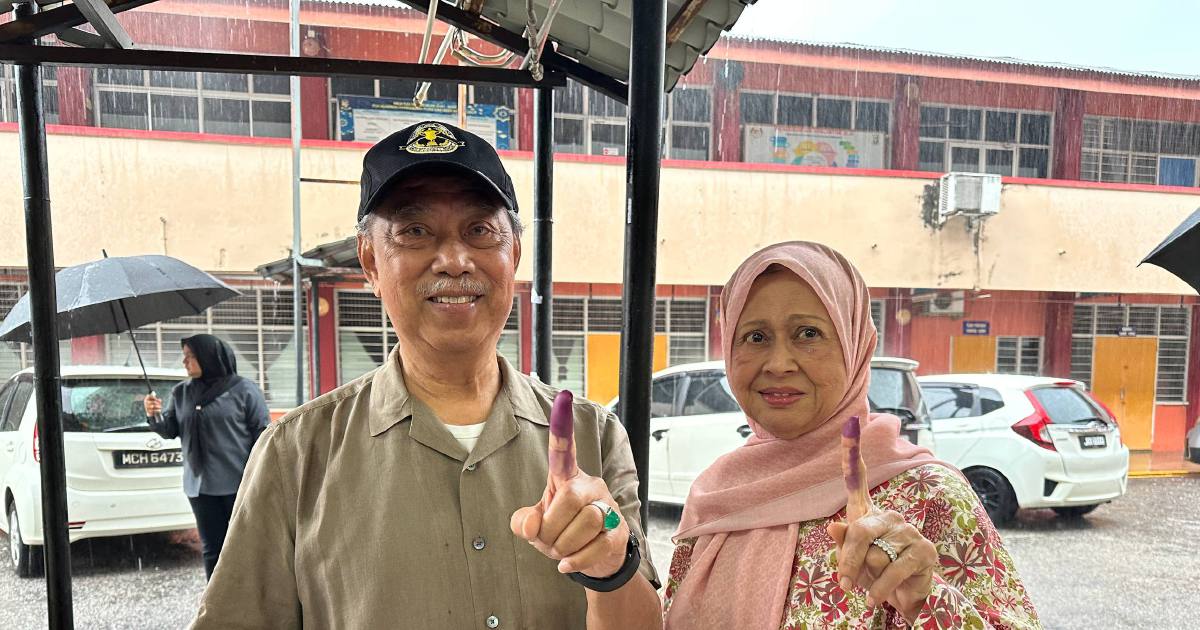
Johor residents headed to the polls today in what observers regard as a significant test of political sentiment in Malaysia's southern economic heartland, with Bersatu leadership expressing optimism that electoral participation would surmount the 70 per cent threshold despite inclement weather complicating the voting process. Senior party figures, including Muhyiddin, have publicly set this turnout benchmark as an indicator of public confidence in the state's governance direction and the legitimacy of the electoral outcome.
Heavy rain swept through multiple districts across Johor since early morning, creating challenging conditions for voters making their way to polling stations. Such weather patterns historically influence participation rates, as precipitation can deter voters in some districts while proving relatively manageable in others depending on local rainfall intensity and duration. The meteorological conditions added an unpredictable element to turnout projections that analysts had previously attempted to forecast based on historical voting patterns and contemporary political dynamics.
Bersatu's emphasis on surpassing the 70 per cent target reflects the party's broader strategic calculation regarding political legitimacy in Johor, a state that has witnessed significant electoral shifts over recent years. The party views a robust participation rate as validating its mandate and demonstrating sustained grassroots support amid ongoing political realignment in Malaysia. This benchmark serves as both an internal performance indicator and a public messaging tool to reinforce party momentum heading into subsequent electoral contests.
Historically, Johor has demonstrated variable turnout patterns across different election cycles, influenced by factors ranging from voter apathy and competing political narratives to structural elements like polling station accessibility and weather conditions. The 70 per cent target, if achieved, would position the state's election within the upper quartile of recent Malaysian state electoral participation rates, signalling relatively engaged electorate participation despite perennial challenges in mobilising voters.
The rain impacting various districts presented logistical challenges for both election administrators and voters. Johor's geographic spread means rainfall distribution proved uneven, with some communities experiencing heavier downpours than others. Electoral officials had prepared contingency arrangements for weather-related disruptions, though rain of itself does not typically delay voting processes but rather affects the practical willingness of citizens to navigate to ballot stations.
Muhyiddin's public statements regarding the turnout expectations underscore how contemporary Malaysian political contests have increasingly focused on participation metrics as symbolic validation of political legitimacy. Beyond the mathematical calculation of voters as a percentage of eligible electorate, turnout figures shape media narratives and provide opposition and ruling coalitions alike with quantitative claims regarding electoral endorsement and public confidence.
For Malaysian observers monitoring Johor politics, turnout levels offer insights into broader voter engagement patterns across the country. Johor's significance extends beyond state-level governance, as electoral trends in this strategically important state frequently presage shifts in national political fortunes. The state's economic importance, geographical position, and demographic diversity make its electoral behaviour particularly instructive for understanding potential shifts in regional political allegiances.
Weather-related voting challenges remain a recurring issue in Malaysia's electoral calendar, as monsoon seasons and tropical rainfall patterns can emerge unpredictably. Election commissions typically plan scheduling and logistics around likely weather conditions, though rainfall severity remains difficult to predict with precision. The 2024 Johor situation exemplifies how natural elements continue intersecting with democratic processes, occasionally testing administrative preparations and voter commitment to participating in electoral exercises.
The emphasis on exceeding 70 per cent turnout also reflects Bersatu's understanding that state elections function as barometers of party health and electoral viability. In multi-party systems where coalitions shift and political loyalty demonstrates increasing fluidity, turnout becomes a metric through which parties attempt to translate abstract political support into tangible numerical validation. Strong participation, from the party's perspective, legitimises specific governance mandates and provides momentum for subsequent political initiatives.
As polling stations remained open despite the rain, electoral observers noted that early morning weather did appear to suppress initial participation in some areas, though this pattern frequently reverses as the day progresses and weather conditions potentially improve. The final turnout figures, once tallied following the close of polls, would provide concrete data regarding whether Bersatu's optimistic 70 per cent projection would materialise, and whether rainfall ultimately constituted a meaningful barrier to participation or merely a temporary disruption to the voting process.

