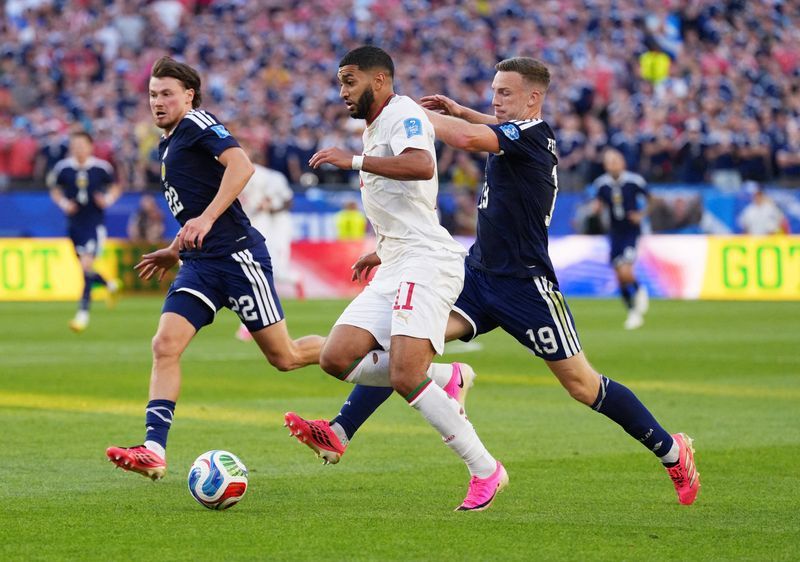
Morocco seized complete control of World Cup Group C on Friday with a dominant 1-0 triumph over Scotland, courtesy of the competition's fastest goal to date. Playing in Foxborough, Massachusetts, the North African side demonstrated overwhelming superiority throughout the encounter, with Ismael Saibari breaking the deadlock after merely 71 seconds to underscore their attacking prowess and defensive organisation.
The decisive moment came from a well-executed move that exposed Scotland's defensive vulnerabilities. Brahim Diaz's cross found Saibari racing behind the Scottish backline after central defender Grant Hanley had advanced too aggressively, leaving the midfielder with the relatively straightforward task of converting. The early breakthrough set the tone for an encounter where Morocco would maintain sustained pressure, repeatedly testing the Scottish resolve without requiring additional goals to secure the points.
This victory represents a significant marker in Morocco's tournament trajectory. The team now possesses four points from two matches, positioning them atop Group C ahead of their final fixture against Haiti on Wednesday. Scotland, meanwhile, find themselves on three points after their surprise opening victory against Haiti ended a 36-year World Cup drought for the Scots. However, their consolation assignment in the final round sees them face five-time world champions Brazil, a daunting prospect that may determine their progression prospects depending on other results.
Saibari's achievement carries particular significance beyond the immediate match context. The midfielder has now scored in consecutive World Cup appearances, having previously netted in Morocco's 1-1 draw with Brazil the previous week. This accomplishment places him in rare company as only the second African player to score in his opening two World Cup matches, joining Egyptian forward Mohamed Salah in this exclusive club. The 24-year-old has reportedly completed medical examinations ahead of a proposed transfer to German champions Bayern Munich, adding another dimension to his rising prominence.
Scotland's defensive frailties became immediately apparent and would persist throughout the encounter. Beyond the opening goal, Morocco manufactured numerous opportunities that threatened to compound the visitors' misery. Azzedine Ounahi produced a promising sequence down the left flank, cutting back for teammates who narrowly failed to capitalise on the gilt-edged chance. The pattern repeated itself when Bilal El Khannouss fired over the crossbar from another well-constructed attacking move midway through the first half, exemplifying Morocco's sustained territorial advantage.
Despite entering the match with considerable momentum following their historic victory over Haiti, Scotland appeared overawed by Morocco's intensity and technical superiority. The Scots managed not to register a single shot, either on or off target, until deep into first-half stoppage time—a stark illustration of their inability to establish any attacking rhythm or penetration against the well-marshalled North African defence. Instead, they found themselves perpetually chasing possession, with Morocco's pressing and transition play repeatedly catching the Scottish backline exposed.
The second half witnessed an intensification of Morocco's dominance rather than any meaningful Scottish revival. Saibari came agonisingly close to a second goal when his effort, deflected by a Scottish defender, struck the post. Moments later, El Khannouss executed a glancing header that forced goalkeeper Angus Gunn into a crucial save, indicating that Morocco's attacking threats remained consistent and potent throughout the 90 minutes. The cumulative effect of this sustained pressure would gradually sap Scotland's resistance.
Scotland's late attempts to engineer an unlikely comeback lacked the incisiveness required to trouble a well-organised Moroccan defensive unit. Despite creating occasional openings as their opponents sat deeper in the final stages, the Scots possessed neither the attacking impetus nor the creative spark necessary to breach the North African rearguard. Morocco's tactical discipline and professional management of the game's closing phases ensured that their slender advantage never came under genuine jeopardy.
Azzedine Ounahi had generated headlines the previous day when expressing his belief that Morocco possessed the quality to reach the tournament final. Friday's performance provided compelling evidence that such ambitions are not mere rhetoric but grounded in genuine capability. The team's ability to establish control early, maintain relentless pressure, and execute their gameplan with precision suggests they possess the resources to navigate the remainder of the competition competitively.
The broader Group C narrative now hinges significantly on the Brazil versus Haiti encounter scheduled for Friday evening. Brazil's involvement complicates the permutations for both Scotland and Haiti, as the five-time champions remain potent contenders despite their draw with Morocco. Scotland's final assignment against Brazil essentially becomes a battle for second place in the group, assuming Morocco's expected victory over Haiti. For Malaysian and Southeast Asian observers, Morocco's emergence as genuine title contenders adds an intriguing non-European and non-South American dimension to tournament narratives, potentially shifting the traditional power balance in world football's premier competition.


%22%2F%3E%3C%2Fpattern%3E%3C%2Fdefs%3E%3Crect%20width%3D%22100%25%22%20height%3D%22100%25%22%20fill%3D%22url(%23ph2hy9vg)%22%2F%3E%3Crect%20width%3D%22100%25%22%20height%3D%22100%25%22%20fill%3D%22url(%23ph2hy9vp)%22%2F%3E%3Ctext%20x%3D%2250%25%22%20y%3D%2250%25%22%20text-anchor%3D%22middle%22%20dominant-baseline%3D%22central%22%20fill%3D%22rgba(255%2C255%2C255%2C0.95)%22%20font-family%3D%22Georgia%2C%20'Times%20New%20Roman'%2C%20serif%22%20font-weight%3D%22700%22%20font-size%3D%22272%22%20letter-spacing%3D%22-0.02em%22%3EAnwar%3C%2Ftext%3E%3C%2Fsvg%3E)