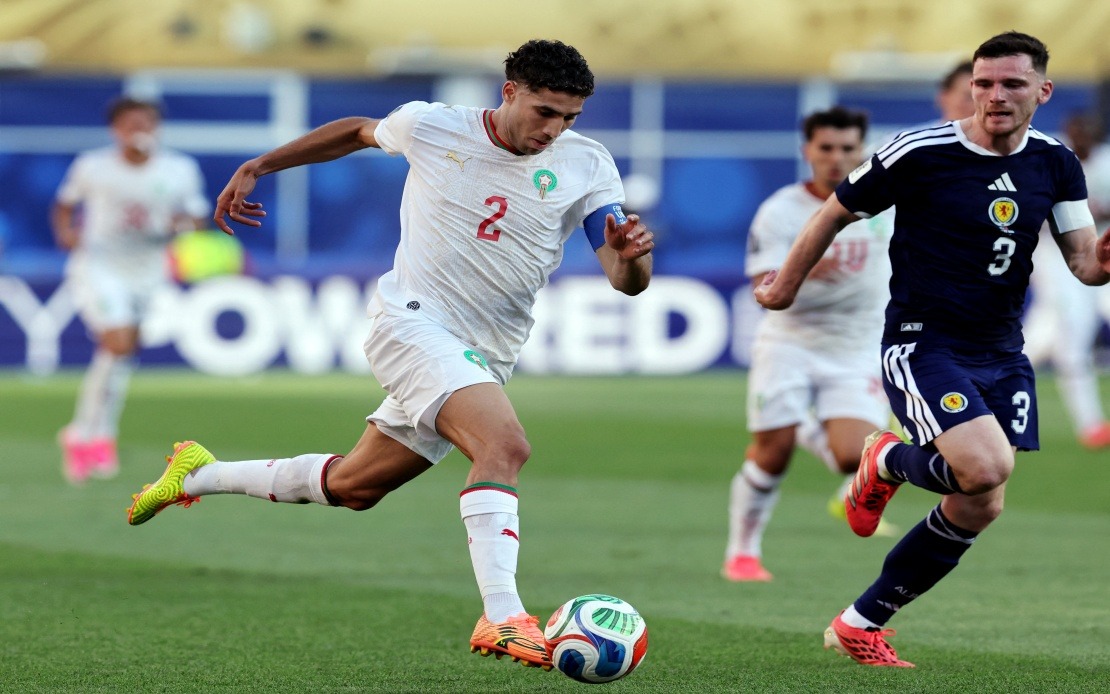
Mohamed Ouahbi has publicly thrown his support behind Achraf Hakimi, Morocco's captain, after the Paris Saint-Germain defender endured sustained jeering from sections of the crowd during Friday's 1-0 World Cup victory against Scotland in Foxborough, Massachusetts. The hostile reception proved particularly pointed, with Hakimi receiving boos when his name was announced in the team lineup and again each time he possessed the ball during the Group H encounter.
The timing of the crowd's reaction was decidedly uncomfortable, arriving just hours after a French court issued a significant legal development affecting the 25-year-old fullback. A Versailles appeal court determined that Hakimi must stand trial on rape charges following accusations that he assaulted a 24-year-old woman at his Paris residence in 2023. The judicial announcement created a complex backdrop for Morocco's participation in the tournament, thrusting unwanted scrutiny onto one of African football's most celebrated defensive talents.
Hakimi has consistently rejected the allegations levelled against him. In a social media statement released following the Versailles court's decision, the defender expressed relief at the prospect of finally being able to present his account, suggesting that the extended period of legal limbo had been particularly challenging. His assertion of innocence sets up a forthcoming trial process that will likely extend well beyond the current World Cup proceedings, adding further uncertainty to his immediate sporting future.
Despite the controversial circumstances surrounding the match, Ouahbi firmly positioned himself as an advocate for his captain's continued involvement and contribution to Morocco's campaign. When addressing journalists after the Scotland victory, the coach deliberately steered conversation away from the legal proceedings, declining to engage substantively with questions about the court case. Instead, he emphasised the collective unity of the squad and its unwavering confidence in Hakimi's qualities as a footballer.
Ouahbi's measured response reflected a broader strategy adopted by the Moroccan delegation to compartmentalise the legal situation from their World Cup aspirations. Rather than allowing external pressures to define their narrative, the coaching staff sought to highlight Hakimi's professional composure and on-field performance during what was undoubtedly an emotionally fraught encounter. The coach's public backing represented both personal solidarity and tactical positioning—sending signals to both the player and international media that Morocco would not be deterred or distracted by the controversy.
The performance itself arguably validated Ouahbi's confidence in his captain. Despite the psychological burden of facing a hostile crowd while simultaneously navigating serious legal proceedings, Hakimi maintained his defensive responsibilities effectively throughout the ninety minutes. This resilience under pressure demonstrated the mental fortitude required of elite athletes operating in the contemporary media landscape, where personal and sporting challenges can intersect in ways that previous generations of players rarely experienced.
Teammates deliberately chose to remain silent on the matter, respecting both the legal processes underway in France and the privacy of their colleague during a delicate period. This unified silence represented more than mere discretion—it signalled solidarity with Hakimi and a collective determination to maintain focus on Morocco's World Cup objectives. In professional football, where squad cohesion directly impacts performance, such apparent unity carries genuine significance.
Ouahbi's assertion that Hakimi was playing well and that both player and coach remained relaxed about the circumstances suggests a deliberate effort to project confidence and normalcy around the situation. The language employed—describing Hakimi as displaying strength and maintaining composure—reframed the narrative from one of distraction or weakness to one of professional resilience. This positive framing, while necessarily contested by those concerned with the gravity of rape allegations, reflected the coaching staff's commitment to maintaining their player's psychological wellbeing during an extraordinarily challenging moment.
For Malaysian and Southeast Asian football observers, the incident underscores the increasing intersection of professional sport with broader social and legal complexities in an age of global media scrutiny. Players operating at the highest levels now navigate expectations to perform while potentially facing serious personal challenges that would have remained largely private in earlier eras. Hakimi's situation, while specific to his circumstances, raises broader questions about athlete wellbeing, due process, and the responsibilities of sporting institutions when confronted with such situations.
The World Cup context adds particular significance to these dynamics. For Morocco, the presence of a talented player whose contributions could prove decisive in tournament outcomes creates genuine tensions between inclusive solidarity and accountability. Ouahbi's public support reflected a calculated decision to maintain squad integrity while avoiding explicit engagement with the allegations themselves—a delicate balance that will likely become increasingly tested should Morocco advance deeper into the tournament.
Moving forward, the resolution of Hakimi's legal proceedings will occur independently of his World Cup participation, creating a prolonged period of uncertainty spanning multiple months. The defendant's assertion that he will now have opportunity to defend himself suggests confidence in eventual vindication, though the French legal process typically unfolds deliberately. Until trial conclusions are reached, Hakimi will operate under the shadow of these allegations while attempting to deliver elite-level performances on football's grandest stage.
The broader sporting implications extend beyond Morocco's immediate campaign. How football institutions at club and international level navigate such situations will increasingly influence governance frameworks and player welfare policies. Ouahbi's choice to publicly support Hakimi while maintaining appropriate professional boundaries may become a template for similar future scenarios, emphasizing the importance of distinguishing between personal judicial matters and collective sporting responsibility.
%22%2F%3E%3C%2Fpattern%3E%3C%2Fdefs%3E%3Crect%20width%3D%22100%25%22%20height%3D%22100%25%22%20fill%3D%22url(%23ph25143g)%22%2F%3E%3Crect%20width%3D%22100%25%22%20height%3D%22100%25%22%20fill%3D%22url(%23ph25143p)%22%2F%3E%3Ctext%20x%3D%2250%25%22%20y%3D%2250%25%22%20text-anchor%3D%22middle%22%20dominant-baseline%3D%22central%22%20fill%3D%22rgba(255%2C255%2C255%2C0.95)%22%20font-family%3D%22Georgia%2C%20'Times%20New%20Roman'%2C%20serif%22%20font-weight%3D%22700%22%20font-size%3D%22320%22%20letter-spacing%3D%22-0.02em%22%3ETV3%3C%2Ftext%3E%3C%2Fsvg%3E)