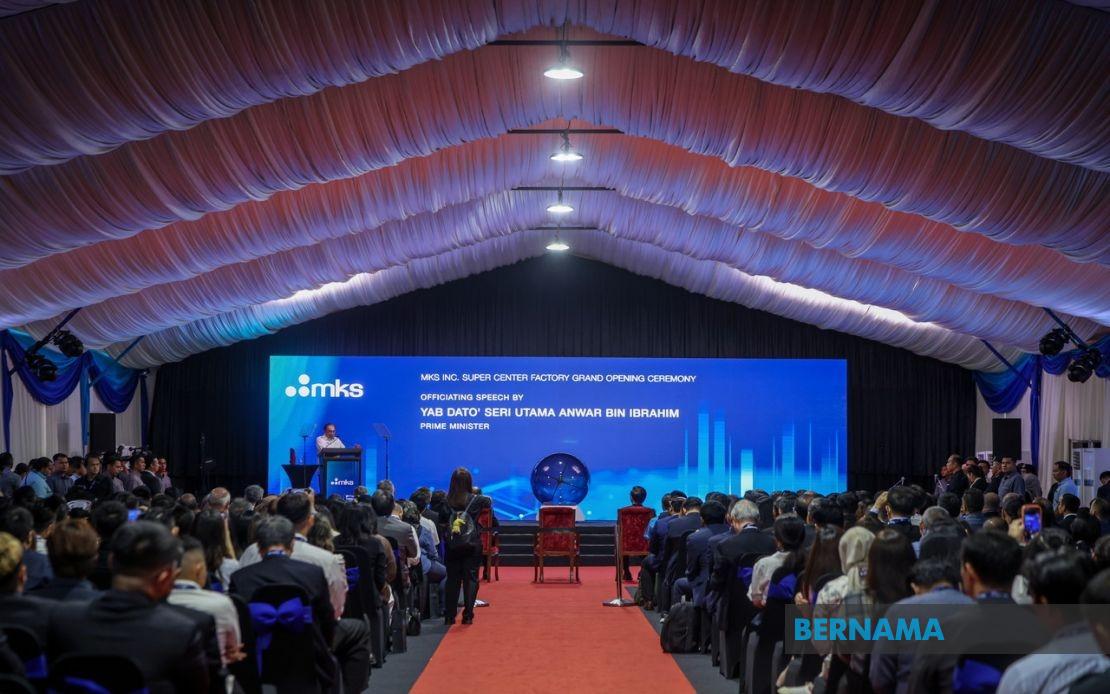
Prime Minister Datuk Seri Anwar Ibrahim has underscored Malaysia's capacity to leverage its position as an independent player in international affairs, arguing that the nation's commitment to engaging nations across competing geopolitical spheres has translated into tangible commercial gains and bolstered global confidence in Malaysian institutions and governance. Speaking at an industrial facility opening in Penang, he outlined how this diplomatic approach has enabled the country to deepen partnerships with diverse trading partners while preserving its strategic autonomy—a posture increasingly valuable as global powers vie for influence in Southeast Asia.
The Prime Minister's remarks reflect a deliberate policy framework that rejects alignment with any single geopolitical bloc. Instead, Malaysia pursues what might be characterised as principled pragmatism: engaging constructively with the United States, China, India, Russia, and other significant actors simultaneously, without compromising core national interests or surrendering foreign policy independence. This balancing act, Anwar suggested, has proven more profitable than choosing sides in contemporary great-power competition, allowing Malaysian entities to access opportunities that exclusive alignment might otherwise foreclose.
Concrete evidence of this strategy's efficacy emerged in Petronas's recent commercial agreement with Turkmenistan, a transaction Anwar cited as emblematic of how neutrality translates into economic advantage. The state-owned energy giant's capacity to negotiate such deals reflects the trust that partners across different regions place in Malaysia as a reliable, non-aligned interlocutor. For Southeast Asian readers, this signals that Malaysia's refusal to take rigid positions in disputes involving major powers—whether Sino-American tensions, Russian-Western friction, or Indo-Pacific rivalries—positions domestic enterprises favourably when competing for contracts and partnerships globally.
The diplomatic record supporting this narrative is substantial. Recent high-level visits have included engagement with United States President Donald Trump, who visited Malaysia last year, followed by separate diplomatic engagements with China and India. These interactions, occurring within a relatively compressed timeframe, underscore Malaysia's active pursuit of relationships across ideological and strategic divides. Such accessibility to multiple power centres grants Malaysian policymakers informational advantages and negotiating leverage unavailable to countries perceived as locked into bloc politics.
For multinational corporations and foreign investors considering Southeast Asian bases, Malaysia's positioning offers particular appeal. The nation's reputation as a stable, non-aligned actor with access to multiple economic blocs reduces perceived political risk compared to countries viewed as proxy battlegrounds for great-power competition. This comparative advantage becomes increasingly significant as supply chains reorganise away from conflict zones and as multinational enterprises seek to diversify geographic exposure.
Anwar's articulation of Malaysia's approach emphasised that independence does not imply silence or passivity on global issues. Rather, the government expresses principled positions on contested matters affecting international stability while simultaneously welcoming engagement from all quarters. This formula allows Malaysia to maintain moral credibility and diplomatic voice without sacrificing pragmatic relationships with any particular power. The distinction proves crucial for a nation whose economic prosperity depends on maintaining open channels with diverse partners.
Penang's significance as a venue for these remarks merits attention. The state has emerged as a critical node in Malaysia's manufacturing and technology infrastructure, hosting facilities like the MKS Super Centre where Anwar made his comments. Penang Chief Minister Chow Kon Yeow's presence alongside the Prime Minister highlighted how regional governments are integral to executing national economic strategy. The state's competitive advantages—modern industrial parks, skilled workforce, strategic port facilities—depend partly on the security and openness that Malaysia's international positioning provides.
The industrial opening itself—attended by Deputy Minister of Investment, Trade and Industry Sim Tze Tzin and MKS president John T.C. Lee—represented tangible outcomes of the policy framework Anwar described. Manufacturing facilities like MKS generate employment, technology transfer, and export revenues, benefits that flow partly from Malaysia's reputation as an attractive destination relatively insulated from geopolitical instability. Foreign manufacturers choosing to locate production in Penang rather than competitor nations do so partly because they perceive Malaysia as unlikely to become collateral damage in great-power conflicts.
The strategic calculus underlying Malaysian neutrality reflects both geographic position and economic structure. Sitting astride crucial shipping lanes and proximate to multiple major economies, Malaysia cannot afford antagonism from any significant power. Simultaneously, the nation's trade-dependent economy requires access to markets and capital across political divides. Strict non-alignment, therefore, constitutes not idealistic principle but rational statecraft grounded in material interests.
For investors and trade partners, Malaysia's approach offers predictability absent in countries subject to sanctions, secondary boycotts, or sudden diplomatic ruptures tied to bloc politics. A neutral Malaysia remains accessible to American technology firms, Chinese manufacturers, Indian conglomerates, and Russian energy companies simultaneously—an advantage competitors in more explicitly aligned regions cannot replicate.
The Prime Minister's framing also addresses domestic audiences, particularly in an era when neutrality faces pressure from those advocating closer alignment with specific powers. By demonstrating economic dividends from independence—through examples like Petronas deals and industrial expansion—Anwar builds political support for continued non-aligned foreign policy despite external pressure. This proves significant in Malaysian domestic politics, where segments advocate closer ties to Islamic nations, Western democracies, or Asian powers.
Moving forward, Malaysia's capacity to maintain this balancing act will determine whether the nation can sustain its current economic trajectory. Regional rivalry intensifies as major powers extend influence into Southeast Asia through infrastructure investment, technology transfer, and security partnerships. Smaller nations face temptation to defect toward stronger partners, abandoning neutrality for guaranteed support. That Malaysia continues articulating and defending non-alignment suggests confidence that the strategy's economic benefits—access to diverse markets and capital—outweigh security assurances that bloc alignment might theoretically provide.
For Malaysia's neighbours and the broader Southeast Asian region, the Prime Minister's statements carry implications extending beyond national borders. If non-alignment generates prosperity, other regional nations may attempt similar strategies, potentially consolidating Southeast Asia's collective non-aligned positioning in emerging great-power competition. Conversely, if Malaysia proves unable to maintain neutrality amid intensifying pressure, regional consensus on non-alignment might fracture, altering the geopolitical landscape that has enabled Southeast Asia's economic dynamism.

%22%2F%3E%3C%2Fpattern%3E%3C%2Fdefs%3E%3Crect%20width%3D%22100%25%22%20height%3D%22100%25%22%20fill%3D%22url(%23ph2hy9vg)%22%2F%3E%3Crect%20width%3D%22100%25%22%20height%3D%22100%25%22%20fill%3D%22url(%23ph2hy9vp)%22%2F%3E%3Ctext%20x%3D%2250%25%22%20y%3D%2250%25%22%20text-anchor%3D%22middle%22%20dominant-baseline%3D%22central%22%20fill%3D%22rgba(255%2C255%2C255%2C0.95)%22%20font-family%3D%22Georgia%2C%20'Times%20New%20Roman'%2C%20serif%22%20font-weight%3D%22700%22%20font-size%3D%22272%22%20letter-spacing%3D%22-0.02em%22%3EAnwar%3C%2Ftext%3E%3C%2Fsvg%3E)