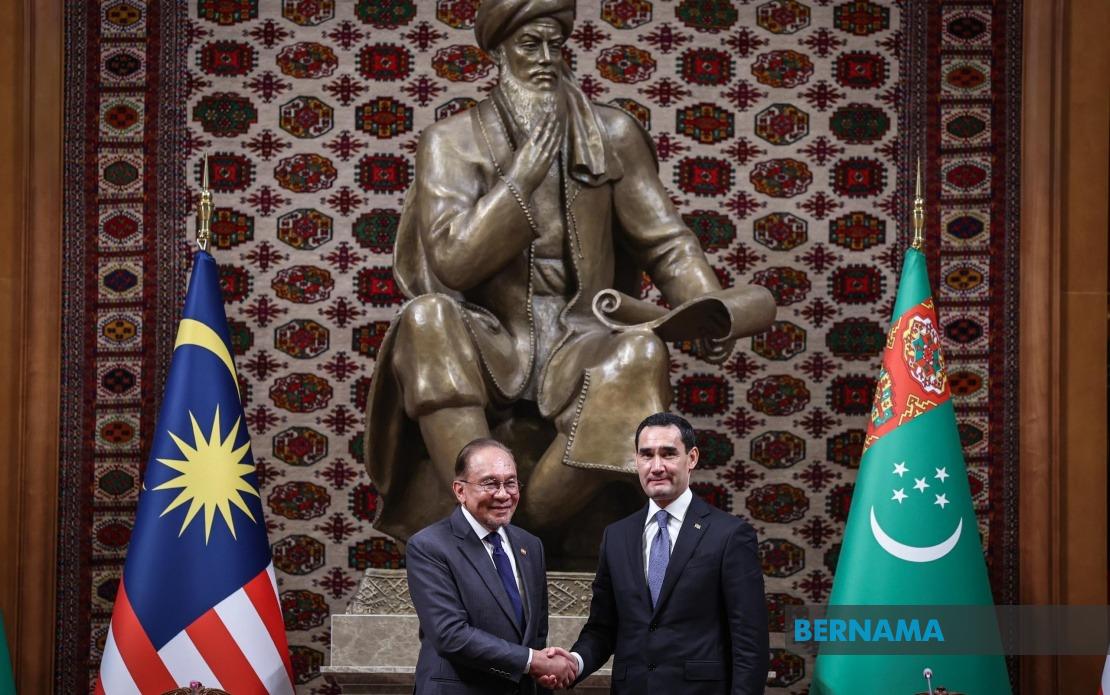
Prime Minister Datuk Seri Anwar Ibrahim and Turkmenistan President Serdar Berdimuhamedov have committed their nations to a more methodical and forward-thinking partnership anchored in mutual interests and long-term national benefit. The declaration emerged from their bilateral discussions at the Presidential Palace in Ashgabat on Friday, where both leaders underscored their intention to build a relationship grounded in trust and transparency. This overture marks a significant diplomatic moment for Malaysia in Central Asia, opening fresh channels for economic and institutional cooperation across multiple sectors vital to both economies.
The substantive nature of this partnership was codified through the simultaneous exchange of four formal instruments between the two governments. An Air Services Agreement now forms the foundation for enhanced aviation connectivity, potentially reducing travel barriers and facilitating people-to-people exchanges. Complementing this infrastructure accord were three separate memoranda of understanding addressing institutional collaboration. The Ministry of Transport linkage with Turkmenistan's State Service creates a framework for transportation sector cooperation, while the pairing between Malaysia's Institute of Diplomacy and Foreign Relations and Turkmenistan's Institute of International Relations promises deeper diplomatic and analytical engagement. The fourth MoU, binding the Academy of Sciences Malaysia with its Turkmenistan counterpart, positions both nations to collaborate on research initiatives and scientific advancement.
Anwar emphasised during the joint press conference that both capitals had established rigorous mechanisms to ensure implementation accountability. The emphasis on discipline, transparency and effectiveness signals recognition that bilateral agreements require robust institutional frameworks to deliver tangible outcomes. This procedural commitment reflects lessons learned from previous partnerships where aspirational declarations failed to translate into concrete results. By insisting on structured implementation protocols, Malaysia and Turkmenistan are signalling serious intent to move beyond ceremonial diplomacy into substantive collaboration.
The breadth of sectors identified for cooperation reveals both nations' recognition of complementary strengths and mutual needs. Energy emerged as a prominent focus area, reflecting Turkmenistan's substantial hydrocarbon reserves and Malaysia's ongoing requirements for diversified energy sourcing and technology exchange. The emphasis on trade and investment opens pathways for Malaysian businesses to access Central Asian markets while attracting Turkmen capital into Southeast Asian ventures. The halal industry designation carries particular significance for Malaysia, whose certification standards and expertise position it as a credible partner for Turkmenistan's growing halal sector development within the broader Muslim world.
Islamic banking and financial services represent another dimension of this partnership with regional implications. Malaysia's status as a global leader in Islamic finance and Shariah-compliant banking infrastructure offers Turkmenistan a proven model for developing its own Islamic financial ecosystem. This cooperation extends beyond mere technical exchange, reflecting deeper alignment between the two nations on Islamic economic principles and modern financial integration. Such collaboration could position Malaysia as the preferred partner for Turkmenistan's financial sector modernisation while creating new opportunities for Malaysian banks and fintech companies in Central Asian markets.
Educational and scientific partnerships warrant particular attention for their long-term multiplier effects. By establishing formal channels between respective academies of sciences and encouraging educational exchanges, Malaysia and Turkmenistan are investing in human capital development that transcends immediate economic transactions. Malaysian universities could attract Turkmen scholars while positioning themselves as premier destinations for Central Asian students seeking higher education. Simultaneously, research collaborations between scientific institutions can yield innovations applicable to both regions' developmental challenges, from agricultural efficiency to resource management.
Tourism and air connectivity constitute the final pillar of this partnership architecture. The Air Services Agreement directly enables tourism growth by reducing operational costs for airlines and facilitating passenger movement. For Malaysia, enhanced connectivity to Turkmenistan opens opportunities to position Southeast Asian tourism as an integrated regional offering. Conversely, promoting Turkmenistan's natural attractions and cultural heritage to Malaysian travellers can foster economic activity in Central Asia while deepening people-to-people familiarity.
Anwar's delegation composition underscored the economic substance of this visit. The presence of Datuk Seri Johari Abdul Ghani as Minister of Investment, Trade and Industry and Akmal Nasrullah Mohd Nasir as Minister of Economy signalled that commercial dimensions commanded equal attention to diplomatic protocol. This configuration suggests Malaysia approaches the Turkmenistan partnership not as peripheral engagement but as a strategic economic initiative with measurable business potential.
The timing of this visit carries regional significance. As Malaysia seeks to diversify its international partnerships and strengthen ties beyond its immediate Southeast Asian neighbourhood, Central Asia represents an underutilised sphere for engagement. Turkmenistan's geographic position at the intersection of European and Asian markets makes it a potential gateway for Malaysian enterprises seeking to extend their reach into broader Eurasian networks. Similarly, Turkmen businesses gain access to Southeast Asian distribution channels and integration into ASEAN's economic ecosystem through Malaysian partnerships.
From a geopolitical perspective, strengthened Malaysia-Turkmenistan relations contribute to a more multipolar international order. Both nations maintain principled foreign policies emphasising non-alignment and balanced engagement across different power blocs. Deepening bilateral ties reinforces this positioning while demonstrating Malaysia's capacity to build meaningful relationships across diverse regions and cultural contexts. For Turkmenistan, Malaysian partnership offers a bridge to Southeast Asia and the Indo-Pacific region, counterbalancing excessive dependence on Russian or Chinese patronage.
The joint statement signed during this visit establishes a political foundation upon which subsequent economic and institutional cooperation can solidify. Joint statements in diplomatic practice typically commit signatories to implementing the agreed framework and conducting regular consultations to assess progress. This mechanism ensures the bilateral relationship maintains momentum beyond the initial announcements, with scheduled reviews providing opportunities to expand cooperation into emerging sectors and address implementation challenges.
Looking forward, the success of this partnership hinges on follow-through capacity by both governments. The elaborate institutional architecture established through these MoUs requires dedicated personnel, budget allocation, and political commitment at working levels. Malaysian enterprises must proactively engage Turkmen counterparts to commercialise opportunities in halal certification, Islamic finance, and technology transfer. Similarly, Turkmen officials must facilitate Malaysian investments and educational partnerships, ensuring bureaucratic processes support rather than obstruct bilateral objectives.
Anwar's inaugural official visit to Turkmenistan since assuming office in November 2022 demonstrates Malaysia's expanding diplomatic horizons under his leadership. This partnership with a Central Asian nation of approximately 6 million people may seem modest in scale, yet it exemplifies Malaysia's strategy to cultivate relationships in strategically important regions often overlooked by Southeast Asian capitals. As global supply chains reshape and new trade corridors emerge, nations positioned at crossroads of commerce and culture gain disproportionate advantage. Malaysia's engagement in Turkmenistan positioning itself precisely at such advantageous intersections.

%22%2F%3E%3C%2Fpattern%3E%3C%2Fdefs%3E%3Crect%20width%3D%22100%25%22%20height%3D%22100%25%22%20fill%3D%22url(%23ph2hy9vg)%22%2F%3E%3Crect%20width%3D%22100%25%22%20height%3D%22100%25%22%20fill%3D%22url(%23ph2hy9vp)%22%2F%3E%3Ctext%20x%3D%2250%25%22%20y%3D%2250%25%22%20text-anchor%3D%22middle%22%20dominant-baseline%3D%22central%22%20fill%3D%22rgba(255%2C255%2C255%2C0.95)%22%20font-family%3D%22Georgia%2C%20'Times%20New%20Roman'%2C%20serif%22%20font-weight%3D%22700%22%20font-size%3D%22272%22%20letter-spacing%3D%22-0.02em%22%3EAnwar%3C%2Ftext%3E%3C%2Fsvg%3E)