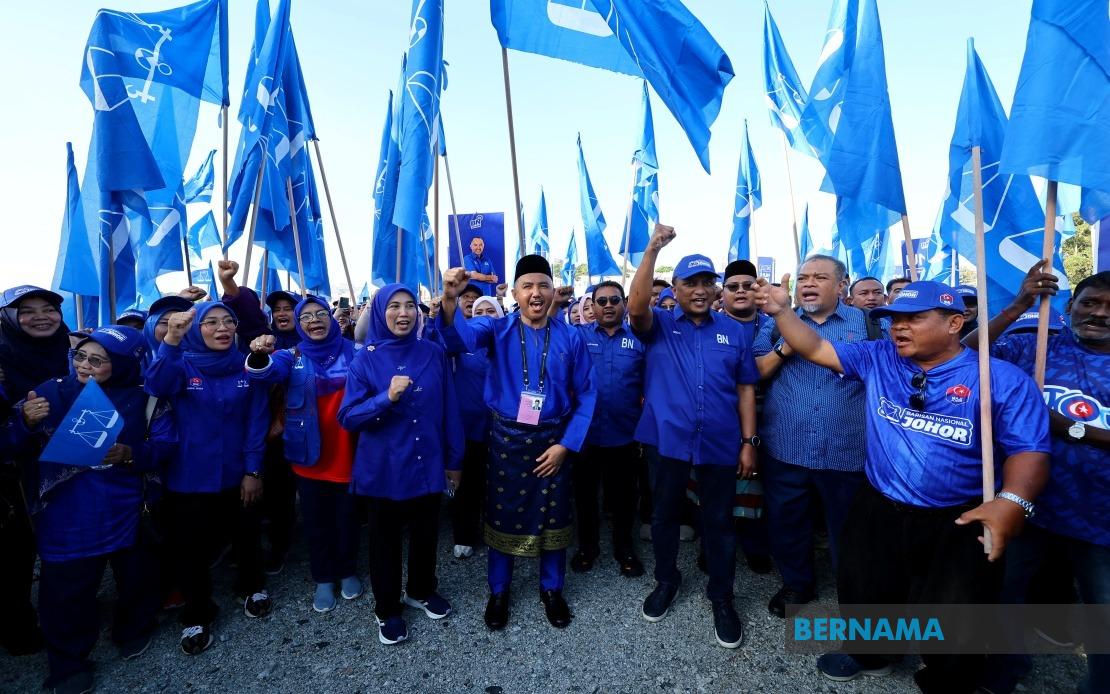
The candidate nomination phase for Johor's 16th state election concluded this morning when all 56 nomination centres statewide shut their doors at 10am on June 27, marking a pivotal moment in the electoral calendar. The one-hour window for submitting nomination documents began at 9am and proceeded without major disruptions, with returning officers formally announcing the closure at each venue as the deadline passed. This orderly conclusion allows the focus to now shift to the Election Commission's publication of the official roster of qualified candidates and the distribution of contestants across the state's electoral seats.
The nomination exercise proceeded under conditions of heightened security and close oversight. Police and members of the People's Volunteer Corps maintained a visible presence throughout the day, ensuring the process remained peaceful and incident-free. At numerous centres, party supporters and campaign teams accompanied their nominated candidates, creating animated scenes typical of electoral gatherings in Malaysia, yet the overall atmosphere remained disciplined and free from confrontation. This peaceful transition reflects growing maturity in how Malaysia's states conduct electoral administration.
With nominations now finalised, the 16th Johor State Election advances to its next critical phase. The Election Commission has established a 14-day campaign window that will commence immediately and extend until 11.59pm on July 10, providing political parties with a defined period to canvas voters and present their platforms. The compressed timeframe means candidates and their machinery must move swiftly to build momentum, organising grassroots engagement and media activities within the designated window before voters head to the polls.
Election day itself has been set for July 11, with the commission also scheduling early voting for July 7 to accommodate voters who cannot cast ballots on the main day. This two-phase voting arrangement reflects standard practice in Malaysian state elections and aims to maximise participation among the eligible electorate. The provision of early voting is particularly significant for military and police personnel whose service commitments may coincide with polling day.
The electoral roll for this election encompasses a substantial constituency. A total of 2,727,926 voters are entitled to participate, comprising 2,703,175 ordinary voters who form the backbone of the electoral base, complemented by 12,041 military personnel and their spouses and 12,710 police personnel and their spouses. This voter composition underscores how state elections in Malaysia extend beyond civilian participation, incorporating security force personnel whose contributions to the nation warrant electoral representation. The diverse make-up of the electorate reflects Johor's character as Malaysia's most southerly state, encompassing urban, semi-rural, and military communities.
Johor's electoral significance within Malaysia's political landscape cannot be overstated. As the country's second-largest state by population and a powerhouse of economic activity, the 16th state election carries implications extending beyond the state's borders. The results will influence the broader political narrative across Southeast Asia's largest economy and may reverberate through regional and federal considerations. Political strategists and observers throughout Malaysia will closely monitor voting patterns and outcomes to gauge shifts in voter sentiment on critical governance and development issues.
The 56 nomination centres distributed across the state represent an extensive administrative apparatus designed to ensure accessibility for candidates and their supporters. This network, efficiently coordinated by the Election Commission, facilitated a smooth submission process across Johor's diverse geography, from urban Johor Bahru to more distant constituencies. The logistics of managing such a distributed system while maintaining consistency in procedures and timelines demonstrates the organisational capability of Malaysian electoral administration at the state level.
The period ahead until July 11 will witness intense political activity as parties mobilise resources and messaging to compete for seats. Johor's voters will evaluate competing visions for state development, economic opportunity, and social welfare. Issues likely to feature prominently include economic resilience, infrastructure development, healthcare and education provision, and governance quality. The campaign period affords candidates opportunities to differentiate themselves and articulate distinct positions on these matters.
For Malaysian observers and Southeast Asian analysts watching Johor's electoral process unfold, the exercise demonstrates the region's commitment to democratic procedures and institutional continuity. The orderly execution of nomination procedures, despite Malaysia's sometimes contentious political environment, reflects institutional maturity and respect for electoral norms among competing political actors. The Election Commission's management of the process, combined with security force professionalism and the discipline displayed by party machinery, underlines how democratic competition in Malaysia occurs within established procedural frameworks that command widespread acceptance.
Looking forward, the 14-day campaign period will test the persuasive capacity and organisational stamina of all participating parties and candidates. Voters will ultimately determine the outcome on July 11, concluding an election cycle that began with the nomination process now concluded. The path forward from June 27 sees Johor's political actors and voters engaged in the democratic exercise, with implications reaching across state boundaries and contributing to Malaysia's ongoing democratic narrative.

