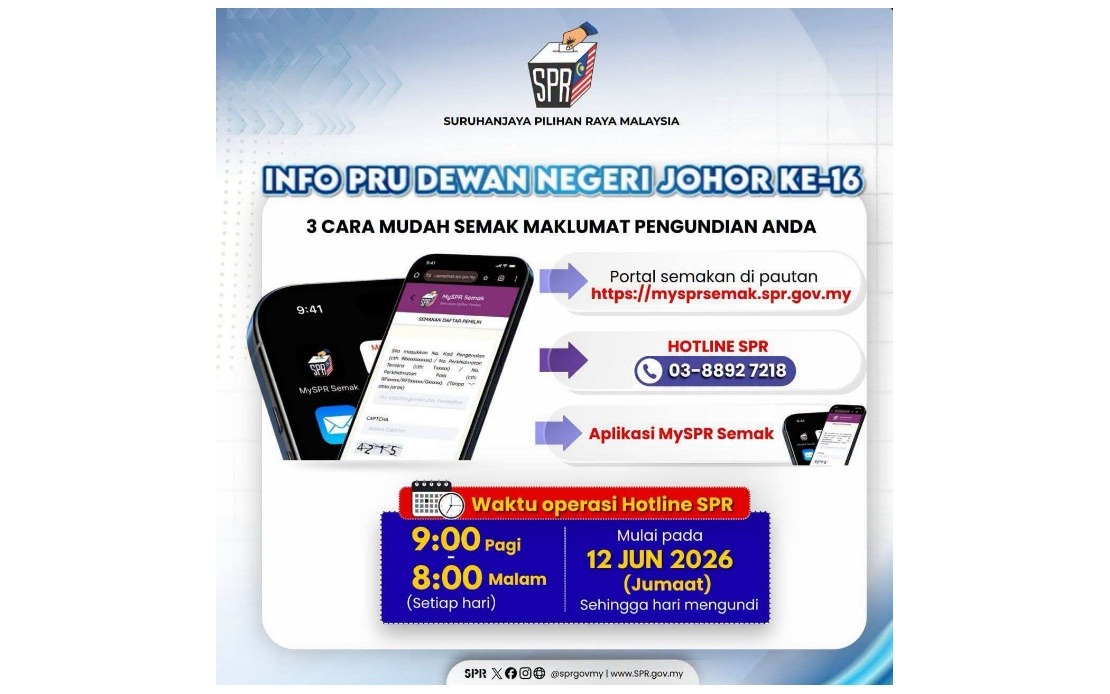
The Election Commission has issued a timely reminder to the 2.7 million registered voters across Johor to familiarise themselves with their designated polling locations ahead of the 16th state election scheduled for this Saturday, July 11. Eligible voters can cross-check their polling stations and voting information through two convenient digital channels: the MySPR Semak online portal or the MySPR Semak mobile application, allowing citizens to verify their details at their own pace in the days remaining before the election.
This advisory comes as part of the electoral body's broader voter engagement strategy to ensure a smooth and well-organised election process. By encouraging voters to undertake these verification steps in advance, the Election Commission aims to minimise confusion and delays on polling day itself, thereby facilitating efficient voting procedures across all participating constituencies. The commission's emphasis on civic responsibility reflects its commitment to encouraging maximum participation in the democratic exercise.
The scale of Saturday's election underscores the significant representation at stake. A total of 56 state assembly seats will be contested, with nearly 2.7 million ordinary voters expected to cast their ballots to determine which parties will form the next state government in this economically significant region. Early voting has already taken place, with 19,471 personnel from the security forces exercising their franchise on the previous Tuesday, including 7,960 military personnel and their spouses alongside 11,511 police personnel drawn from regular forces and the General Operations Force, along with their families.
The election features a notably diverse range of competing parties and candidates, reflecting Malaysia's vibrant multi-party political landscape. A total of 172 candidates are contesting the 56 seats, demonstrating substantial competition across constituencies. The two major coalition blocs—Pakatan Harapan and Barisan Nasional—have each fielded 56 candidates to contest every seat, reflecting their ambitions to govern the state. Perikatan Nasional has put forward 33 candidates, while emerging players including Parti Bersama Malaysia with 15 candidates and the youth-oriented MUDA with four candidates have also mounted campaigns.
Beyond these larger entities, the electoral contest includes candidates representing smaller parties with distinct political philosophies and constituencies. Parti Orang Asli Malaysia, representing indigenous community interests, and Parti Sosialis Malaysia, championing left-wing ideologies, are also participating in the contest. Additionally, six independent candidates are running without party affiliation, providing voters with alternative options outside formal party structures. This breadth of choice reflects the democratic principle of equal opportunity for diverse political voices.
The logistics of accommodating such a large electorate across 56 constituencies demands meticulous planning and organisation by the Election Commission. Voters navigating their way to correct polling stations is fundamental to the operational success of the election day. The commission's proactive messaging encourages citizens not merely to show up on Saturday, but to arrive prepared and informed about their specific voting locations and procedures, thereby reducing potential congestion and administrative bottlenecks.
For Malaysian voters, particularly those in Johor, utilising the MySPR Semak tools represents more than administrative convenience—it embodies the integration of digital technology into electoral processes to enhance accessibility and transparency. These platforms allow voters from any location with internet connectivity to access their electoral information instantaneously, eliminating the need for physical visits to government offices and accommodating the digital-first expectations of modern electorates. This technological approach particularly benefits working voters and those with mobility constraints.
The Election Commission's call for voters to fulfil their responsibilities carries broader significance in the context of Malaysia's political trajectory. State elections serve as important barometers of public sentiment and provide opportunities for voters to shape regional governance directly. The Johor election, occurring in a state that historically plays a pivotal role in Malaysian politics, will likely influence national political dynamics and coalition politics. Strong voter participation validates the election's outcome and enhances the legitimacy of the resulting state government.
Voters should note that verifying polling information well in advance allows time to address any discrepancies or issues with their voter registration status. Those discovering errors in their details can contact the Election Commission's offices during business hours to rectify problems before Saturday. This proactive approach prevents last-minute complications that might prevent eligible citizens from voting, thereby maximising inclusive participation across all demographic groups and constituencies throughout the state.

