When France and Morocco take the pitch in Boston on Thursday for a World Cup quarter-final, they will carry far more than tactical ambitions. The two nations share a complex historical relationship dating back to Morocco's status as a French protectorate from 1912 until independence in 1956, a legacy that continues to shape migration patterns, economic ties and cultural exchange across the Mediterranean. That history has found its fullest expression in football, where the sport has become a mirror reflecting the intricate bonds between populations separated by geography but connected by generations of movement and settlement.
The Moroccan squad itself embodies these overlapping identities. Six players were born on French soil, while numerous others developed through French academies or played in Ligue 1 before electing to represent Morocco. This pattern reveals Morocco's strategic approach to player recruitment, transforming its European diaspora into a competitive asset rather than accepting it as a loss of talent. The strategy has proven remarkably effective, allowing Morocco to field a squad that combines the technical sophistication gained through European development systems with the hunger and unity of a national project. Ayyoub Bouaddi exemplifies this trajectory perfectly: born in France, trained at Lille, capped at French youth level, yet choosing to represent Morocco at senior level.
The relationship between Kylian Mbappe and Achraf Hakimi, forged during their partnership at Paris St Germain, adds another dimension to this fixture. These are not merely competing nations but football communities shaped by shared experiences in the same clubs and cities. The personal friendships that develop in European football create genuine bonds that transcend national rivalry, a reality that often goes unexamined in coverage that emphasizes conflict over connection.
When Morocco and France last met in Qatar in 2022, France emerged victorious with a 2-0 scoreline. Yet that encounter, despite its competitive nature, carried striking undertones of mutual recognition. Morocco's journey to the semi-finals had captivated global audiences and demonstrated African football's growing sophistication at the tournament's highest level. France's multicultural squad, assembled from generations of migration and integration, stood as living proof of the currents that have shaped modern French identity. The rematch carries different weight now, with Morocco arriving not as plucky underdog but as a side with genuine credentials to challenge established powers.
Boston as a venue presents an intriguing contrast to the security-heavy atmosphere surrounding such fixtures in France. While the Moroccan community in the wider Boston metropolitan area is smaller and less politically prominent than in French cities, it has developed into an established network of families, professionals and businesses. This translates into a fundamentally different social context for the match. Mohammed Saadi, a 57-year-old taxi driver, described the likely scenario bluntly: neighbours and friends will watch together across ethnic and national lines, shaking hands afterwards regardless of outcome. The notion of the fixture dividing Boston cleanly into hostile camps fundamentally misreads the community dynamics at play.
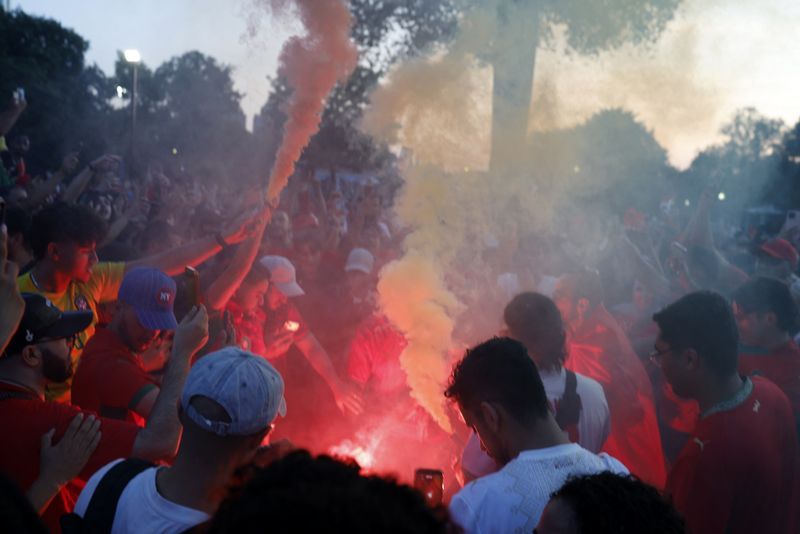
Evidence of this sentiment emerged in gatherings around Boston Common, where over a thousand supporters assembled peacefully, singing Dima l-Maghrib and waving flags in celebration rather than confrontation. Youssef Bennani, a 36-year-old software engineer who travelled from Finland to follow Morocco's entire campaign, described the Boston setting as optimal for supporters seeking to experience the tournament's communal rather than divisive dimensions. His observation that he encountered both Moroccan and French supporters in an atmosphere approaching celebration rather than tension speaks to how geography and community composition reshape the emotional contours of international football.
Morocco's trajectory through this tournament has fundamentally altered the nature of this fixture compared to their 2022 encounter. They arrive in Boston no longer as the compelling underdog narrative but as a side with the organisational depth, player development infrastructure and tactical discipline to genuinely trouble France. Their federation has executed a deliberate strategy connecting domestic youth development with European-based talent, creating a pipeline that transforms diaspora players into national assets. This approach has yielded tangible results: Morocco's methodical 3-0 dismantling of Canada demonstrated the pace, organisation and ambition that carried them back to the quarter-finals after achieving African football's first semi-final appearance just four years earlier.
France, as defending world champions from 2018, carry expectations befitting their status as one of football's established powers. They possess the tournament experience and attacking talent required to pursue another World Cup. Yet their path to the quarter-finals, which included victory over Paraguay, has left room for vulnerabilities to exploit. Morocco's ability to suffocate opposition through disciplined defensive structures while operating with dangerous pace in transition represents precisely the type of challenge that has previously troubled French teams. The attacking potency France has demonstrated throughout Qatar remains formidable, but Morocco has shown the capacity to contain even the tournament's most threatening offences.
What makes this fixture distinctive extends beyond tactical consideration. The personal connections between players, the shared developmental experiences in European football, and the family ties that bind French and Moroccan communities create a social context where the outcome matters intensely but does not demand bitter enmity. In Boston, where Moroccan and French residents live alongside one another without the historical tensions that characterise some European cities, this reality finds clearer expression. The match will be competitive and emotionally significant, yet the Boston setting permits a celebration of football's capacity to connect rather than exclusively divide.

