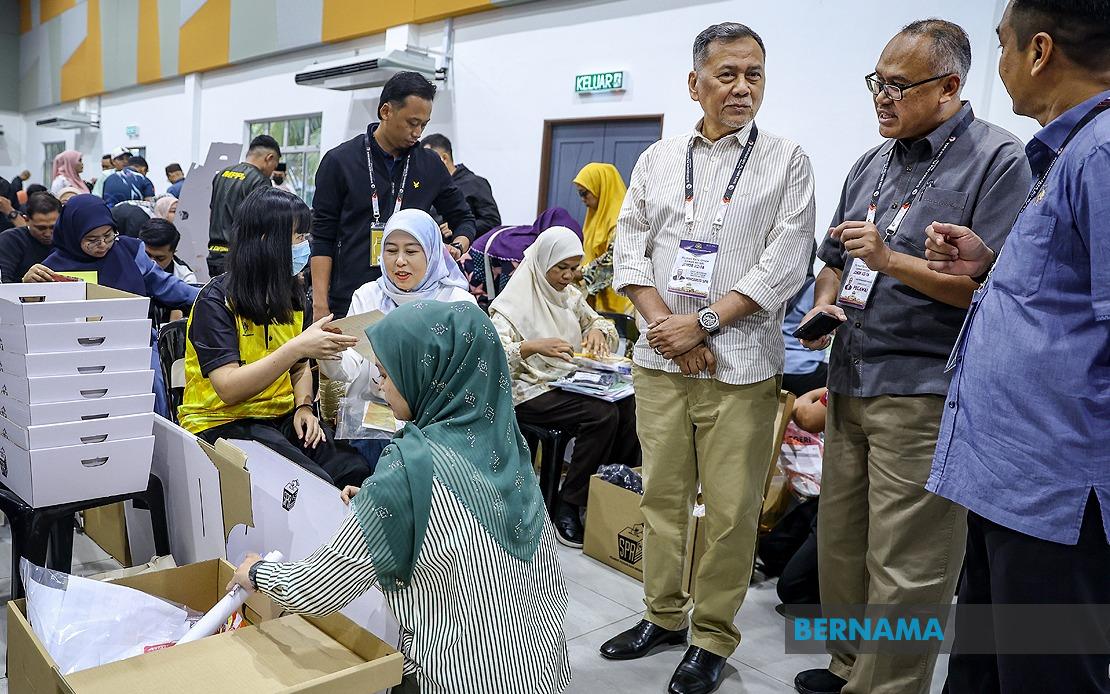
The Election Commission has put the final touches on arrangements across Johor, with personnel at polling centres and vote-tallying facilities working through yesterday to ensure the 16th Johor State Election proceeds without disruption when polls open tomorrow. The undertaking involves coordinating logistics across a sprawling state to accommodate 2.7 million registered voters, a responsibility that Election Commission Chairman Datuk Seri Ramlan Harun characterised as central to upholding the integrity of Malaysia's democratic process.
Verification procedures for ballot boxes and election equipment across all 56 state constituencies have now been finalised, according to the EC chief, who stressed that such inspections rank among the most crucial safeguards for a trouble-free polling day. Datuk Seri Ramlan noted that Returning Officers stationed at the 56 constituency centres have largely wrapped up their preparatory duties, positioning the commission to handle the large voter turnout expected. The comprehensive pre-election audit reflects the EC's systematic approach to managing a state-level election of significant political importance, particularly given heightened interest from voters and the multiple political coalitions contesting seats.
On-the-ground observations from polling centres reveal meticulous preparation work underway. At Sekolah Kebangsaan Bukit Mutiara in Johor Bahru, commission staff were engaged in labelling election materials, arranging furniture, and placing directional signage to guide voters through the polling process. The Puteri Wangsa constituency polling centre typifies the scale of coordination required, with 12 classrooms being converted into separate polling streams serviced by 74 commission personnel and 12 police officers providing security. Such decentralisation into multiple streams aims to minimise queuing times and ensure voters can cast ballots efficiently during their designated time windows.
Accessibility considerations have featured prominently in the commission's planning. The EC has provisioned wheelchairs and dedicated facilities to accommodate senior citizens and persons with disabilities, reflecting a commitment to inclusive voting that extends beyond merely opening polling doors to all. At the Kluang polling centre in the Mahkota constituency, 30 personnel are preparing five separate voting streams designed to process approximately 3,000 voters smoothly. This granular approach to crowd management, replicated across multiple constituencies, demonstrates how the commission is attempting to translate logistical theory into practical voter convenience.
The complexity of Johor's electoral geography has introduced distinctive challenges for the commission. In Mersing, the Tenggaroh state constituency encompasses four islands—Pulau Aur, Pulau Pemanggil, Pulau Sibu, and Pulau Tinggi—requiring ballot boxes and election officials to be transported via the Mersing Jetty under tight maritime security protocols. This operation involves approximately 50 commission personnel coordinated with the Marine Police Force and district police headquarters, underscoring how Malaysia's electoral administration must adapt to diverse geographical and security conditions. Such logistical complexity, though demanding, is necessary to uphold the principle that every registered voter—whether urban or island-based—can participate in elections.
The Election Commission chairman has appealed directly to voters to observe recommended time slots for casting ballots, urging citizens to bring identity documents and comply with the instructions of polling officials. These seemingly straightforward directives reflect accumulated experience with managing large voting populations; congestion at polling centres not only frustrates voters but can also introduce procedural risks if queuing becomes disorderly. The commission's explicit messaging on voter conduct suggests it is attempting to build cooperative participation rather than relying solely on enforcement.
The candidate field across Johor's 56 seats reflects the current Malaysian political landscape, with 172 contenders representing competing visions for the state's future. Pakatan Harapan and Barisan Nasional have fielded complete slates across all constituencies, indicating their positioning as the primary competing coalitions. Perikatan Nasional enters the contest with 33 candidates, while newer entrants such as Parti Bersama Malaysia, MUDA, and the Malaysian Orang Asli Party field smaller contingents. This diversity of political contestants, alongside independent candidates, means the commission must administer elections that accommodate meaningful choice across the ideological and programmatic spectrum.
For Malaysian observers and the broader Southeast Asian region, the Johor election carries significance beyond the state itself. As the country's most economically developed state and traditionally a barometer of national political trends, Johor's electoral outcome may offer signals about voter sentiment heading into future federal contests. The commission's ability to manage voting smoothly across such a large, geographically complex state also demonstrates Malaysia's institutional capacity for administering competitive elections in a middle-income democracy.
Chain-of-custody procedures and security measures appear to have received particular emphasis in these final preparations. The involvement of police forces, from Marine Police in Mersing to district headquarters elsewhere, indicates that the commission is treating election security as integral to credibility. For voters to trust election results, they must perceive the process as secure from interference and the handling of ballots and equipment as uncompromised. Such security arrangements, while occasionally appearing heavy-handed, address legitimate concerns about protecting democratic processes from manipulation.
The sheer logistical undertaking of Johor's state election—coordinating thousands of personnel, securing ballot materials, preparing polling stations across urban and island constituencies, and accommodating 2.7 million voters—underscores why democratic elections in complex societies require substantial institutional infrastructure. The Election Commission's final-stage preparations, visible at individual polling centres from Johor Bahru to Mersing, represent the culmination of weeks of planning and the dedication of electoral professionals committed to conducting legitimate polls despite inevitable administrative challenges.

