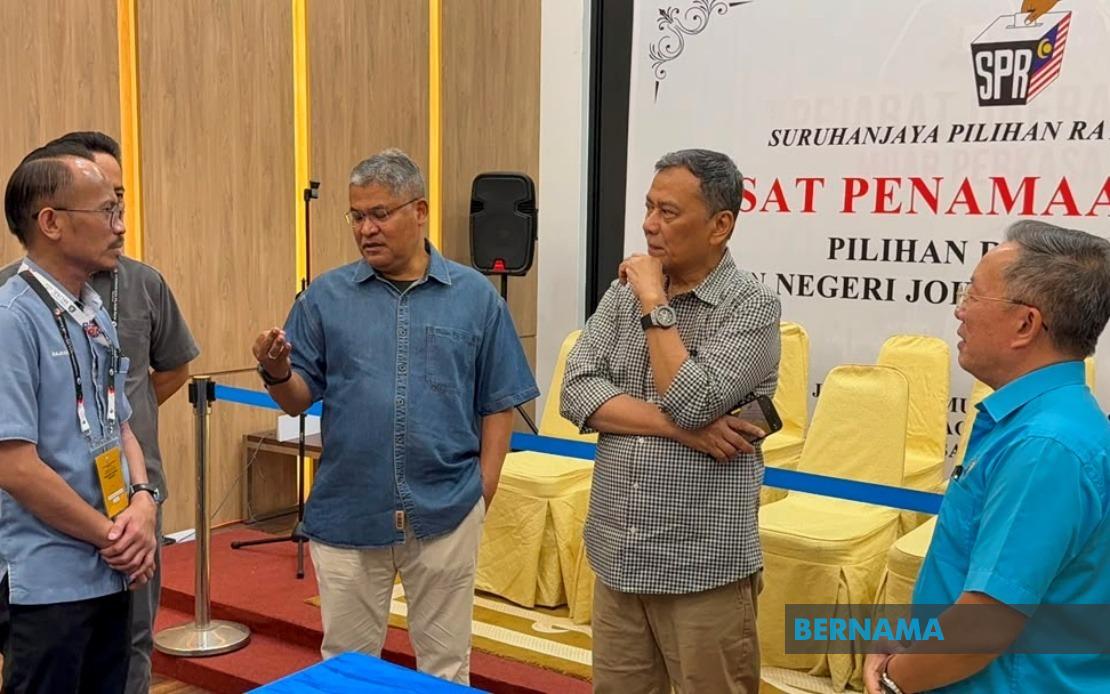
The Election Commission is putting final touches to its logistical framework ahead of tomorrow's nomination day for the Johor state election, a critical juncture that will determine which candidates can proceed to the July 11 polling day. Commission personnel have been conducting last-minute reviews at all candidate nomination centres throughout Johor Bahru, focusing on technical arrangements and coordination with supporting agencies to guarantee a seamless electoral process.
Inspections of multiple nomination centres reveal that organisers have largely completed infrastructure setup, with only finishing touches remaining on technical elements. The Perling state constituency centre, housed at Dewan Jubli Intan Hall, exemplifies the state of readiness across the state. Nazatul Shima Mohamad, the returning officer overseeing this location, expressed confidence that all stakeholders have demonstrated equal commitment to the nomination process, with both government agencies and political parties cooperating to meet the tight timeline.
Prospective candidates have been advised to arrive early on nomination day and come equipped with all necessary documentation, including their nomination deposits. The returning officer's emphasis on preparation reflects the Commission's desire to minimise delays and procedural complications that could frustrate candidates or their supporters. With nominations scheduled between 9 and 10 am tomorrow at all 56 designated centres, time management will be crucial to processing what could be a substantial number of applications across the state.
Security and crowd management represent significant operational challenges, particularly given the competitive nature of state elections and the emotional investment from party supporters. The Kota Iskandar centre, situated at the Iskandar Puteri City Council's main hall in Medini, has incorporated comprehensive security protocols developed in cooperation with local police authorities. These measures include strategic road closures near the nomination venue, a 50-metre restricted perimeter around the centre itself, temporary tent structures positioned outside the main hall to channel supporter movements, and physical barriers designed to maintain spatial separation between supporters of rival parties.
These precautions underscore the Election Commission's experience managing large public gatherings during high-stakes electoral moments. By physically isolating candidate supporters and managing crowd flow, the Commission aims to reduce friction between rival party members while maintaining public order. The restrictions, however, require public cooperation—the returning officer has specifically appealed to supporters to exercise restraint and avoid provocative behaviour that could escalate tensions at nomination centres.
The electoral statistics reveal the scale of this exercise. Nearly 2.73 million voters have registered to participate in the Johor state election, comprising 2.7 million ordinary voters alongside military and police personnel and their spouses. This substantial electorate necessitates not merely efficient nomination procedures tomorrow but also robust planning for early voting on July 7 and the main polling day on July 11. The Commission's decision to establish 56 nomination centres reflects an attempt to distribute demand and prevent bottlenecks at individual locations.
The dissolution of the Johor State Legislative Assembly on June 1 triggered this compressed election schedule, compressing what would normally be a more extended preparation period. The 10-day gap between nomination day and early voting represents a narrow window for candidates to campaign and for voters to familiarise themselves with their choices. This accelerated timeline intensifies pressure on the Election Commission to execute flawlessly tomorrow, since any irregularities could generate legal challenges or voter confusion during the formal voting period.
For Malaysian observers, the Johor election carries significance beyond the state itself. As a major component of the Malaysian federation, Johor's political direction influences broader coalitional calculations at the federal level. The state remains a crucial battleground for competing blocs, with implications for governmental stability and policy direction. An orderly nomination process tomorrow helps ensure that the subsequent campaign and voting proceed with legitimacy and public confidence.
The nomination day itself will reveal several important dynamics. The number of candidates seeking each seat will indicate the level of competition and which parties view which constituencies as genuinely contestable. Multiple candidates per seat generate more complex ballot designs and potentially reduce the vote share required to win, fundamentally altering tactical calculations. The Commission's infrastructure must accommodate whatever candidate configurations emerge from tomorrow's nominations.
The Election Commission has also sought to educate prospective voters about their role in the broader electoral process. Clear communication about voting arrangements, early voting opportunities, and polling procedures helps reduce confusion and encourages participation. For a state with Johor's demographic diversity—encompassing urban, suburban, and rural populations—effective information dissemination requires multiple channels and culturally sensitive messaging.
Looking ahead, the Commission's preparations tomorrow set the tone for the subsequent campaign and voting phases. Any logistical failures or perceived procedural irregularities could undermine public confidence in the election's fairness, potentially affecting voter turnout and acceptance of results. Conversely, a well-executed nomination day establishes momentum and demonstrates professional competence that carries through to polling day.
The Election Commission's confidence in its readiness reflects months of planning and coordination among multiple government and law enforcement agencies. Local police, council authorities, and Election Commission personnel have aligned their preparations to create an integrated operational framework. This inter-agency coordination, while routine for major elections, remains essential to success and demonstrates the institutional capacity that Malaysian electoral administration has developed over successive cycles of democratic contests.

