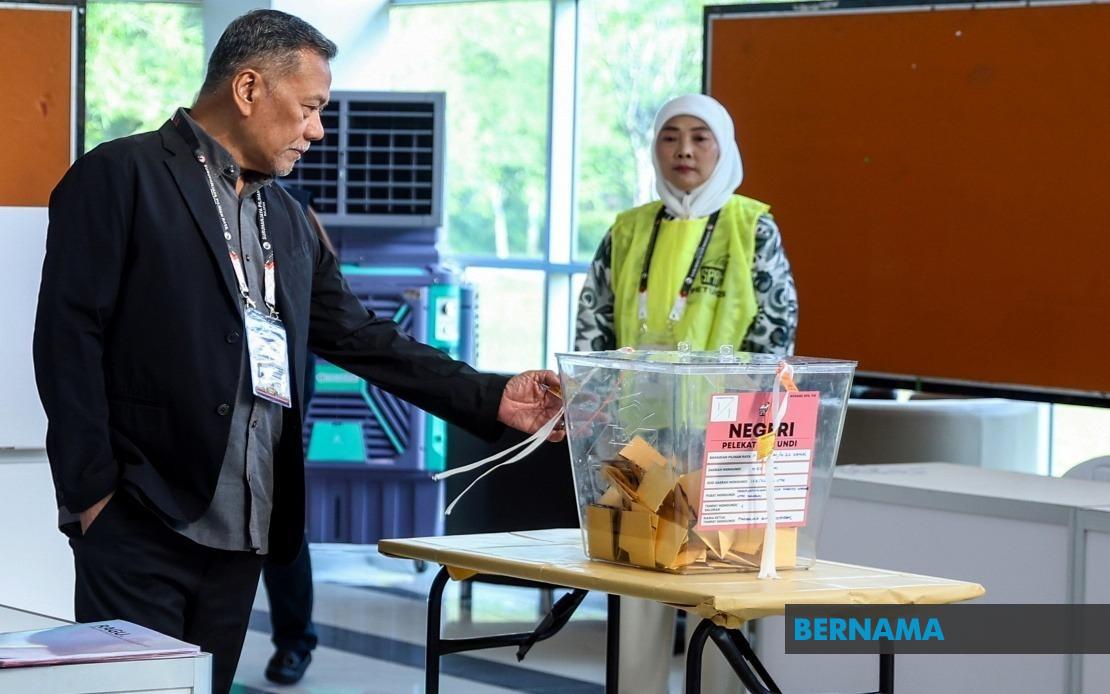
Election Commission chairman Datuk Seri Ramlan Harun visited four polling centres scattered across Johor on July 11 to oversee the conduct of the state election, underscoring the EC's commitment to maintaining electoral integrity during a closely watched political contest. The comprehensive inspection tour, which commenced at approximately 8.50 am, represented a hands-on approach to electoral supervision during polling day, with the chairman personally assessing voting conditions and administrative arrangements at each location.
Ramlan's first stop took him to the Dewan Raya Taman Ungku Tun Aminah in the Skudai constituency, where seven distinct polling streams had been established to manage voter flow. This location served as the opening point of the chairman's verification process, allowing him to assess the foundational procedures being implemented across the Johor ballot. The Skudai constituency, as one of Johor's significant political battlegrounds, represented an important benchmark for understanding the election's overall execution.
The EC chief subsequently travelled to the Raja Zarith Sofiah Library at Universiti Teknologi Malaysia in Senai constituency, which operated two polling streams. This campus-based venue presented particular logistical considerations, given the concentration of student voters and the need to manage both academic activities and electoral operations simultaneously. The UTM location also highlighted how polling infrastructure had been distributed across diverse environments, from institutional to community-based settings.
Continuing his inspection circuit, Ramlan visited Sekolah Agama Taman Bukit Mewah in the Kempas constituency, where six polling streams functioned to accommodate voter numbers. School-based polling centres remained a standard feature of Malaysian elections, balancing accessibility with security considerations. The Kempas location represented the midpoint of the chairman's tour, enabling assessments across different demographic catchments within the Johor electorate.
The inspection concluded at Sekolah Menengah Kebangsaan Bandar Uda Utama in the Perling constituency, the largest polling operation visited that morning with nine active streams. This final destination presented the most complex logistical scenario, requiring careful coordination of multiple voting queues and election personnel. The Perling centre's scale reflected how the EC had sought to balance efficiency with the procedural safeguards essential to democratic elections.
During each site visit, Ramlan engaged directly with election officials who provided detailed briefings on voting procedures being followed. These interactions allowed the chairman to verify that standardised protocols were being consistently applied across different constituencies and polling facilities. Beyond procedural oversight, the chairman also conducted physical inspections of the voter facilities and workstations provided for both polling officials and members of the public exercising their franchise.
The EC's emphasis on direct supervision reflected broader concerns about electoral credibility in Malaysia's competitive political landscape. Johor, as a state with significant historical voting importance and multiple contested constituencies, warranted heightened oversight to ensure public confidence in results. The chairman's personal involvement signalled that the commission took its custodian role seriously, particularly when electoral outcomes carried substantial implications for state-level governance.
The inspection framework encompassed multiple dimensions of electoral administration beyond merely counting votes. Facility standards, security protocols, crowd management, and voter accessibility all fell within the scope of the chairman's assessment. By visiting multiple locations across different constituencies, Ramlan obtained a cross-sectional view of how the 16th Johor state election was being administered in practice, rather than relying solely on administrative reports filtered through bureaucratic channels.
The geographical spread of the four polling centres—spanning Skudai, Senai, Kempas, and Perling—provided a representative sample of Johor's diverse electoral geography. This distribution allowed the EC chairman to assess voting procedures across urban and suburban environments, institutional and community facilities, and constituencies with varying demographic profiles. Such comprehensive coverage strengthened the commission's ability to identify and address any systemic issues before they potentially affected election outcomes or public perception.
Ramlan's tour reflected the EC's dual mandate: ensuring the mechanical efficiency of polling operations while simultaneously maintaining the democratic legitimacy that underpins Malaysian electoral systems. The visibility of such high-level oversight also served a public relations function, demonstrating to voters and political stakeholders that elections were being conducted under careful scrutiny. In Malaysia's competitive political environment, where electoral processes frequently attract scrutiny from multiple quarters, such transparent supervisory measures contribute to public confidence in democratic institutions.
The scheduled press conference following the inspection tour indicated that the EC intended to communicate its findings to media and public audiences. Such transparent reporting of observations during polling day reflected contemporary international best practices in electoral administration, where open communication about procedures and any identified issues strengthens democratic accountability. The timing of this communication—following hands-on observation but before final results were announced—positioned the EC as an active arbiter of electoral standards rather than a passive administrator of predetermined procedures.
For stakeholders monitoring the 16th Johor state election, Ramlan's inspection activities demonstrated that the EC maintained continuous oversight throughout polling day. The commission's proactive monitoring approach suggested that electoral management extended beyond preliminary preparations or post-election audits, encompassing real-time supervision designed to identify and rectify problems before they compromised the integrity of voting procedures. This hands-on approach reflected the EC's understanding that modern electoral administration required constant vigilance and direct engagement with ground-level realities.

