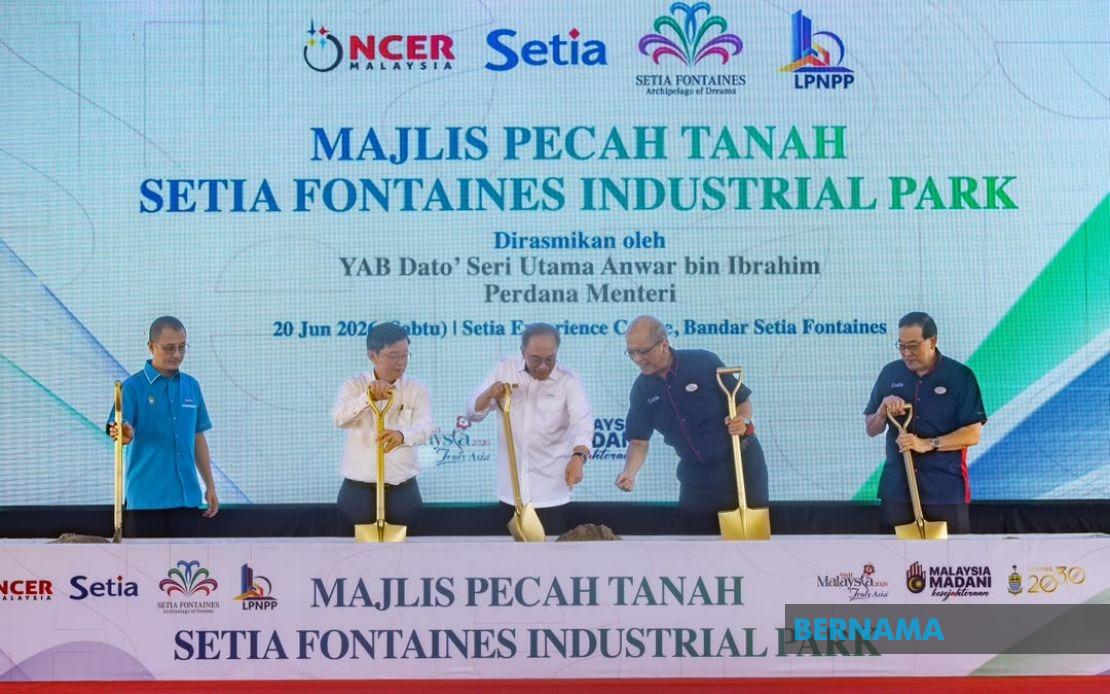
Prime Minister Datuk Seri Anwar Ibrahim has issued a pointed reminder to both government-linked investment vehicles and private sector corporations that rapid development cannot come at the cost of widening inequality. Speaking at the groundbreaking of the Setia Fontaines Industrial Park in Kepala Batas on June 20, Anwar underscored a central concern animating his economic vision: that growth divorced from inclusive opportunity serves only to deepen existing fault lines within Malaysian society.
The Prime Minister's remarks reflected frustration with a development model that generates impressive headline figures without translating into meaningful prosperity across all strata. He identified a troubling pattern where approvals granted to major institutional players—whether Khazanah Nasional Berhad, Permodalan Nasional Berhad, the Employees Provident Fund, or large private enterprises—frequently bypass ordinary Malaysians struggling in the middle and lower income brackets. Without deliberate structural interventions, Anwar warned, such groups face an ever-tightening squeeze on economic mobility.
This framing reflects Anwar's broader economic philosophy, one that distinguishes between growth as mere statistical achievement and growth as lived improvement. The metric that ultimately matters, in his formulation, is whether development translates into genuine opportunity for ordinary Malaysians rather than simply enriching those already well-positioned. It is a subtle but significant rebuke to purely technocratic approaches to economic management that prioritize investment volumes and sectoral expansion without accounting for distributional consequences.
The government has begun institutionalizing this concern, pressuring relevant agencies to embed equity considerations into developmental planning from inception rather than attempting remedial adjustments downstream. This signals a shift toward what might be termed "inclusive-by-design" project frameworks, where stakeholder benefit mapping occurs before shovels hit ground. The Setia Fontaines project itself is being positioned as a model for this approach, demonstrating how large-scale industrial development can be structured to diffuse benefits across income levels.
For Seberang Perai specifically, the industrial park development carries particular significance. The peninsular mainland district has historically absorbed investment at a slower pace than Penang Island and the southern parts of Penang state, creating a developmental gradient that perpetuates regional inequality within the state itself. By concentrating infrastructure and employment generation in Seberang Perai, planners hope to catalyze more balanced geographical growth. This represents an attempt to leverage private capital flows toward lagging regions rather than relying solely on government fiscal transfers.
Anwar placed particular emphasis on the quality of employment opportunities that should emerge from the facility. As Malaysia transitions from lower-value manufacturing assembly work toward higher-technology sectors, the industrial park is envisioned as part of that industrial upgrade. Yet this transition carries its own equity risk: if local workers lack requisite skills, jobs will flow to expatriate specialists, again excluding the very groups Anwar aims to prioritize. The employment opportunity becomes merely a theoretical possibility rather than actual pathway to prosperity.
This skills challenge animated much of Anwar's remarks. He identified a fundamental mismatch between Malaysia's vocational and technical education apparatus and the pace of technological change within industry. Individual institutions and companies operate on different timescales: universities and technical colleges function within multi-year curriculum development cycles, while technology evolves on annual or even sub-annual horizons. This structural asynchrony leaves workers perpetually underprepared, even when educational access expands.
To bridge this gap, Anwar called for genuine collaboration between industry players, technical and vocational training bodies, and universities including Universiti Sains Malaysia. The language of "collaboration" often masks superficial engagement, but Anwar's emphasis on alignment suggests something more substantive: real-time curriculum evolution driven by employers' actual skill requirements, internship pipelines that function as genuine talent pipelines rather than ceremonial programs, and tertiary institutions positioned not as autonomous knowledge producers but as responsive partners in workforce development. This represents a significant shift in how universities are expected to position themselves relative to industrial needs.
The implicit tension in Anwar's remarks deserves unpacking. He calls simultaneously for equitable opportunity distribution and industrial competitiveness through technological advancement. These goals can conflict: rigorous pursuit of high-skill employment may require recruiting the most talented individuals regardless of background, potentially reproducing existing educational hierarchies. Ensuring that middle- and lower-income groups actually access these positions demands not merely opportunity creation but affirmative intervention in hiring, training, and career progression practices. Whether companies will embrace such measures voluntarily, or whether the government will need to mandate them, remains unspecified.
The regional dimension carries weight for Southeast Asian observers. Malaysia's own struggles with inclusive growth parallel challenges across the region, where rapid industrialization and foreign investment have created pockets of prosperity amid broader populations experiencing stagnating real wages and diminishing intergenerational mobility. Anwar's insistence that development serve all income groups, not merely dominant minorities, speaks to anxieties about social fragmentation that extend well beyond Malaysia's borders.
Looking forward, the Setia Fontaines Industrial Park functions as both practical infrastructure and symbolic commitment. Its success or failure in actually delivering inclusive employment opportunity will shape perceptions of whether the government's equity rhetoric translates into enforceable requirements or remains merely aspirational language. Given the intensity with which Anwar has articulated this concern, stakeholders can expect sustained pressure to ensure that outcomes match intention.
%22%2F%3E%3C%2Fpattern%3E%3C%2Fdefs%3E%3Crect%20width%3D%22100%25%22%20height%3D%22100%25%22%20fill%3D%22url(%23ph25143g)%22%2F%3E%3Crect%20width%3D%22100%25%22%20height%3D%22100%25%22%20fill%3D%22url(%23ph25143p)%22%2F%3E%3Ctext%20x%3D%2250%25%22%20y%3D%2250%25%22%20text-anchor%3D%22middle%22%20dominant-baseline%3D%22central%22%20fill%3D%22rgba(255%2C255%2C255%2C0.95)%22%20font-family%3D%22Georgia%2C%20'Times%20New%20Roman'%2C%20serif%22%20font-weight%3D%22700%22%20font-size%3D%22320%22%20letter-spacing%3D%22-0.02em%22%3ETV3%3C%2Ftext%3E%3C%2Fsvg%3E)