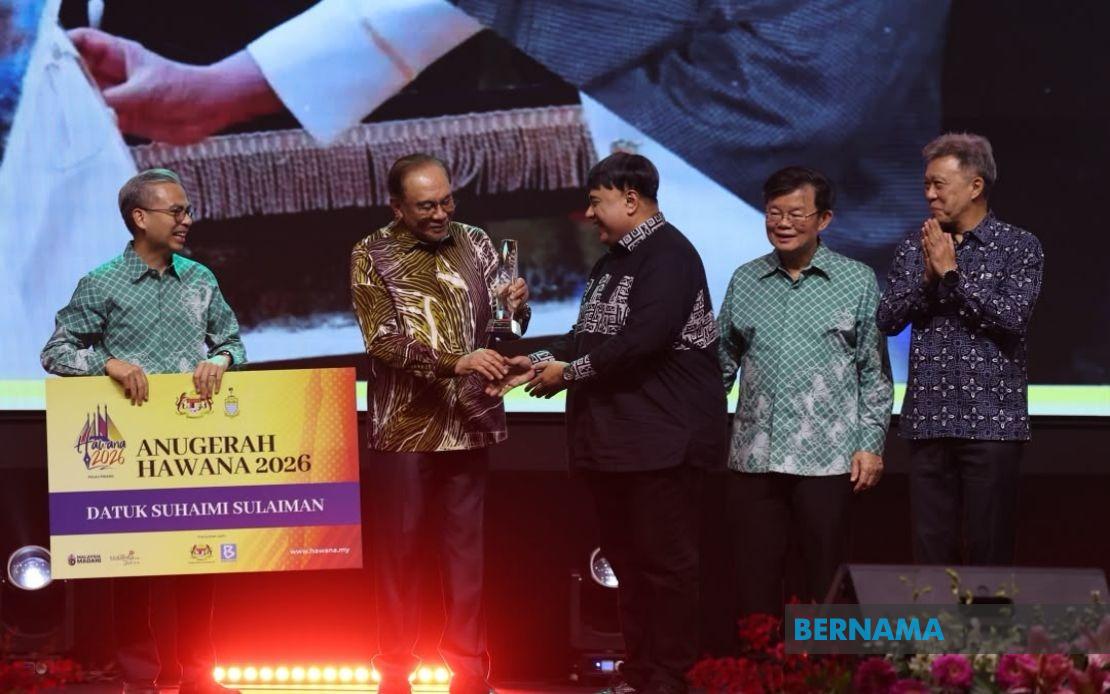
Datuk Suhaimi Sulaiman, a broadcasting veteran who has shaped Malaysia's media landscape over more than thirty years, has been honoured with the National Journalists' Day 2026 Award in recognition of his distinguished career and enduring influence on the country's journalism sector. The ceremony took place at the HAWANA 2026 Grand Finale held at PICCA @ Arena Butterworth Convention Centre in Butterworth on June 20, marking a significant acknowledgement of his lifelong dedication to Malaysian broadcasting and journalism.
The award was presented by Prime Minister Datuk Seri Anwar Ibrahim during the grand finale event, underscoring the national significance placed on Suhaimi's contributions to media development. The presence of senior government officials and industry leaders at the ceremony—including Penang Chief Minister Chow Kon Yeow, Communications Minister Datuk Fahmi Fadzil, and Bernama chairman Datuk Seri Wong Chun Wai—reflected the broad recognition of his impact across Malaysia's institutional media framework.
Suhaimi's career trajectory has been firmly rooted in Malaysia's most established broadcasting institution. As the former director-general of Suruhanjaya Komunikasi dan Multimedia Malaysia (Malaysian Communications and Multimedia Commission), and previously in senior roles at Broadcasting Malaysia (RTM), he has been instrumental in navigating the country's media sector through periods of significant technological and regulatory transformation. His tenure at these organizations positioned him at the intersection of policy, innovation, and journalistic practice.
In responding to the honour, Suhaimi characterised the recognition as both deeply meaningful and a renewed impetus for continued growth. He emphasised that the award represents more than personal achievement, framing it instead as motivation to persist in learning and transferring institutional knowledge to the next generation of media practitioners. This perspective reveals his commitment to institutional continuity and mentorship within Malaysia's journalism sphere.
The timing of Suhaimi's recognition coincides with one of the most transformative periods in global media. Artificial intelligence is fundamentally altering how news organisations operate, from content generation and distribution to audience analytics and personalisation. Suhaimi's explicit acknowledgement of this shift demonstrates awareness that contemporary journalism requires continuous adaptation and skill acquisition. His call for media practitioners to embrace new technological competencies reflects the broader challenge facing regional newsrooms struggling to balance traditional editorial standards with digital-era demands.
The HAWANA awards themselves serve as Malaysia's premier recognition system for journalistic excellence and media contributions. Operating under the auspices of Bernama, the Malaysian National News Agency, the awards identify and celebrate individuals whose work strengthens the institutional fabric of Malaysian journalism. By presenting the award during a grand finale event featuring prominent government figures, the ceremony underscores the state's investment in recognising media contributions as essential to national discourse.
For Malaysian readers and media observers, Suhaimi's recognition carries implications beyond personal honour. His prominence in shaping broadcasting policy and institutional culture means that his continued engagement with younger journalists and evolving media challenges influences the sector's direction. The emphasis on AI adaptation particularly resonates with Southeast Asian newsrooms grappling with limited resources and urgent digitalisation pressures that differ markedly from challenges faced by better-resourced international organisations.
Suhaimi's career also reflects the institutional evolution of Malaysian broadcasting itself. From the analogue era through digital transition to the current AI-inflected moment, his presence in senior positions has meant that RTM and related organisations navigated these shifts under leadership familiar with both traditional broadcast principles and contemporary media realities. This continuity of institutional knowledge, particularly regarding editorial standards and journalistic ethics, becomes increasingly valuable as younger practitioners enter an environment saturated with technological tools that can automate editorial decisions.
The award presentation by Prime Minister Anwar Ibrahim carries additional symbolic weight. It signals government recognition that media infrastructure and journalistic integrity remain priorities even as political dynamics evolve. By publicly honouring a figure associated with institutional media rather than digital-native or alternative news platforms, the government's choice emphasizes the continued relevance of traditional broadcasting institutions in Malaysia's information ecosystem.
Looking forward, Suhaimi's continued influence—whether through formal advisory roles, mentorship initiatives, or public commentary—will shape how Malaysian newsrooms approach the confluence of artificial intelligence, regulatory change, and audience fragmentation. His articulation of the challenge facing contemporary journalists provides a framework through which regional media can evaluate their own readiness for technological disruption while maintaining editorial credibility.
%22%2F%3E%3C%2Fpattern%3E%3C%2Fdefs%3E%3Crect%20width%3D%22100%25%22%20height%3D%22100%25%22%20fill%3D%22url(%23ph5pufhg)%22%2F%3E%3Crect%20width%3D%22100%25%22%20height%3D%22100%25%22%20fill%3D%22url(%23ph5pufhp)%22%2F%3E%3Ctext%20x%3D%2250%25%22%20y%3D%2250%25%22%20text-anchor%3D%22middle%22%20dominant-baseline%3D%22central%22%20fill%3D%22rgba(255%2C255%2C255%2C0.95)%22%20font-family%3D%22Georgia%2C%20'Times%20New%20Roman'%2C%20serif%22%20font-weight%3D%22700%22%20font-size%3D%22170%22%20letter-spacing%3D%22-0.02em%22%3EJudicial%3C%2Ftext%3E%3C%2Fsvg%3E)