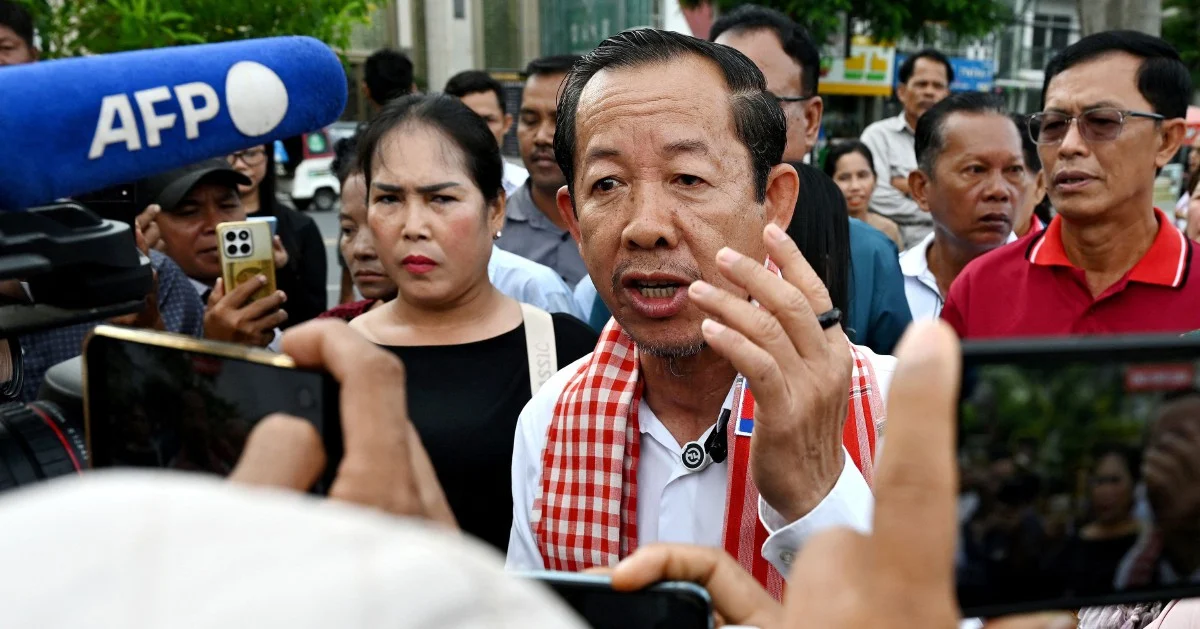
Cambodia's Supreme Court has taken a mixed approach to opposition politician Rong Chhun's case, suspending his prison term while maintaining restrictions that bar him from electoral participation, according to statements from his legal representatives on Friday. The dual ruling reflects the complexities surrounding dissent and political opposition in Cambodia, where the judicial system has increasingly been used to manage challenges to the ruling government.
The suspension of Rong Chhun's prison sentence provides some relief to the activist and politician, though legal experts suggest the decision should be understood within the broader context of Cambodia's political environment. The imprisoned term's suspension may indicate either a recalibration of judicial approach or recognition of international pressure regarding political freedoms, though commentators remain cautious about interpreting such moves as systemic reform. The politician's detention and subsequent legal proceedings have drawn attention from regional and international human rights organisations concerned about restrictions on political expression in Southeast Asia.
The upheld election ban represents a more enduring constraint on Rong Chhun's political future. By maintaining this prohibition, the court has effectively removed him from electoral competition for the foreseeable future, limiting his ability to contest national or local elections. This aspect of the ruling carries particular significance because it demonstrates how judicial mechanisms can be employed to constrain political competition beyond immediate criminal punishment. For Cambodia's opposition movement, the decision signals continued obstacles to meaningful electoral participation and democratic competition.
Rong Chhun's case exemplifies broader patterns in Cambodia's contemporary political landscape. Opposition figures have faced multiple legal challenges over recent years, with charges ranging from incitement to defamation. These proceedings have often resulted in convictions that remove key opposition voices from the political arena during critical electoral periods. The timing and nature of prosecutions have prompted regional observers to examine whether Cambodia's legal system operates with genuine independence or remains influenced by political considerations.
The opposition movement in Cambodia has struggled to maintain organisational coherence and public visibility amid persistent legal challenges. Several prominent opposition figures have been imprisoned, exiled, or banned from political activity, which has significantly weakened the democratic opposition's capacity to contest elections competitively. Rong Chhun's situation reflects this broader constraint on opposition politics in a country where elections have increasingly been characterised by dominant-party control and limited genuine competition.
For Malaysia and other ASEAN members, Cambodia's approach to managing political opposition offers important lessons about institutional pressures and judicial independence in the region. While Malaysia has its own complex history with political prosecutions and opposition politics, the Cambodian experience demonstrates how electoral bans and imprisonment can be combined to achieve long-term political consequences. Understanding these mechanisms helps Malaysian observers appreciate both the vulnerabilities and resilience of democratic institutions in Southeast Asia.
The Supreme Court's decision on Rong Chhun must be situated within Cambodia's election cycle and broader governance trajectory. The country approaches its next major electoral test, and with key opposition voices constrained or inactive, the electoral landscape may be further consolidated around dominant-party participation. International observers and regional democratic advocates have raised concerns about whether Cambodia's electoral processes provide adequate space for political competition and voter choice.
Civil society organisations across Southeast Asia have begun tracking the legal conditions facing opposition politicians more systematically, recognising that seemingly technical judicial decisions can reshape political possibilities. The suspension of Rong Chhun's prison sentence might reduce his immediate physical confinement but does not ameliorate the deeper constraint imposed by the election ban. For analysts of ASEAN governance, this distinction matters because it reveals how different legal mechanisms can achieve comparable political outcomes through apparently distinct channels.
The ruling also carries implications for Cambodia's international positioning and relationships. Regional trade partners and development institutions have occasionally raised concerns about democratic governance, though these interventions have generally been limited and selective. The handling of political opposition through the judiciary reflects choices Cambodia's leadership makes about maintaining domestic control while navigating international expectations regarding rule of law and political freedom.
For opposition parties and civil society actors throughout Southeast Asia, Rong Chhun's case serves as a reminder of the fragility of electoral participation rights in democracies still consolidating their institutions. The combination of criminal prosecution and electoral disqualification creates formidable barriers that opposition movements struggle to overcome. Whether through suspension of prison terms or upholding of electoral bans, judicial systems can be instrumental in reshaping political landscapes in ways that may not immediately appear as direct suppression but nonetheless constrain democratic competition.
Looking forward, observers will assess whether the suspension of Rong Chhun's sentence signals any broader shift in Cambodia's approach to political opposition or represents a discrete decision without systemic implications. The maintenance of his election ban suggests continuity in mechanisms that limit opposition participation, even as individual criminal punishments may be adjusted. For the broader ASEAN region seeking to strengthen democratic institutions and genuine political competition, Cambodia's trajectory raises persistent questions about how judicial systems function and whether they serve as independent arbiters or extensions of political power.

%22%2F%3E%3C%2Fpattern%3E%3C%2Fdefs%3E%3Crect%20width%3D%22100%25%22%20height%3D%22100%25%22%20fill%3D%22url(%23ph2hy9vg)%22%2F%3E%3Crect%20width%3D%22100%25%22%20height%3D%22100%25%22%20fill%3D%22url(%23ph2hy9vp)%22%2F%3E%3Ctext%20x%3D%2250%25%22%20y%3D%2250%25%22%20text-anchor%3D%22middle%22%20dominant-baseline%3D%22central%22%20fill%3D%22rgba(255%2C255%2C255%2C0.95)%22%20font-family%3D%22Georgia%2C%20'Times%20New%20Roman'%2C%20serif%22%20font-weight%3D%22700%22%20font-size%3D%22272%22%20letter-spacing%3D%22-0.02em%22%3EAnwar%3C%2Ftext%3E%3C%2Fsvg%3E)