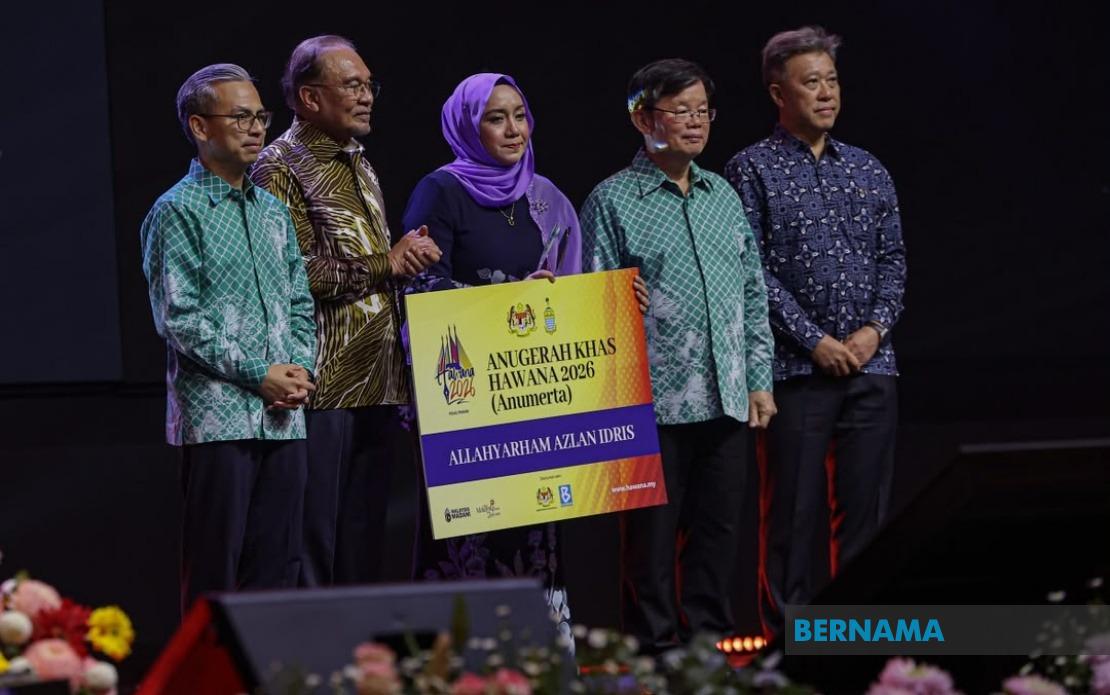
The National Journalists' Day (HAWANA) 2026 Special Award was bestowed posthumously upon Azlan Idris, the former chief of Bernama Radio, in recognition of his substantial contributions to Malaysian broadcasting and journalism. Prime Minister Datuk Seri Anwar Ibrahim conferred the honour at a formal ceremony held at the PICCA@Arena Butterworth Convention Centre, where the award was received by Idris's widow, Wan Syahrina Wan Abdul Rahman. The occasion drew high-level attendance, including Penang Chief Minister Chow Kon Yeow, Communications Minister Datuk Fahmi Fadzil, and Malaysian National News Agency (Bernama) chairman Datuk Seri Wong Chun Wai, underscoring the significance attributed to the recognition.
Azlan Idris passed away on January 15 at the age of 57, leaving behind a legacy spanning decades in Malaysian electronic media. His career trajectory encompassed significant roles across multiple broadcast platforms, including positions with commercial television networks TV3, NTV7, and Channel 9, demonstrating his widespread influence in the broadcasting industry. However, his most defining contribution came through his pioneering work at Bernama Radio, where he served as chief following the outlet's establishment in 2007. During his tenure, Idris was instrumental in shaping the station's editorial direction and operational framework, transforming it into a credible source of news and information for Malaysian audiences seeking reliable coverage through radio medium.
The decision to honour Idris with the HAWANA 2026 Special Award reflects the journalism community's acknowledgment of his instrumental role in advancing Malaysia's media landscape during a transformative period. The award carried particular significance given Idris's active involvement in organising the National Journalists' Day celebrations themselves. Beginning with the 2022 event in Melaka, he served as chairman of the main celebration committee, a position he maintained through successive years. His organisational contributions to these annual gatherings demonstrated his commitment not merely to his own professional advancement but to fostering cohesion and recognition within the broader journalistic fraternity across the nation.
Bernama Radio's launch in 2007 represented a strategic expansion of Malaysia's national news agency into the radio broadcasting sphere, complementing its established print and wire distribution services. Azlan Idris's stewardship during these formative years proved critical to establishing the station's operational protocols, news-gathering methodologies, and editorial standards. Radio journalism in Malaysia occupies a unique position, reaching audiences during commutes, at workplaces, and in vehicles where television and print media prove less accessible. Through Idris's leadership, Bernama Radio developed into a trusted companion for millions of Malaysians seeking timely updates on domestic and international affairs.
The ceremony in Butterworth, located in Penang's industrial heartland, witnessed the gathering of senior representatives from Malaysian media organisations, testament to the widespread respect Idris commanded across the industry. The presence of Datin Paduka Nur-ul Afida Kamaludin, Bernama's chief executive officer and chair of the HAWANA 2026 Organising Committee, further emphasised the institutional recognition of Idris's contributions. For a journalist to be honoured posthumously at this level indicates not only professional achievement but also the personal respect colleagues and government officials maintained toward him throughout his career.
The HAWANA framework itself serves as Malaysia's principal mechanism for celebrating journalistic excellence and recognising outstanding contributions to the profession. The annual observance provides opportunity for the media industry, government stakeholders, and industry leaders to collectively acknowledge exemplary practitioners who have advanced standards, expanded coverage capabilities, or mentored emerging talent within their respective organisations. By naming Idris as the 2026 Special Award recipient, the selection committee recognised someone whose influence extended beyond individual reporting or editorial assignments into the structural and organisational dimensions of national broadcasting.
For Malaysian journalists and broadcasting professionals, Idris's career trajectory illustrated the possibilities available to those demonstrating dedication across multiple platforms and organisational contexts. His movement from commercial broadcasting into the national news agency sphere demonstrated professional versatility and the potential for individuals to contribute meaningfully at different operational levels. Those entering Malaysian journalism today, particularly within broadcast media, inherit institutions shaped partly by pioneers like Idris who established protocols, trained personnel, and embedded professional standards during periods of technological and organisational change.
The recognition also carries implications for how Malaysia's media landscape recognises contributions during an era of significant transformation. As digital platforms, streaming services, and social media reshape information consumption patterns, traditional broadcasters like Bernama Radio must continually evolve their offerings whilst maintaining journalistic integrity. Idris's legacy encompasses this transition period, having guided a state news organisation through early-stage digital adoption whilst maintaining commitment to factual reporting and editorial independence. His posthumous honour acknowledges this navigational challenge that journalists of his generation confronted.
The award presentation occurred within broader context of Malaysian government attention to media development and journalism standards. Communications Minister Datuk Fahmi Fadzil's attendance signalled government recognition of journalism's societal role and commitment to supporting professional standards within the industry. This institutional acknowledgment matters significantly in countries where media freedom and journalistic autonomy face periodic pressure from various quarters. Public recognition of journalistic achievement through ceremonies like HAWANA reinforces societal valuation of professional journalism and the individuals who dedicate careers to gathering and disseminating accurate information.
For Wan Syahrina Wan Abdul Rahman and Azlan Idris's family, the posthumous award provided formal recognition of his professional accomplishments and the tangible mark he left upon Malaysian journalism. Beyond personal gratification, such honours establish historical record of individual contributions to national institutions, ensuring that future journalists and media researchers understand the foundations upon which contemporary broadcasting organisations were constructed. The HAWANA 2026 Special Award thus transforms a private loss into a public acknowledgment of professional legacy.
%22%2F%3E%3C%2Fpattern%3E%3C%2Fdefs%3E%3Crect%20width%3D%22100%25%22%20height%3D%22100%25%22%20fill%3D%22url(%23ph25143g)%22%2F%3E%3Crect%20width%3D%22100%25%22%20height%3D%22100%25%22%20fill%3D%22url(%23ph25143p)%22%2F%3E%3Ctext%20x%3D%2250%25%22%20y%3D%2250%25%22%20text-anchor%3D%22middle%22%20dominant-baseline%3D%22central%22%20fill%3D%22rgba(255%2C255%2C255%2C0.95)%22%20font-family%3D%22Georgia%2C%20'Times%20New%20Roman'%2C%20serif%22%20font-weight%3D%22700%22%20font-size%3D%22320%22%20letter-spacing%3D%22-0.02em%22%3ETV3%3C%2Ftext%3E%3C%2Fsvg%3E)