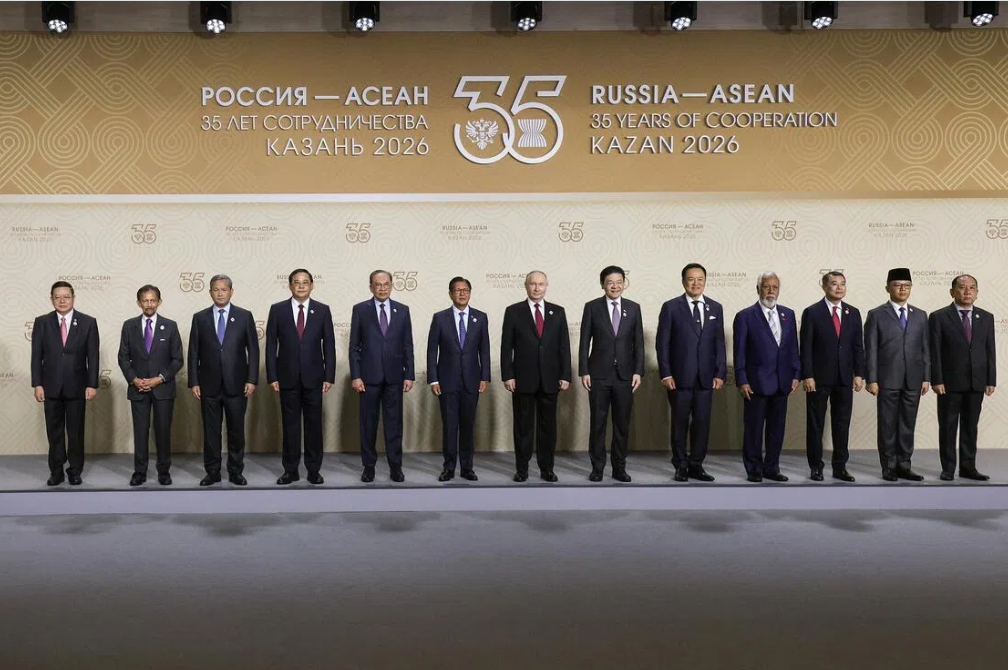
The Asean-Russia Commemorative Summit held in Kazan this month has reinforced both blocs' determination to expand their partnership across multiple domains, even as geopolitical tensions elsewhere complicate the global order. The two-day gathering, which took place on June 17 and 18, celebrated three and a half decades of formal relations while establishing concrete mechanisms to guide cooperation until 2030. For Southeast Asian nations, the summit signals an effort to maintain engagement with Moscow despite international divisions, reflecting the region's traditional commitment to non-alignment and inclusive diplomacy.
The centrepiece of the Kazan meeting was the adoption of three key documents designed to reshape the relationship's trajectory. The Kazan Declaration provides a comprehensive review of progress over the past 35 years while plotting the course ahead, explicitly identifying maritime affairs, trade and investment, energy security, infrastructure connectivity, defence cooperation, educational exchange and cultural promotion as priority areas. Alongside this overarching declaration, both sides endorsed a Joint Statement on Cultural Cooperation aimed at strengthening people-to-people bonds, and a five-year Comprehensive Plan of Action spanning 2026 to 2030 that will operationalise specific collaborative initiatives. These frameworks represent more than symbolic gestures; they translate broad political commitment into actionable programmes with measurable outcomes, a particularly important signal in a region where stability depends heavily on institutional confidence-building.
Singapore's Prime Minister Lawrence Wong, speaking on behalf of Asean at the summit, articulated a nuanced position that characterises the region's diplomatic balancing act. Rather than pursuing blanket partnership across all domains, Wong advocated for cooperation precisely where interests converge, a formulation that acknowledges legitimate areas of collaboration without requiring alignment on contentious international issues. He specifically welcomed Russia's endorsement of Asean Centrality, the principle that regional organisations should serve as the driving force in shaping regional architecture and norms, a doctrine increasingly under pressure in an era of great-power competition. Wong's emphasis on shared interests rather than ideological unity reflects Southeast Asia's desire to engage multiple powers constructively while preserving strategic autonomy.
Among the concrete areas identified for deeper engagement, disaster management and drug trafficking prevention emerged as particularly relevant for Malaysia and its neighbours. Natural disasters remain a persistent threat across Southeast Asia, from floods and typhoons to earthquakes, and coordinating response mechanisms with a major power like Russia could enhance preparedness. Similarly, narcotics production and trafficking along porous land borders and maritime trade routes continues to plague the region; partnering with Moscow on intelligence sharing and interdiction operations could yield tangible security benefits. These less politically sensitive domains offer pathways for substantive cooperation that sidestep the complications arising from different positions on global conflicts.
Educational and civil service exchanges represent another pillar of the revitalised relationship. Wong noted that Russian officials regularly participate in professional training courses within Asean member states, including Singapore, a mechanism that builds understanding and facilitates people-to-people connections at the institutional level. These exchanges work in both directions, creating networks of professionals across borders who understand each other's systems and constraints. For Malaysia, such programmes could yield benefits in areas ranging from public administration to technical fields, whilst simultaneously strengthening informal diplomatic channels that prove invaluable during crises.
Wong's bilateral meeting with President Vladimir Putin underscored a delicate diplomatic reality: substantive engagement with Russia continues despite Singapore's firm stance on international law and its earlier imposition of sanctions over the Ukraine invasion. Wong stressed that Singapore's position on Ukraine derives not from alignment with any party but from consistent application of principles surrounding national sovereignty and territorial integrity. This distinction matters enormously for Southeast Asian credibility in the region and beyond. By engaging Russia whilst simultaneously upholding international legal norms, countries like Singapore attempt to preserve their role as honest brokers capable of speaking to all parties, a status that becomes increasingly valuable as global polarisation deepens.
The summit's timing carries particular significance for Malaysia and the broader region. Singapore will assume the rotating Asean chair in 2027, a position that requires active engagement with all major powers, including Russia. Wong explicitly invited Moscow to participate in the East Asia Summit and Asean Regional Forum, both mechanisms that facilitate dialogue on security matters ranging from maritime safety to counter-terrorism. Russia's participation in these forums, contingent on its willingness to engage constructively on regional rules and norms, could influence how effectively Asean manages rising tensions between established and emerging powers.
Energy cooperation represents an underexplored dimension of the renewed partnership, yet one with profound implications for Malaysian interests. Russia remains a major energy producer, and as Southeast Asia navigates the energy transition whilst maintaining economic growth, diversified supply relationships become strategically valuable. Russia's hydrocarbon exports and potential involvement in renewable energy projects could offer alternatives to existing suppliers, though such arrangements must navigate international sanctions regimes and domestic political considerations in Southeast Asian capitals.
Wong also highlighted Asean's commitment to unimpeded transit rights through key maritime passages, invoking the United Nations Convention on the Law of the Sea as the governing framework. This emphasis carries particular resonance given recent incidents affecting freedom of navigation in regional waters and the Strait of Malacca's critical importance to Malaysian commerce and geopolitical positioning. By securing Russia's acknowledgment of these principles at the summit, Asean reiterates that all major powers, including Moscow, must respect the legal frameworks underpinning regional stability and commercial activity.
The Singapore Prime Minister's remarks on the Middle East peace agreement between the United States and Iran, and his hope that it might reopen the Strait of Hormuz, reveals how interconnected regional and global security challenges have become. Disruptions to energy supplies or shipping routes in distant theatres rapidly affect Southeast Asia's economic prospects and energy security. By supporting diplomatic solutions to conflicts far from home, Asean countries protect their own economic interests whilst reinforcing the norm of peaceful dispute resolution.
Wong's separate engagement with Rais Rustam Minnikhanov of the Republic of Tatarstan reflects the historical significance of Singapore's earlier diplomatic opening to Russia's regions, traced back to former Prime Minister Lee Kuan Yew's 2007 visit. Regional relationships within Russia offer additional channels for cultural and educational cooperation that may prove less politically charged than dealings with Moscow's federal government. For Malaysia, this tiered approach to engagement, operating simultaneously at national and sub-national levels, could unlock opportunities in areas like tourism, academic partnerships and cultural heritage preservation.
The Asean-Russia relationship ultimately exemplifies the complex diplomatic terrain Southeast Asian nations must navigate in a multipolar world. Rather than choosing sides in global ideological or strategic competitions, countries like Malaysia and Singapore pursue pragmatic partnerships that advance concrete national interests whilst maintaining principled stances on international law. The Kazan summit's outcome demonstrates that such nuanced engagement remains possible even amid geopolitical turbulence, provided all parties prioritise dialogue over confrontation and recognise areas of genuine mutual benefit. As the region confronts challenges from climate change to pandemics to terrorism, partnerships that transcend political divisions become increasingly indispensable for effective collective action.

%22%2F%3E%3C%2Fpattern%3E%3C%2Fdefs%3E%3Crect%20width%3D%22100%25%22%20height%3D%22100%25%22%20fill%3D%22url(%23ph2hy9vg)%22%2F%3E%3Crect%20width%3D%22100%25%22%20height%3D%22100%25%22%20fill%3D%22url(%23ph2hy9vp)%22%2F%3E%3Ctext%20x%3D%2250%25%22%20y%3D%2250%25%22%20text-anchor%3D%22middle%22%20dominant-baseline%3D%22central%22%20fill%3D%22rgba(255%2C255%2C255%2C0.95)%22%20font-family%3D%22Georgia%2C%20'Times%20New%20Roman'%2C%20serif%22%20font-weight%3D%22700%22%20font-size%3D%22272%22%20letter-spacing%3D%22-0.02em%22%3EAnwar%3C%2Ftext%3E%3C%2Fsvg%3E)