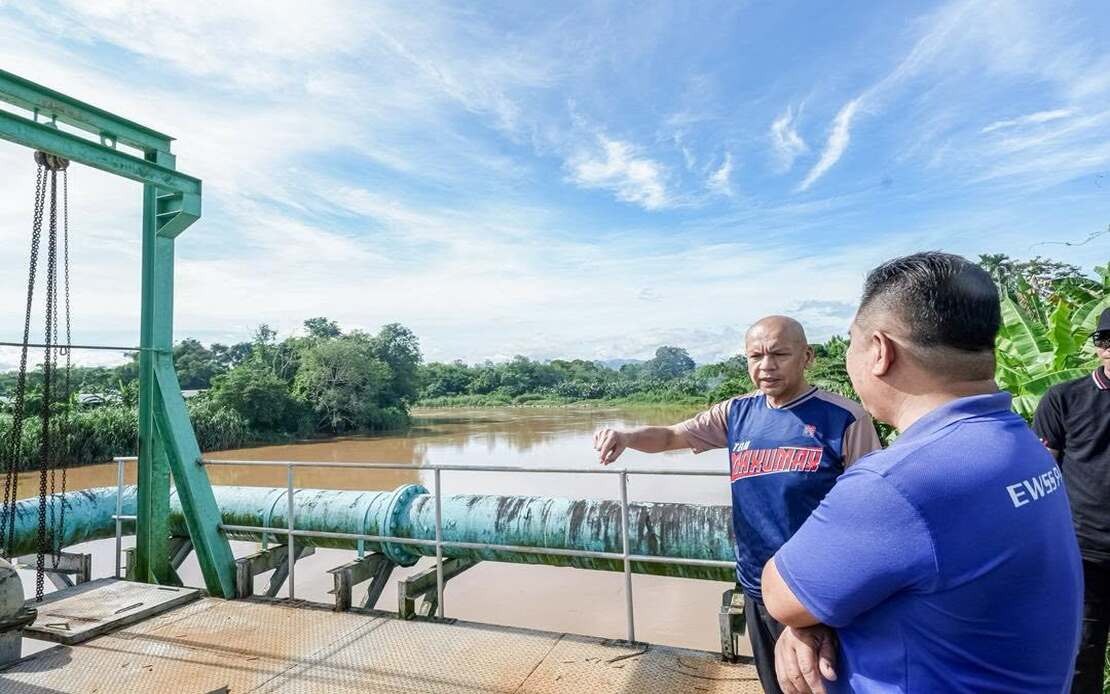
Datuk Armizan Mohd Ali, Malaysia's Domestic Trade and Cost of Living Minister and Member of Parliament for Papar, conducted an on-site inspection of water supply infrastructure projects in his constituency on June 19, underscoring the government's commitment to resolving persistent water distribution challenges affecting residents. The visit followed a coordination meeting held four days earlier to assess implementation progress and identify bottlenecks impeding service delivery across the Papar district.
Two major capital projects currently under execution form the backbone of Papar's water security strategy. The Kogopon Water Treatment Plant is being expanded to double its current daily production capacity from 40 million litres to 80 million litres, whilst the Kampung Kabang water intake facility is simultaneously undergoing upgrading works. These complementary improvements address the fundamental supply constraints that have plagued the district as residential and commercial water demand continues rising annually.
The timing of Armizan's inspection proved particularly significant, as both the EWSS Plant and JETAMA Limbahau Plant had recently experienced forced operational shutdowns due to elevated turbidity levels in raw water entering their treatment systems. Turbidity, measured in nephelometric turbidity units (NTU), reflects the cloudiness or murkiness of water caused by suspended sediment, organic matter, and microorganisms. When NTU values exceed safe thresholds at intake points, treatment facilities must temporarily cease operations until incoming water quality improves sufficiently for processing.
Such disruptions expose vulnerabilities in Papar's water supply chain, particularly during periods of heavy rainfall or upstream disturbances that increase sediment loads in source waters. The sequential failures of multiple treatment plants within a single week highlighted systemic vulnerabilities rather than isolated incidents, prompting ministerial-level intervention to coordinate remedial responses. Armizan's personal examination of both facilities demonstrated heightened political attention to infrastructure resilience, a critical concern for constituents dependent on reliable piped water access.
The Kogopon WTP expansion represents the most substantial capacity enhancement in Papar's recent history. Doubling treatment throughput from 40 to 80 million litres daily should substantially alleviate supply pressures, provided that raw water availability from source reservoirs remains adequate and that distribution networks can efficiently convey the increased output without unacceptable losses. The economics of water infrastructure development in Malaysian districts increasingly depend on balancing expansion costs against demand projections and ensuring that capital-intensive treatment plants operate near optimal utilization rates to justify public investment.
Intake facility upgrades at Kampung Kabang complement treatment plant enhancements by improving raw water collection efficiency and potentially incorporating pre-filtration technologies that reduce sediment loads before water reaches main treatment plants. Such staged infrastructure improvements distribute technical and financial burdens across multiple components rather than concentrating investment in single facilities, thereby reducing systemic vulnerability to localized failures. This approach reflects mature water utility planning that addresses supply chains holistically rather than attempting quick-fix solutions at individual nodes.
Armizan's emphasis on direct field monitoring reveals an important governance principle: senior officials must personally verify operational conditions and staff performance rather than relying exclusively on written reports from implementing agencies. Ground-level observation enables identification of problems that formal documentation may obscure or downplay, and direct ministerial presence signals political accountability for results. For Malaysian water consumers accustomed to periodic service disruptions, such visible ministerial engagement offers modest reassurance that authorities recognize and actively address their concerns.
The specific challenge of managing raw water turbidity extends beyond Papar, affecting treatment facilities throughout Malaysia and Southeast Asia during monsoon seasons and dry periods when hydrological conditions fluctuate dramatically. Sustainable solutions require investment in source water protection—preventing erosion and sedimentation in reservoir catchments—alongside treatment plant sophistication. Papar's infrastructure programme appears focused on treatment-side improvements, but long-term sustainability depends equally on watershed management interventions that reduce turbidity at origin rather than managing it reactively at treatment plants.
For Malaysian readers in water-stressed regions, Papar's experience illustrates both progress and persistent vulnerabilities in urban water supply systems. The commitment to doubling treatment capacity and upgrading intake facilities demonstrates government recognition that previous infrastructure investments have proven insufficient for growing populations. However, the recent operational disruptions underscore that expanding facilities alone cannot guarantee reliable supplies if raw water quality deteriorates unpredictably and if distribution networks suffer from aging infrastructure or inefficient management.
Armizan's inspection agenda reflected broader policy recognition that water security has become an urgent governance priority across Malaysia. Climate variability, urban population growth, and aging infrastructure create compounding pressures on water utilities. Southeast Asia more broadly faces comparable challenges, with countries including Indonesia, the Philippines, and Thailand grappling with supply-demand imbalances. Papar's infrastructure initiatives, whilst locally focused, contribute to building regional expertise in addressing shared water management challenges through technology deployment and institutional coordination.
The two-pronged strategy of expanding treatment capacity whilst improving raw water intake infrastructure indicates that Papar authorities understand water supply management requires simultaneous investments across multiple system components. Treatment plant modernization alone cannot succeed without reliable raw water availability, whilst expanded intake capacity delivers limited benefits if treatment facilities cannot process higher volumes efficiently. This integrated approach offers valuable lessons for other Malaysian districts facing comparable service reliability challenges.