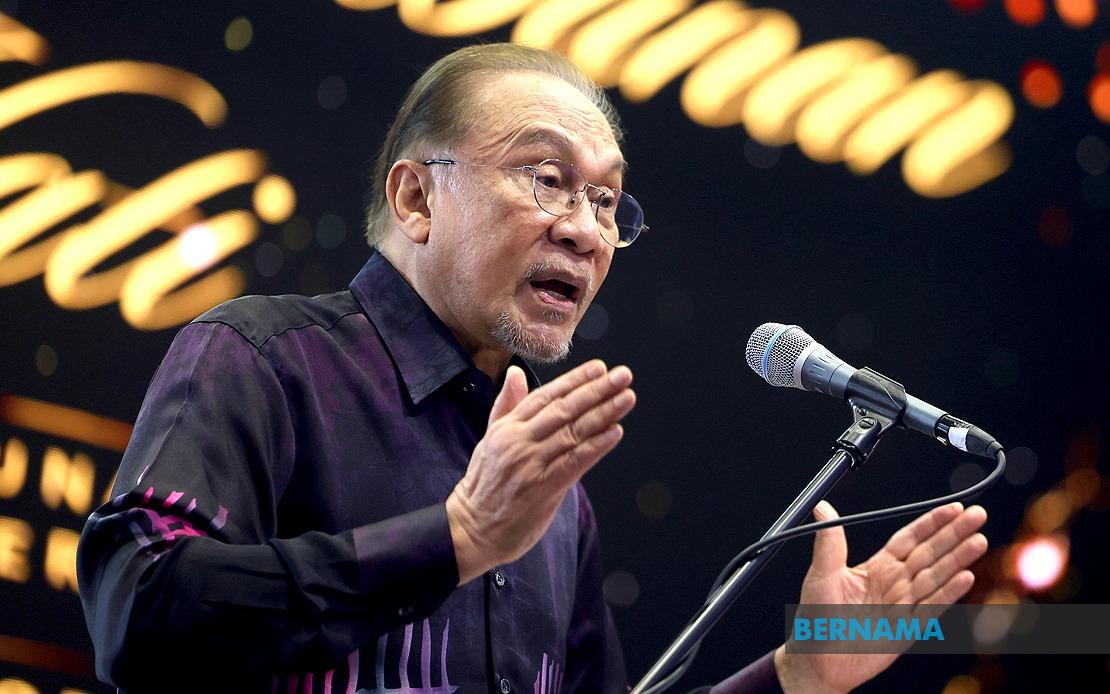
Prime Minister Datuk Seri Anwar Ibrahim has issued a direct appeal to Malaysians across all ethnic communities to stand firm in defence of national unity, cautioning against the divisive strategies employed by certain political figures who seek to weaponise racial sentiment for personal gain. Speaking at a gathering organised by Pertubuhan Lima Generasi (PLG) Malaysia in Seremban on June 20, Anwar articulated a vision of a cohesive nation in which shared purpose transcends ethnic boundaries, casting such unity as essential to Malaysia's long-term stability and prosperity.
The prime minister's remarks come amid an observable trend of increasingly polarised political rhetoric across the region, where appeals to ethnic identity have become a favoured tool for mobilising voter bases. By explicitly naming the tactic of pit setting communities against one another—Malays against Chinese, Chinese against Indians, and Indians against Malays—Anwar sought to expose and delegitimise an approach that threatens the delicate social compact established at Malaysia's founding. His intervention signals executive-level concern about the trajectory of public discourse and the potential consequences of unchecked sectarian messaging.
Central to Anwar's argument is the assertion that Malaysia's ethnic heterogeneity, far from being a liability or a source of friction that requires management, represents instead a distinctive asset capable of generating comparative advantage. This framing inverts a common nationalist narrative that treats diversity as a problem to be solved through assimilation or domination. Instead, Anwar contends that when communities of genuine goodwill interact with respect and seek common ground, the resulting synergies strengthen the entire nation, creating institutional and social resilience.
The prime minister emphasised that such unity cannot exist in the abstract or as mere rhetorical flourish; it must be grounded in tangible mutual understanding and genuine cooperative effort across institutional, economic, and social domains. This distinction matters considerably, as it suggests that unity demands not symbolic gestures but substantive commitment to policies and practices that advance shared wellbeing. For Malaysian readers attuned to the gap between political language and actual governance, this calibration represents an implicit acknowledgment that words alone cannot reverse years of communal distrust.
Anwar's invocation of Malays, Chinese, Indians, Kadazans and others working together as a unified force reflects an attempt to broaden the conversation beyond the Malay-Chinese binary that has historically dominated Malaysian racial politics. By explicitly including indigenous communities and other groups, he signals recognition of Malaysia's full demographic complexity and suggests that inclusive national narratives must account for the entire population rather than focusing narrowly on the largest communities. This rhetorical choice may also carry implications for electoral dynamics and coalition-building in future political contests.
The event itself—a dinner attended by over one thousand PLG members and Negeri Sembilan Menteri Besar Datuk Seri Aminuddin Harun—served as a platform for demonstrating grassroots commitment to the unity message. The presence of a state leader of comparable rank underscores that the call for cohesion enjoys support across multiple tiers of government, lending it institutional weight beyond personal political capital. For observers tracking fault lines within Malaysia's ruling coalition and among state administrations, such moments of visible alignment on core national values carry interpretive significance.
The timing of these remarks warrants consideration within the broader Southeast Asian context. Across the region, democratic societies have wrestled with the challenge of maintaining pluralistic governance while resisting the gravitational pull toward ethnic or religious mobilisation. Myanmar's descent, Sri Lanka's intercommunal violence, and Thailand's recurring instability all offer cautionary examples of what can transpire when political actors systematically exploit identity divisions. Malaysia's track record of relative stability stands in contrast, yet that stability cannot be taken as assured or permanent without active political leadership.
Anwar's emphasis on leaders deliberately propagating hatred introduces a moral dimension into what might otherwise be framed as merely tactical political disagreement. By characterising such behaviour not simply as strategically unwise but as fundamentally wrong—as a betrayal of the nation's founding principles—he attempts to shift the discursive frame and raise the reputational cost of sectarian campaigning. Whether such framing proves effective in constraining actual political behaviour remains an open question, though the attempt itself reflects recognition that norms and shared values matter in maintaining social cohesion.
For Malaysian citizens navigating an increasingly fractious information environment, where social media algorithms amplify divisive content and political messaging becomes ever more targeted and personalised, Anwar's appeal to collective restraint and mutual respect offers a counterweight to fragmentation. The challenge ahead lies in translating such appeals into institutional mechanisms and cultural practices capable of resisting the structural incentives toward polarisation inherent in contemporary competitive politics.
The substance of this intervention also carries implications for how Malaysia positions itself internationally, particularly as regional powers scrutinise the governance health of their neighbours. A nation visibly united across ethnic lines, where leadership actively resists sectarian temptation, presents a more stable investment climate and more reliable partnership than one riven by communal tension. In this regard, Anwar's appeal to unity serves not only domestic stability but also Malaysia's strategic interests in an increasingly contested region.