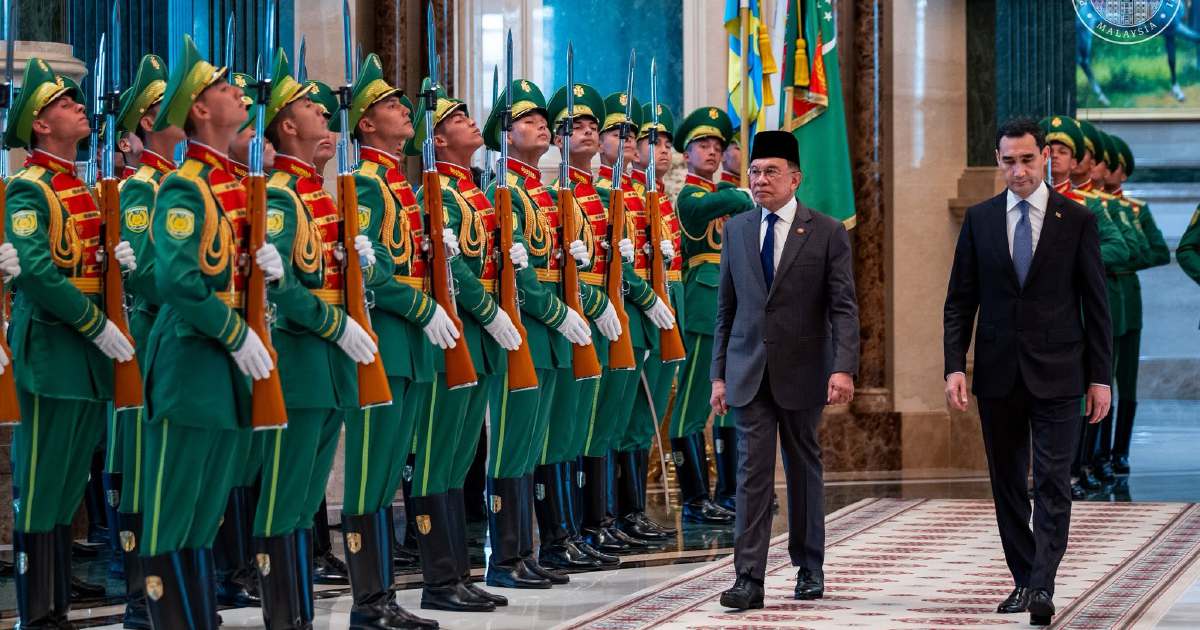
Prime Minister Datuk Seri Anwar Ibrahim has arrived in Turkmenistan for a landmark state visit, receiving full ceremonial honours at the Presidential Palace in Ashgabat. The occasion marks the first official trip by Malaysia's current premier to this strategically positioned Central Asian nation, underscoring Kuala Lumpur's intention to broaden its diplomatic footprint beyond traditional Southeast Asian boundaries.
The formal welcome extended to Anwar reflects Turkmenistan's diplomatic acknowledgement of Malaysia's growing role as an intermediary between Asia and the broader international community. Central Asia has increasingly become a focal point for emerging powers seeking to establish economic and political partnerships, particularly as the region manages its positioning between Russian and Chinese spheres of influence. Malaysia's engagement in this theatre signals a maturation of the country's foreign policy under Anwar's leadership, moving beyond reactive diplomacy towards proactive relationship-building with distant but economically significant partners.
Turkmenistan, bordered by Kazakhstan, Uzbekistan, Afghanistan, and Iran, sits atop vast reserves of natural gas and represents a critical nexus for energy commerce and transportation corridors linking Europe, Asia, and the Middle East. For Malaysia, a nation dependent on global energy markets and seeking diversified trade partnerships, establishing high-level political connections with Ashgabat opens potential avenues for bilateral cooperation spanning energy, technology transfer, and knowledge exchange. The presidential reception signals that both nations view this engagement as substantive rather than ceremonial.
Anwar's initial ascent to the premiership in late 2022 marked a significant political realignment domestically, but his administration has equally focused on rehabilitating Malaysia's international standing following years of political turbulence. State visits of this calibre—complete with presidential palace ceremonies—represent tangible outcomes of that rehabilitation effort. The dignified reception in Ashgabat serves as evidence that Malaysia remains a valued diplomatic interlocutor on the global stage, capable of commanding respect from distant governments.
The timing of this visit carries additional significance within the broader regional context. Southeast Asia and Central Asia remain largely disconnected despite complementary economic interests and shared exposure to transnational challenges including terrorism, trafficking, and climate vulnerability. Anwar's journey therefore potentially catalyzes broader patterns of inter-regional cooperation that could benefit Malaysia's commercial interests while positioning Kuala Lumpur as a bridge-builder between these distinct geographical zones.
Historically, Malaysian diplomatic engagement has concentrated on ASEAN, the Organisation of the Islamic Conference, and bilateral relationships with Western powers. The deliberate cultivation of ties with Central Asian nations represents a deliberate strategic diversification, reducing dependency on any single partnership vector while expanding Malaysia's options across the complex global order. For a mid-sized power like Malaysia, such portfolio expansion remains essential for long-term prosperity and security.
Turkmenistan's own foreign policy emphasizes perpetual neutrality, a constitutional principle that guides its international relations and makes state visits from non-neighbouring powers particularly noteworthy. The presidential reception accorded to Anwar thus demonstrates Ashgabat's willingness to elevate Malaysia's status as a partner worthy of ceremonial recognition, suggesting that substantive bilateral discussions are anticipated beyond the formalities of the welcome ceremony.
Energy cooperation naturally ranks prominently among potential discussion points. Malaysia's petrochemical industry and energy requirements create natural intersections with Turkmenistan's vast hydrocarbon reserves, though geographical distance and existing contractual commitments to other buyers present practical limitations. However, technological cooperation, particularly in liquefied natural gas processing and downstream manufacturing, offers realistic avenues for collaboration that could benefit both economies.
Anwar's visit also reflects Malaysia's broader engagement with the Organisation of Islamic Cooperation, within which both nations hold membership. As a Muslim-majority democracy navigating contemporary geopolitical complexities, Malaysia's relationship with Turkmenistan carries subtle but real significance for the wider Islamic world's approach to development and modernization. Both nations represent alternative models of governance and economic organization within Muslim contexts, potentially creating common ground for exchange on policy challenges ranging from education to economic diversification.
The Presidential Palace ceremony represents merely the formal opening of what may develop into sustained institutional engagement. Subsequent discussions between senior officials will likely address mechanisms for enhanced trade, student exchange programmes, diplomatic coordination on multilateral platforms, and potentially security cooperation in areas of mutual concern. The symbolic importance of the state reception lies in its public signalling that both governments prioritize this relationship sufficiently to invest ceremonial capital.
For Malaysian observers, this visit underscores their government's commitment to expanding Malaysia's global influence beyond comfortable regional confines. Anwar's administration appears determined to leverage Malaysia's position as a stable, diplomatically experienced actor capable of engaging constructively across diverse political and cultural contexts. Turkmenistan's warm reception validates this approach, suggesting that Malaysia's diplomatic rehabilitation efforts are yielding measurable international acknowledgement.
Looking forward, the success of this visit will ultimately be measured not by the pageantry of the welcome ceremony but by concrete outcomes in trade volumes, institutional partnerships, and coordinated positions within multilateral forums. The official reception in Ashgabat represents a promising beginning to a relationship that, if carefully cultivated, could open doors for Malaysian enterprise across Central Asia while contributing to Malaysia's strategic positioning in an increasingly multipolar international system.
%22%2F%3E%3C%2Fpattern%3E%3C%2Fdefs%3E%3Crect%20width%3D%22100%25%22%20height%3D%22100%25%22%20fill%3D%22url(%23ph3n7zyg)%22%2F%3E%3Crect%20width%3D%22100%25%22%20height%3D%22100%25%22%20fill%3D%22url(%23ph3n7zyp)%22%2F%3E%3Ctext%20x%3D%2250%25%22%20y%3D%2250%25%22%20text-anchor%3D%22middle%22%20dominant-baseline%3D%22central%22%20fill%3D%22rgba(255%2C255%2C255%2C0.95)%22%20font-family%3D%22Georgia%2C%20'Times%20New%20Roman'%2C%20serif%22%20font-weight%3D%22700%22%20font-size%3D%22320%22%20letter-spacing%3D%22-0.02em%22%3EKTMB%3C%2Ftext%3E%3C%2Fsvg%3E)