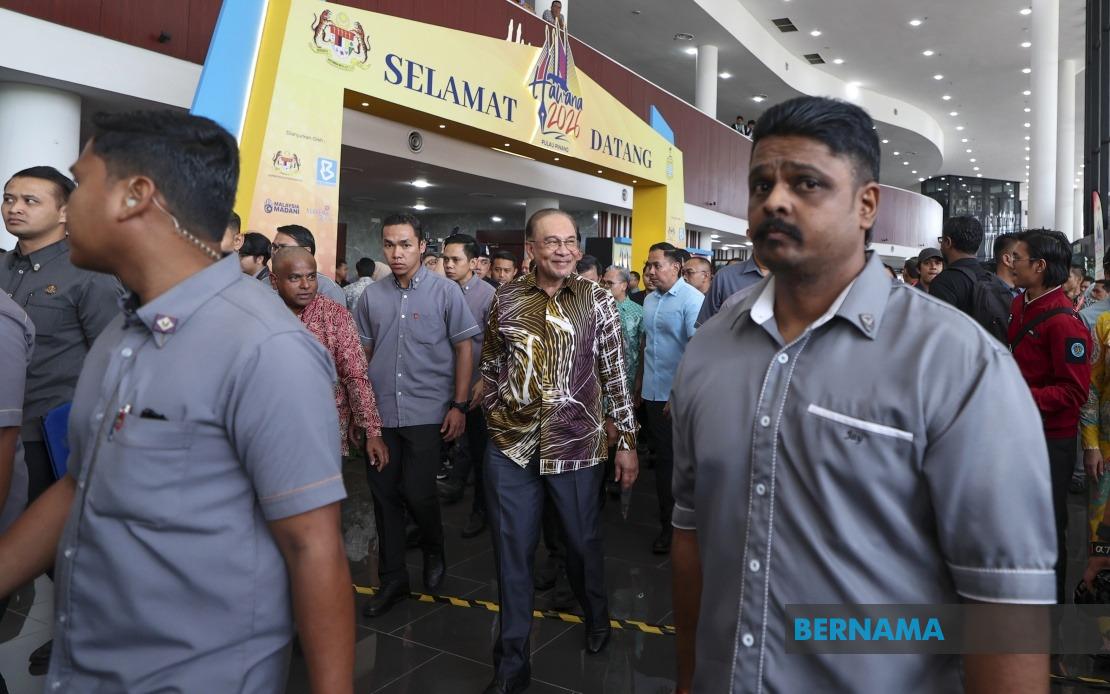
Prime Minister Datuk Seri Anwar Ibrahim officially inaugurated the HAWANA 2026 National Journalists' Day celebration at the PICCA Convention Centre @ Butterworth Arena in Penang on Thursday, marking a significant gathering for the region's media community. The Prime Minister's arrival at 2.40 pm signalled the formal commencement of the event's headline proceedings, underscoring the government's commitment to recognising the vital role of journalism in Malaysia's democratic landscape.
Anwar was formally received by Penang Chief Minister Chow Kon Yeow, Communications Minister Datuk Fahmi Fadzil, and senior ministry officials, reflecting the importance placed on the occasion at both federal and state levels. The ceremonial welcome demonstrated cross-government alignment on media policy and the significance of honouring the fourth estate. Upon arrival, the Prime Minister engaged with the event's exhibition displays and toured the HAWANA 2026 Photo Gallery installed in the venue's foyer, providing a personal glimpse into the contributions and achievements of Malaysia's journalism sector over recent years.
The gathering brought together an impressive constellation of senior figures from Malaysia's news establishment and regional counterparts. Bernama chairman Datuk Seri Wong Chun Wai, chief executive officer Datin Paduka Nur-ul Afida Kamaludin, and editor-in-chief Arul Rajoo Durar Raj were among those present, alongside key working committee members orchestrating the two-day event. Their involvement underscored how Malaysia's premier state news agency views HAWANA as a cornerstone initiative for reinforcing professional standards and institutional prestige within the region's media infrastructure.
The international dimension of the celebration was particularly notable, with delegations from across Southeast Asia attending to participate in discussions on contemporary journalism challenges and opportunities. Timor-Leste's Secretary of State for Social Communication Expedito Loro Dias Ximenes, Cambodia's Undersecretary of State at the Ministry of Information Prak Thaveak Amida, and Laos's Permanent Secretary for the Cabinet Office at the Ministry of Technology and Communications Phuangpasert Keosouvanh represented their respective governments' commitment to collaborative regional media development. This ASEAN participation reflects how professional journalism standards have become a shared priority across the ten-member bloc, particularly as digital transformation and misinformation present common challenges to news integrity.
Timor-Leste's Agencia Noticiosa de Timor-Leste (TATOLI), represented by President Noemio Mateus Soares Falcao and Deputy President Madalena DE JCP Carlos, brought additional perspective from a younger nation's media institution. Meanwhile, major news agencies from Indonesia's Antara News Agency and Vietnam News Agency (VNA), alongside China's Xinhua, participated alongside regional journalist associations including Indonesia's PWI and the Ikatan Setiakawan Wartawan Malaysia-Indonesia (ISWAMI). This breadth of representation highlighted how HAWANA has evolved from a domestic recognition platform into a strategic convening space for shaping media discourse across a crucial region.
The substantive centrepiece of the event involved the Prime Minister presenting HAWANA Awards and Special HAWANA Awards to individuals whose contributions have significantly advanced journalism practice and informed public discourse in Malaysia. These honours carry particular weight in a region where professional recognition remains essential for maintaining morale and standards within news organisations often operating under resource constraints. The awards ceremony celebrated individual achievement while simultaneously reinforcing institutional commitment to journalistic excellence and ethical practice across the sector.
Beyond formal honours, the occasion provided an opportunity for meaningful support to veteran journalists through the Kasih@HAWANA Fund. The Prime Minister's presentation of contributions from this dedicated fund to deserving media veterans acknowledged the often precarious economic circumstances facing retiring journalists in Malaysia and the region broadly. This welfare dimension demonstrates how HAWANA extends beyond ceremonial recognition to address tangible professional security concerns affecting those who have devoted careers to public information service.
The overarching theme of this year's celebration—"Media Integrity Strengthens Credibility"—reflects contemporary challenges facing journalism globally. In Southeast Asia particularly, where digital platforms have disrupted traditional business models and where misinformation campaigns have targeted democratic processes, the emphasis on integrity gains heightened resonance. By positioning credibility as a fundamental outcome of principled editorial practice, organisers signalled that professional standards represent not merely professional preference but essential infrastructure for democratic health and public trust.
The scale of the gathering, attracting approximately 1,000 media practitioners from Malaysia and international locations, transformed the event into a substantive platform for examining journalism's evolving role and responsibilities. Such large-scale assemblies provide rare opportunities for practitioners scattered across newsrooms and digital media outlets to connect, exchange experiences, and collectively examine emerging professional questions. The convening itself serves functional purpose beyond ceremonial celebration, fostering networks and mutual understanding essential for maintaining professional community during periods of technological and business model disruption.
Organised by the Ministry of Communications with Bernama as implementing agency, HAWANA represents government investment in formalising recognition and advancement of journalism as a profession worthy of institutional attention. This structure acknowledges that while editorial independence remains essential, journalists also require regulatory clarity, professional development support, and institutional validation of their societal contribution. For Malaysian readers and regional observers, the event underscores how the government views media engagement as an ongoing dialogue requiring regular ceremonial and substantive reinforcement.
The 2026 iteration of HAWANA occurs within a particular regional moment characterised by heightened scrutiny of news quality, persistent questions about digital platform accountability, and ongoing tensions between editorial autonomy and government expectations. The gathering's emphasis on integrity and credibility implicitly addresses these tensions, suggesting that professional excellence represents the optimal path for balancing public interest, journalistic independence, and institutional accountability. For practitioners across Malaysia and ASEAN, the ceremony served as both recognition and gentle reminder that journalism's legitimacy ultimately rests on consistent delivery of accurate, contextualised, and ethically produced information to increasingly sophisticated audiences navigating complex information environments.
Looking forward, the 2026 celebration establishes precedent for continued government engagement with journalism as a profession requiring recognition and investment. The regional participation suggests that HAWANA functions increasingly as a Southeast Asian forum rather than merely Malaysian event, with implications for how professional standards, ethical frameworks, and journalistic practice may eventually be harmonised across borders. For Malaysia specifically, the event reinforces official commitment to supporting journalism as essential democratic infrastructure while providing opportunity for the sector itself to demonstrate responsiveness to calls for integrity and credibility in an era of information abundance and trust deficits.
%22%2F%3E%3C%2Fpattern%3E%3C%2Fdefs%3E%3Crect%20width%3D%22100%25%22%20height%3D%22100%25%22%20fill%3D%22url(%23ph25143g)%22%2F%3E%3Crect%20width%3D%22100%25%22%20height%3D%22100%25%22%20fill%3D%22url(%23ph25143p)%22%2F%3E%3Ctext%20x%3D%2250%25%22%20y%3D%2250%25%22%20text-anchor%3D%22middle%22%20dominant-baseline%3D%22central%22%20fill%3D%22rgba(255%2C255%2C255%2C0.95)%22%20font-family%3D%22Georgia%2C%20'Times%20New%20Roman'%2C%20serif%22%20font-weight%3D%22700%22%20font-size%3D%22320%22%20letter-spacing%3D%22-0.02em%22%3ETV3%3C%2Ftext%3E%3C%2Fsvg%3E)