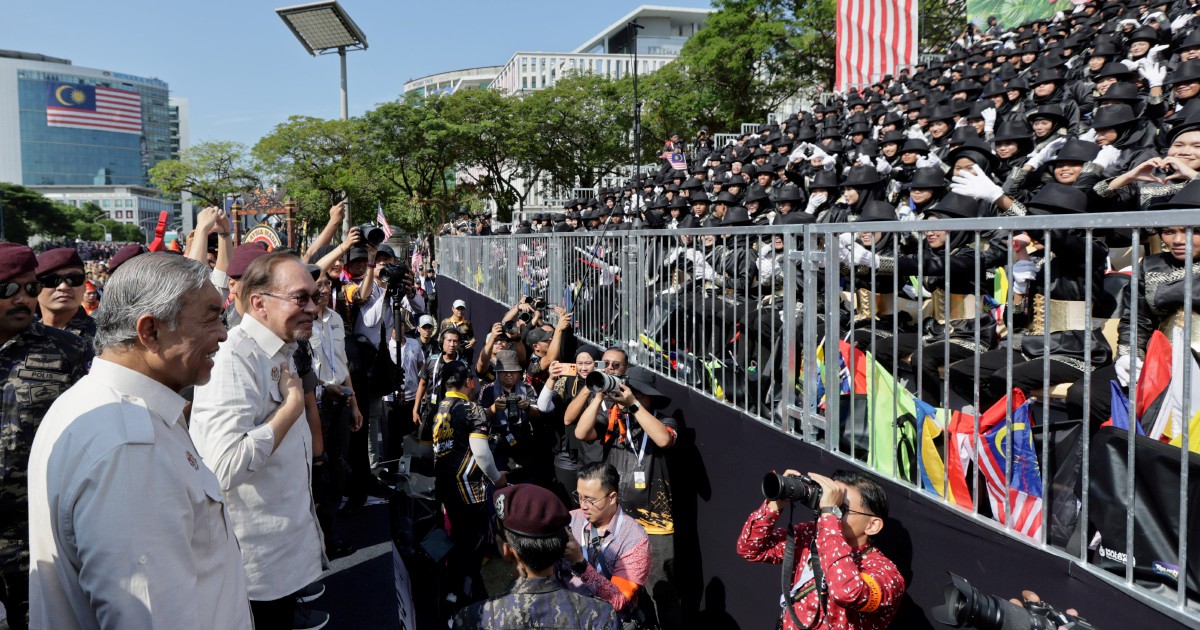
Prime Minister Datuk Seri Anwar Ibrahim demonstrated an approachable demeanor during festivities at Dataran Putrajaya today, setting aside formal protocol to connect directly with Malaysian citizens in attendance at the National Day parade. The walkabout, which followed the conclusion of the ceremonial proceedings, saw the premier making deliberate stops to engage with spectators, particularly children positioned along the parade route who had gathered to witness the commemoration of the nation's independence.
The interactions highlighted a dimension of public engagement that extends beyond the traditional formality associated with high-level state functions. By pausing his movement through the crowd on multiple occasions, Anwar signaled an openness to direct dialogue with ordinary Malaysians, a gesture that observers noted represented an informal approach to leadership visibility during a significant national occasion. The embrace of children present at the venue underscored the premier's effort to connect across generational lines during the celebration.
National Day commemorations at Dataran Putrajaya typically draw substantial crowds and constitute key moments for political leaders to demonstrate their accessibility to the electorate. The venue in the federal administrative capital serves as a symbolic location for such gatherings, as it represents the institutional heart of governance. Public interactions during such events often receive significant media attention, as they provide insight into how leadership figures navigate the delicate balance between official responsibilities and constituent engagement.
The walkabout format employed by Anwar—rather than remaining positioned at viewing platforms or ceremonial stages—suggested a conscious choice to embed himself within the crowd rather than maintain physical or psychological distance from attendees. This approach contrasts with more insular executive engagement models and has become increasingly common among contemporary political leaders seeking to project accessibility and relatability to diverse voter constituencies. The decision to embrace children specifically carries particular symbolic weight, as it visually communicates a connection to Malaysia's younger demographics and future generations.
National Day celebrations serve multiple functions within the Malaysian political and social calendar. Beyond their ceremonial significance as commemorations of independence achieved in 1957, these occasions provide platforms for demonstrating national unity and for leaders to reinforce messages of patriotism and collective identity. The scale of attendance at Dataran Putrajaya during such events reflects the continued importance Malaysians accord to the national holiday, with families and school groups regularly participating in the festivities.
Anwar's approach to public engagement during the parade follows a broader pattern observed among Malaysian political figures in recent years, wherein direct interaction with constituents has become increasingly valued as a means of demonstrating authentic connection to the electorate. The informal nature of such encounters—stopping mid-walkabout to embrace individuals rather than delivering prepared remarks—suggests an effort to project spontaneity and genuine interest in individual Malaysians rather than engagement choreographed for media consumption alone.
The presence of children at the event underscores the intergenerational dimension that National Day celebrations emphasize. School participation in such commemorations has long formed a core component of how Malaysia transmits national identity and civic consciousness to younger cohorts. By directing particular attention toward children present at the venue, Anwar engaged with a demographic that carries particular resonance within the national narrative, even as it represents the constituency most dependent upon governance decisions regarding education, infrastructure, and future economic opportunities.
From a communications perspective, the walkabout and subsequent interactions generated visual content that would circulate through multiple media channels and social platforms, amplifying the reach and resonance of the premier's presence at the event. The documentation of such moments—referenced in the original reporting through the video notation—extends the impact beyond those physically present at Dataran Putrajaya, creating a broader public record of leadership engagement that can influence perceptions of accessibility and relatability across the national audience.
National Day observances at the federal seat of government additionally carry institutional significance beyond their public celebration dimension. The choice to mark the occasion with substantive public engagement rather than perfunctory appearances reinforces messaging about the continuity of democratic governance and the ongoing relevance of the independence achieved decades earlier. For Anwar specifically, such public-facing moments during major national occasions contribute to the broader projection of his premiership and his approach to the relationship between executive authority and popular sentiment.
The informal nature of the interactions also provides a counterpoint to the formal ceremonial components that characterize official National Day proceedings. While parades feature military contingents, official speeches, and choreographed performances designed to project state authority and national cohesion, the post-parade engagement with crowds introduces an element of spontaneity and human connection that complements rather than detracts from official commemoration. This duality—combining formal ceremony with informal accessibility—appears increasingly central to how Malaysian political leadership navigates the expectations and symbolism surrounding major national occasions.
Looking forward, such moments of direct public engagement during significant national events contribute to the accumulation of impressions and perceptions that shape broader public evaluations of leadership performance. The willingness to embrace children and engage warmly with citizens present at such occasions resonates within collective memory and influences how Malaysians perceive their prime minister's relationship to the nation and its people. For a government seeking to maintain public confidence and demonstrate genuine connection to diverse constituencies, such visible engagement remains a valuable element of political communication and leadership projection.

