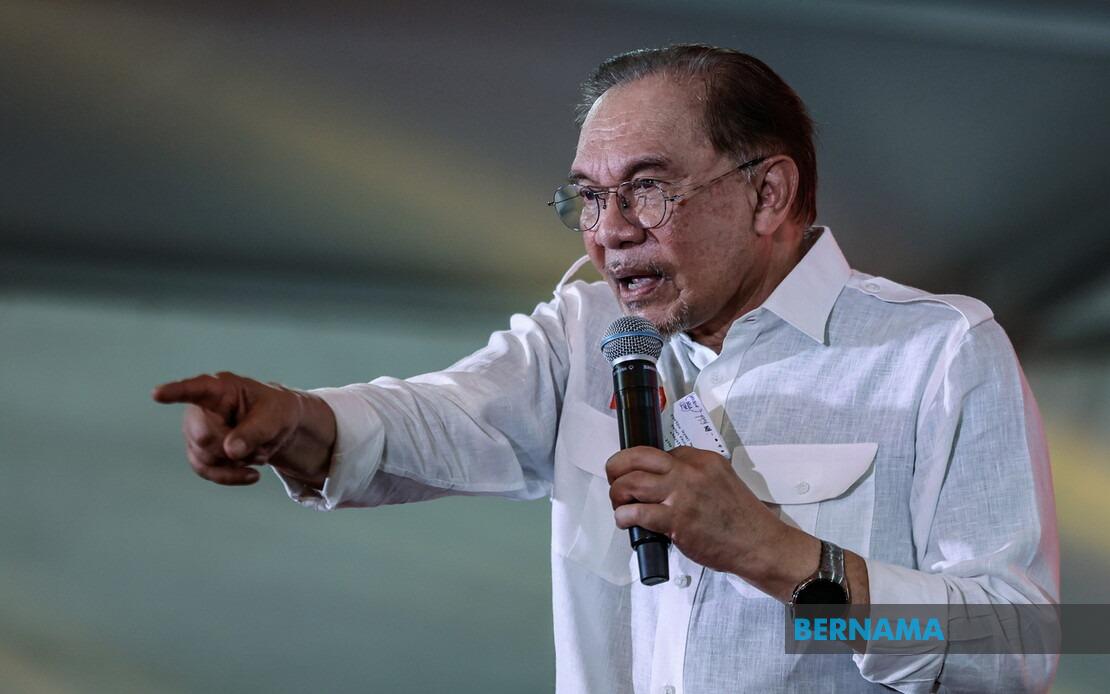
Prime Minister Datuk Seri Anwar Ibrahim has expressed frustration with what he characterizes as unwarranted political attacks from Kedah Menteri Besar Datuk Seri Muhammad Sanusi Md Nor, emphasizing that his administration has maintained a consistent focus on driving development projects that benefit the state's residents. Speaking at a Pakatan Harapan campaign event in Simpang Renggam on July 10, Anwar sought to rebut suggestions that Kedah has been marginalized under federal oversight, asserting instead that his government has actively invested in regional infrastructure and economic initiatives.
The tension between the two leaders appears rooted in divergent political narratives about the distribution of federal resources and attention. Anwar pointed out that despite Muhammad Sanusi's public criticism—including remarks made during a visit to Johor—the Menteri Besar was notably absent when the Prime Minister traveled to Kedah to facilitate significant international collaboration. The contrast underscores a broader dynamic in Malaysian politics where state-level opposition figures sometimes question whether the federal government privileges allied states in resource allocation, a perception Anwar has directly challenged.
A cornerstone of Anwar's visit to the northern border region was his participation in a ceremonial event alongside Thailand's Prime Minister Anutin Charnvirakul, who traveled specifically to Bukit Kayu Hitam rather than meeting in Malaysia's capital. This deliberate choice of location, far from Kuala Lumpur's political epicenter, signals the federal government's strategic interest in developing the border economy through cross-national infrastructure cooperation. The opening of a new road alignment connecting Malaysia's Bukit Kayu Hitam Immigration, Customs, Quarantine and Security Complex with Thailand's corresponding Sadao facility represents a tangible commitment to reducing bottlenecks and facilitating trade flows that benefit both Perlis and Kedah significantly.
Anwar's emphasis on this border development project carries particular relevance for Southeast Asian readers cognizant of regional integration efforts. The Malaysia-Thailand border corridor has historically been underdeveloped relative to its economic potential, with congestion at crossing points constraining bilateral commerce. By elevating the profile of such infrastructure through high-level international ceremonies, the federal government attempts to demonstrate that opposition-ruled states receive equivalent attention to those governed by coalition partners. This approach reflects a pragmatic acknowledgment that Malaysia's federal structure requires equitable treatment regardless of electoral outcomes at the state level.
The Prime Minister's statement that he does not "sideline any state, including those governed by the opposition" represents a deliberate assertion of federalist principle, though one that carries implicit acknowledgment of existing tensions. Anwar framed his responsibility as extending to all Malaysians rather than being constrained by partisan considerations, a rhetorical positioning that seeks to occupy moral high ground while simultaneously addressing perceptions of political favoritism that periodically surface in Malaysian discourse. This framing becomes particularly important in states like Kedah, where PAS governance exists within a broader landscape of competition between federal and state-level powers.
Anwar's comments arrived during an intensified campaign period ahead of Johor state elections, suggesting that the broader inter-coalition dynamics in peninsular Malaysia continue to shape how federal leaders engage with opposition-controlled territories. The Prime Minister's attendance at multiple Johor campaign events on the same day reflects Pakatan Harapan's strategic priorities heading into electoral contests that will influence the coalition's parliamentary arithmetic. However, his willingness to publicly address criticisms from a PAS-led state government indicates that federal-state relations remain sufficiently contentious to warrant direct engagement at the highest political levels.
Beyond the immediate political dispute, Anwar used the occasion to announce potential expansion of the Sumbangan Asas Rahmah assistance programme, contingent upon continued federal stability and electoral support for Pakatan Harapan. The SARA initiative represents a key welfare component of the coalition's governance agenda, and its potential enhancement signals the government's intention to leverage improved financial management toward expanded social provisioning. Anwar explicitly linked this possibility to prudent fiscal stewardship and absence of financial leakage, framing welfare expansion not as political opportunism but as the fruit of responsible administration.
The fiscal discipline narrative advanced by Anwar carries significance for Malaysian audiences grappling with inflation concerns and cost-of-living pressures. By attributing potential welfare increases to careful financial management rather than deficit spending, the Prime Minister positions his government as capable of both fiscal rectitude and expanding social support—a politically attractive combination if credible. Whether such projections materialize will substantially influence public perceptions of federal economic competence heading into subsequent electoral cycles.
The underlying dynamics between Anwar and Muhammad Sanusi reflect broader tensions within Malaysia's political ecosystem where state governments and federal authorities of differing political orientations must navigate resource allocation, development priorities, and regulatory jurisdiction. While Anwar's assertions about his government's commitment to all states carry merit, the fact that such assurances require public articulation suggests that questions about federal-state equity remain persistent within Malaysian political culture. The border infrastructure initiative represents a concrete example of federal investment in an opposition-ruled state, yet it evidently has not fully assuaged concerns about potential political bias in resource distribution.
The episode also illuminates how Malaysian politics continues to operate within a framework where personal relationships between senior leaders significantly influence inter-governmental cooperation. The absence of the Kedah Menteri Besar during Anwar's visit—whether circumstantial or deliberate—communicated a political message that transcended the substance of the announced infrastructure project. Such symbolic dimensions of political engagement often carry as much weight as material policy outcomes in shaping public perceptions of federal-state relations.
Moving forward, the success of initiatives like the Bukit Kayu Hitam border development in generating tangible economic benefits will likely shape both public opinion and the trajectory of federal-state relations in the northern region. If such projects demonstrably improve commerce and employment opportunities, they may partially defuse ongoing criticism regarding federal resource distribution. Conversely, if implementation stalls or benefits remain concentrated rather than broadly distributed, political tensions will probably intensify. The intersection of infrastructure development, fiscal management, and political rivalry evident in Anwar's recent statements will continue defining Malaysian governance dynamics as the nation navigates post-election reconstruction and electoral cycles ahead.

