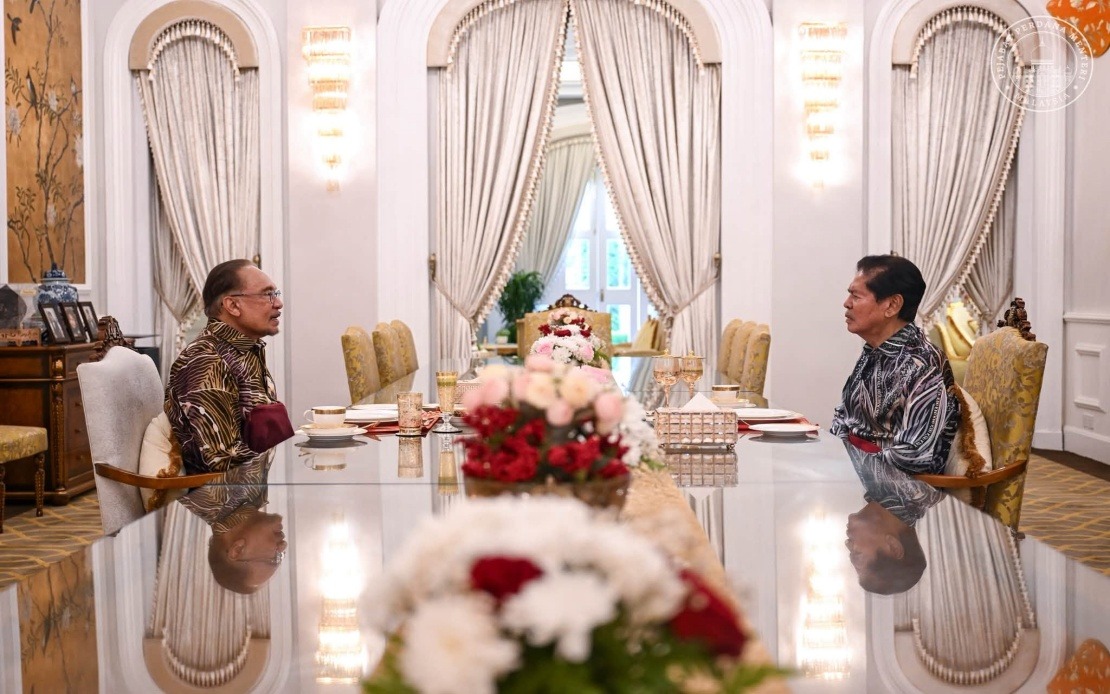
Prime Minister Datuk Seri Anwar Ibrahim brought his two-day working visit to Penang to a close on August 29 with a formal tea reception held at Seri Mutiara, the official residence of Penang Governor Tun Ramli Ngah Talib. The final engagement underscored the collaborative relationship between Malaysia's federal administration and the state government, serving as both a symbolic and substantive moment for cementing governance partnerships.
In remarks posted on Facebook following the reception, Anwar highlighted how the gathering had reinforced the existing cooperation between Kuala Lumpur and George Town. He emphasised that the occasion reaffirmed the mutual commitment shared by federal and state authorities toward advancing Penang's developmental agenda and improving living standards for its residents. Such diplomatic courtesies, while sometimes routine in official calendars, carry significance in Malaysia's federal system, where maintaining cordial ties between central and state administrations affects policy implementation and resource allocation.
Ramli, for his part, expressed genuine appreciation at hosting the Prime Minister at his residence. The Governor characterised the visit as a valuable platform for discussing pressing matters affecting both the state and the nation at large. His comments reflected the typical diplomatic tone adopted during high-level state visits, where officials seek to project harmony and purposeful dialogue. The choice of venue—the Governor's private official residence rather than a government office—signalled an attempt to create a more informal, collegial atmosphere despite the formal nature of the occasion.
A particularly candid detail emerged when Ramli shared that the gathering was enlivened by the presence of his grandson, Aldrey Alfi. The young boy's enthusiasm in posing questions to the Prime Minister, and Anwar's receptiveness in engaging with him, became a humanising element within what could otherwise be a purely ceremonial affair. Ramli's gratitude for this personal touch reflected how such moments—where national leaders interact naturally with families—can reinforce public perceptions of accessibility and warmth in political leadership.
Anwar's sojourn through Penang, spanning two full days, encompassed a diverse array of official commitments that painted a picture of targeted governance priorities. The Permatang Pauh Entrepreneur Revival Programme featured prominently on the itinerary, reflecting the government's emphasis on supporting small and medium-sized enterprises and fostering economic resilience at the grassroots level. This particular programme carries local resonance, as Permatang Pauh itself is a constituency with historical political significance and a vibrant business community that depends on such support mechanisms.
The Prime Minister's attendance at the 15th Malaysia Scout Jamboree represented another dimension of his visit, highlighting the government's investment in youth development and character building through organised scouting activities. Such participation by top political leaders serves multiple purposes: it demonstrates government backing for youth organisations, provides a platform for addressing young Malaysians directly, and generates positive media coverage around community engagement initiatives. The jamboree setting offered Anwar an opportunity to interact with scouts from across the nation, reinforcing messages about national unity and civic responsibility.
Complementing these engagements was the Prime Minister's involvement in the MADANI Sahabat 2026 National Day Countdown Programme. This initiative appears aligned with the government's broader MADANI framework—the administration's development philosophy centring on prosperity, inclusivity, and consensus-building. By launching preparatory activities for National Day celebrations nearly a year in advance, the government signals intention toward comprehensive planning and sustained momentum in building national consciousness and community participation.
The breadth of Anwar's schedule during his Penang stay reflected a deliberate strategy of engaging multiple constituencies and stakeholder groups within a single visit. Rather than confining himself to elite or governmental circles, the Prime Minister made deliberate efforts to connect with entrepreneurs, youth, and ordinary citizens participating in community programmes. This approach mirrors contemporary political communication strategies, where leaders seek to demonstrate accessibility and concern across demographic segments.
From a federal-state relations perspective, Anwar's visit and its concluding tea reception carry particular importance for Penang. The state, while economically significant and politically competitive, benefits from regular high-level federal attention and reassurance of collaborative partnership. The Governor's formal hosting of the Prime Minister, and the subsequent exchange of courtesies, serves to reinforce institutional bonds that underpin the implementation of federal policies and coordinated development initiatives. In Malaysia's context, where resource flows and development prioritisation often involve state-federal negotiations, maintaining such relationships proves administratively consequential.
The Facebook documentation of these events by both Anwar and Ramli reflects modern political communication practices, where social media platforms become primary vehicles for framing official narratives and reaching constituencies directly. By sharing details of their meeting, both leaders project engagement, accessibility, and collaborative spirit to their respective audiences. The informal tone adopted in Ramli's post—particularly regarding his grandson's interaction with the Prime Minister—humanises political leadership in ways that traditional press releases alone cannot achieve.
Looking forward, Anwar's Penang visit exemplifies the rhythm of high-level political engagement necessary for sustaining federal-state harmony in Malaysia's Westminster-influenced system. Regular such visits, coupled with substantive discussions on policy and development, help prevent the institutional friction that can arise when political leadership at different levels operates in isolation from one another. For Penang residents and observers elsewhere in Southeast Asia watching Malaysian governance dynamics, such moments of apparent accord between federal and state authorities signal stable political functioning and shared developmental vision.

