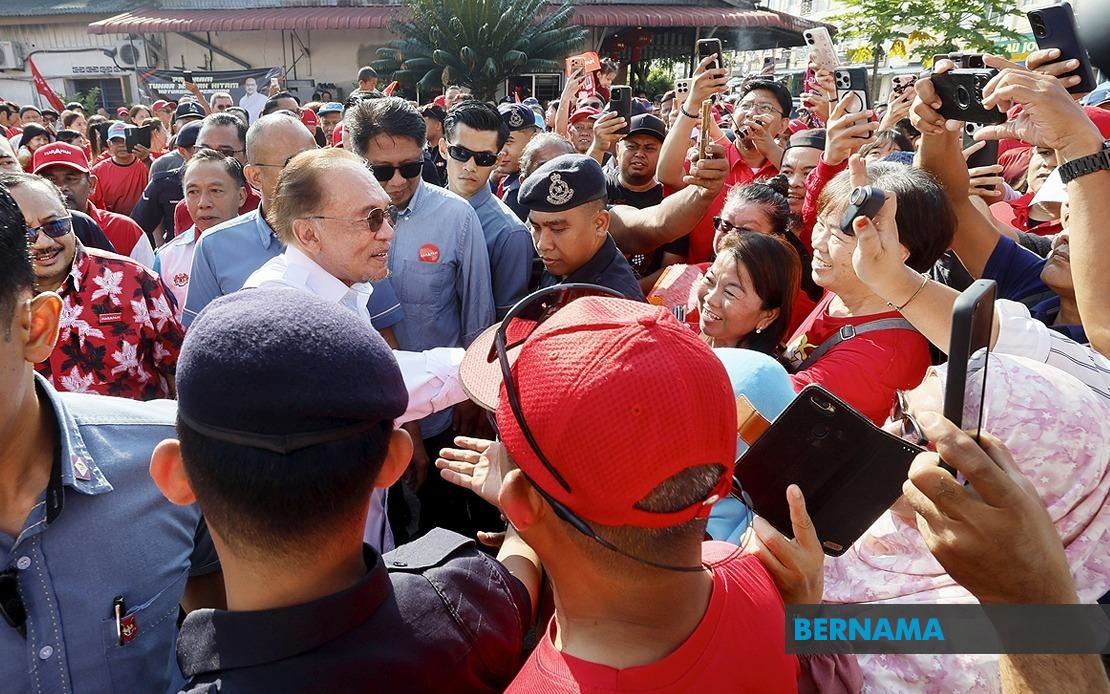
Prime Minister Datuk Seri Anwar Ibrahim has emphasised that his administration maintains an impartial stance when distributing federal resources and development projects across Malaysia, rejecting any suggestion that political alignment influences government assistance to states and communities. Speaking at a campaign event in Batu Pahat during the 16th Johor state election, the Pakatan Harapan chairman underscored the government's principle of equitable treatment, asserting that developmental initiatives are implemented nationwide without partisan consideration.
Anwar's remarks carry particular weight amid ongoing scrutiny regarding how federal funding flows to opposition-controlled states. His assertion reflects a broader narrative the federal administration has sought to establish since assuming power—that governance priorities transcend electoral calculations and factional loyalties. The Prime Minister's comments suggest the government recognises the political sensitivity surrounding resource allocation in a federation where state and federal governments are often controlled by competing coalitions.
The administration has pointed to concrete projects as tangible proof of its commitment to statewide equity. In Johor specifically, Anwar highlighted the Johor-Singapore Special Economic Zone development as a flagship initiative requiring sustained federal investment and coordination. This project carries strategic importance beyond its economic dimensions, positioning Malaysia as a vital node in regional trade corridors and demonstrating federal commitment to peninsular economic hubs.
Flood mitigation represents another dimension of the federal government's stated commitment to Johor. The approval of billions of ringgit for flood management infrastructure in Segamat and Muar indicates recognition of climate-related vulnerabilities affecting the state. These investments respond to documented flooding challenges that have periodically devastated communities, displacing residents and hampering economic activity. By allocating substantial resources to flood mitigation, the federal government addresses infrastructure deficits that affect citizen welfare regardless of electoral outcomes.
The Prime Minister's reference to Kelantan and Kedah extends his equity argument beyond Johor, suggesting a pattern of federal engagement across diverse political contexts. Kelantan has remained a Pakatan Islam Malaysia stronghold for extended periods, while Kedah has alternated between coalitions. Including these states in his development narrative indicates awareness that federal programmes must span the full ideological spectrum of Malaysian governance to maintain credibility.
Anwar specifically rejected the electoral calendar as determining factor for federal assistance, emphasizing that the government's development portfolio reflects sustained commitment rather than campaign-season promises. This distinction addresses a persistent criticism that ruling coalitions sometimes prioritise targeted support in swing states during election periods while neglecting constituencies deemed electorally secure or irretrievably lost. The Prime Minister's framing suggests a deliberate effort to decouple federal resource distribution from immediate electoral incentives.
The campaign event in Senggarang featured prominent federal ministers and Pakatan Harapan candidates contesting the 16th Johor state election, including Communications Minister Datuk Fahmi Fadzil. The assembled leadership attempted to project administrative coherence and unified messaging regarding federal-state relations. The presence of candidates for Senggarang, Semerah, and Penggaram seats demonstrated the coalition's effort to link federal governance performance to state-level electoral prospects.
For Malaysian voters contemplating the relationship between state and federal governments, Anwar's assertions invite evaluation against empirical indicators. Fiscal transfers to states, infrastructure spending per capita, and project completion rates across different political contexts provide measurable benchmarks against which equity claims can be assessed. The federal government's willingness to submit such claims to public scrutiny suggests confidence in underlying data, though independent analysis of resource allocation patterns across states continues to attract academic and journalistic attention.
The political economy of Malaysian federalism means that managing perceptions of equitable treatment carries implications extending beyond immediate electoral cycles. Citizens across states monitor federal behaviour for signs of favouritism or discrimination, and accumulated grievances regarding resource allocation can solidify political preferences across generations. By explicitly addressing concerns about partisan bias in federal resource distribution, Anwar signals awareness that long-term political legitimacy depends upon institutional credibility regarding fair governance.
Regional dynamics add context to the federal government's emphasis on development projects linking Malaysia with neighbouring economies. The Johor-Singapore Special Economic Zone positions the state within broader Southeast Asian economic integration trends, potentially benefiting not only Johor residents but creating spillover effects across the region. Federal promotion of such initiatives demonstrates how development projects serve multiple objectives simultaneously—addressing local welfare needs, advancing state-level economic objectives, and situating Malaysia within regional frameworks.
The federal government's approach to development allocation reflects deeper tensions within Malaysian governance regarding centralism and federalism. States retain constitutionally defined powers, yet federal governments control substantial fiscal resources. Navigating this dynamic while maintaining political legitimacy requires both actual equitable conduct and effective communication of that conduct. Anwar's public statements represent the communicative dimension of federal governance, complementing underlying policy frameworks that determine actual resource flows.
Moving forward, the federal government faces ongoing pressure to demonstrate that development initiatives reflect needs-based assessment rather than political calculations. Citizens across states expect federal governments to behave as stewards of national resources serving collective interests. Anwar's emphasis on non-partisan governance provides a framework against which his administration's subsequent conduct will be measured, establishing benchmarks that constrain future discretionary decision-making around resource allocation.

