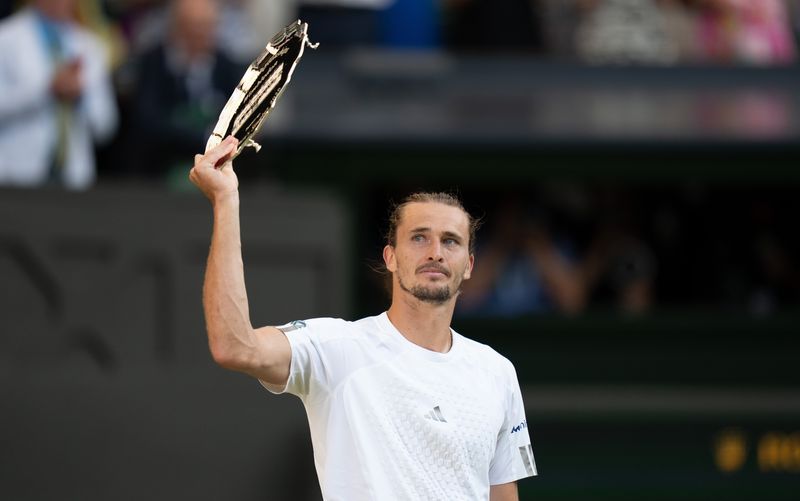
Alexander Zverev's journey to the Wimbledon final represents a significant milestone in his career trajectory, propelling him to the second position in the ATP world rankings on Monday. Yet beyond the ranking points and the consolation of reaching his first grasscourt championship decider, the 29-year-old German is contemplating something more profound: whether his transformation into a more aggressive competitor can finally elevate him into genuine contention against Jannik Sinner and Carlos Alcaraz, the two players who currently define elite men's tennis.
In a gripping final contested on Centre Court on Sunday, Zverev confronted Sinner in a contest that transcended the conventional narrative of dominance. The Italian world number one ultimately prevailed 6-7(7) 7-6(2) 6-3 6-4, but the scoreline masks a match of genuine substance and competitiveness that Zverev had rarely mustered against his superior opponent. This represented Zverev's tenth consecutive defeat to Sinner, yet the manner of this defeat departed dramatically from the pattern established over their previous meetings. For nearly all of their prior encounters, Zverev had surrendered 14 consecutive sets to his Italian rival without mounting credible resistance. Against that backdrop, Sunday's challenge felt like a watershed moment, a demonstration that Zverev had fundamentally altered his approach to competing at tennis's highest level.
The margins that separated victor from vanquished proved remarkably thin. At 3-3 in the third set, with break point in hand, Zverev tumbled during a crucial rally—his only genuine opportunity to shift the match's momentum. That fall, he would later explain, caused him to overextend his knee in a manner reminiscent of an injury sustained two years prior. The physical setback reverberated through his performance, particularly his serving mechanics, as his first-serve pace visibly diminished in the aftermath. Had that point gone differently, had the grass not betrayed him at that precise moment, Zverev might have authored a different narrative entirely, potentially becoming the first German male singles champion at the All England Club since Michael Stich claimed the title in 1991.
For Malaysian and Southeast Asian tennis enthusiasts, Zverev's ascent carries particular resonance as it signals the potential for genuine competition beyond the Sinner-Alcaraz duopoly that has come to define contemporary professional tennis. The region has long followed the sport's elite competitors with passionate engagement, and the possibility of a third challenger genuinely threatening the established order appeals to the broader narrative of competitive balance. Zverev's emergence into genuine contention offers something the sport has lacked in recent seasons: genuine competitive uncertainty at the sport's pinnacle.
Zverev's evolution stems directly from his maiden Grand Slam triumph at the French Open last month, a breakthrough that arrived at his 41st major championship attempt. Critics had noted that his Paris victory came with significant caveats—Sinner's second-round exit and Alcaraz's absence through wrist complications meant the field lacked its usual top-tier depth. Yet the psychological liberation that victory provided cannot be dismissed. Zverev arrived at Wimbledon with newfound confidence, manifesting in a markedly more attacking profile, particularly through his forehand stroke. For years, tennis observers and Zverev himself had acknowledged that his forehand operated with excessive caution, a technical limitation that allowed opponents to dictate rallies. At Wimbledon, that constraint appeared to dissolve.
Statistically, Zverev's first-serve percentage hovered around 80 percent throughout the final, complemented by a weaponised forehand deployed with aggressive intent rather than defensive necessity. When opportunities presented themselves, Zverev attacked rather than consolidating. This philosophical commitment to offense rather than counterpunching represents a deliberate recalibration of his competitive philosophy. Speaking to reporters after his defeat, Zverev articulated this shift with unmistakable clarity: he had announced at the outset of 2024 his intention to embrace this attacking paradigm, and he had maintained fidelity to that commitment despite early struggles with implementation. The more he executed this philosophy, he reasoned, the more proficient he would become.
Zverev's candid assessment of his competitive position acknowledges the formidable challenge that confronts him. Sinner and Alcaraz have accumulated 12 Grand Slam titles between them, establishing themselves as the sport's legitimate superpowers. Yet Zverev contends that his recent performances against these titans have demonstrated meaningful progress. Against Alcaraz in Australia and against Sinner at Wimbledon, Zverev pushed his opponents to the precipice of defeat. He acknowledges having previously occupied the role of "the third guy," a descriptor referring to the search within professional tennis for a player capable of genuinely contending with the sport's two dominant forces. However, Zverev's historical positioning in that third tier has involved a chasm separating him from the top two—a chasm he now believes his tactical innovations can narrow considerably.
The broader implications of Zverev's potential emergence extend beyond individual tennis narratives. Men's professional tennis has endured criticism in recent years for its limited competitive dynamism, with Sinner and Alcaraz regularly overwhelming opposition with clinical efficiency. The sport's stakeholders have tacitly acknowledged concern regarding the restrictive nature of current competition, where these two players' technical superiority and mental fortitude have created an almost insurmountable barrier. Should Zverev successfully bridge that gap through his tactical evolution, the sport would benefit from enhanced competitive tension and narrative complexity.
Zverev's fall during the final serves as a reminder of tennis's vulnerability to contingency, the role that physical mishap plays in determining outcomes. Yet he has characterised his knee setback as manageable rather than determinative. The physical discomfort affected his serving velocity and potentially his confidence momentarily, but he recovered to compete fiercely in the fourth set, suggesting the injury represented an obstacle rather than a catastrophic derailment. This resilience, combined with his tactical innovations, suggests Zverev has accumulated the components necessary for sustained challenge to the established elite.
Moving forward, the critical question concerns whether Zverev can consistently execute the aggressive philosophy that illuminated his Wimbledon campaign. Tactical innovation alone cannot guarantee success; technical execution, mental discipline, and physical durability must accompany strategic intent. Yet his trajectory through 2024—from French Open breakthrough to Wimbledon final—suggests his evolution extends beyond momentary inspiration. Should Zverev maintain this attacking commitment and continue refining his execution, the men's professional tennis landscape could be poised for meaningful reconfiguration, offering the sport's global audience something increasingly rare: genuine uncertainty regarding who will claim tennis's biggest prizes.

