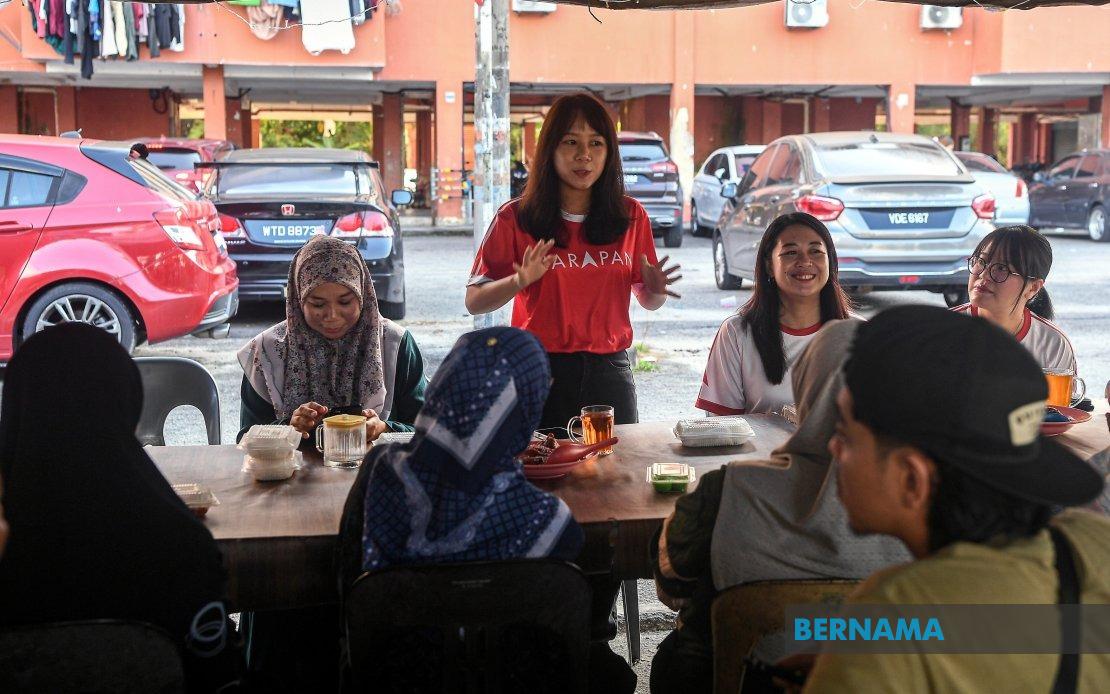
The contest for the Johor Jaya state legislative seat has become a showcase for two contrasting political philosophies on economic development and community engagement, with young professional Lee Wern Yiing representing Pakatan Harapan's vision of harnessing new opportunities, while Barisan Nasional's Chan San San relies on her decade-long track record of grassroots problem-solving. Both candidates are competing in a four-way race that will unfold on July 11, a critical test of voter preferences in this eastern Johor Bahru constituency.
Lee's political entry into this contest reflects a deliberate choice to forgo financial security for public service. At 30 years old, she completed her studies in Singapore in 2018 but rejected the prospect of pursuing a lucrative career across the causeway. Instead, she returned to Malaysia at a pivotal moment when the nation was undergoing significant political transition, convinced that meaningful change was possible if young professionals committed themselves to the reform agenda. This conviction led her to work as a special officer under former Johor Jaya assemblyman Liow Cai Tung, an apprenticeship that eventually positioned her as PH's choice to defend the seat in this election cycle.
As chief of Johor DAP Socialist Youth (Dapsy), Lee has developed a strategy centred on persuading young voters that their engagement with politics matters substantially. She rejects the common refrain that younger generations have disengaged from electoral politics, instead arguing that they conduct their own careful analysis of government performance and make informed voting decisions based on observable reality. This perspective shapes her campaign approach, which blends digital outreach through social media with tangible community initiatives like the 'Johor Jaya Run', creating multiple touchpoints where young residents can discuss their concerns with a candidate who shares their demographic.
The core of Lee's economic platform revolves around the Johor-Singapore Special Economic Zone (JS-SEZ), a megaproject with significant implications for the region's labour market and investment landscape. She advocates for maximising the zone's potential to create a robust ecosystem of employment opportunities that could reverse the brain drain affecting Johor's younger cohort. Her argument is that if the state can offer meaningful career pathways and competitive salaries locally, young people will have less incentive to migrate to Singapore or other more developed economies. This framing transforms infrastructure development from an abstract policy goal into a personal quality-of-life issue: the ability for young Johoreans to build families and careers without leaving their homeland.
Lee has also aligned her platform with broader concerns affecting her demographic constituency, particularly the affordability crisis reshaping urban Malaysia. Housing costs, employment security, and the rising cost of living feature prominently in her messaging, positioning these as interconnected challenges that require integrated policy solutions. By linking large-scale economic development through the JS-SEZ with direct interventions on housing and job creation, she presents a comprehensive vision rather than scattered initiatives.
Chan San San approaches the contest from an entirely different foundation, having built her political capital through more than a decade of direct community engagement in what she describes as her home area of Plentong. Her candidacy represents the traditional BN model of rewarding loyal grassroots activists with candidatures, leveraging their accumulated social capital and network effects. She has served on the Johor Bahru City Council (MBJB) and held positions within the MCA organisational structure, including a role as Johor MCA deputy secretary, while also volunteering with the MCA Crisis Relief Squad (CRSM).
Chan's campaign emphasises the gap between abstract policy announcements and real community impact, arguing that her years in direct service have taught her that residents' problems are concrete realities requiring urgent attention rather than statistics in government reports. This rhetorical positioning implicitly critiques technocratic approaches to governance, suggesting that only candidates with genuine street-level experience can be trusted to implement solutions effectively. Her framing appeals to voters skeptical of newcomers to politics, even highly educated ones, positioning community experience as a more valuable credential than educational credentials or think-tank affiliations.
The BN candidate has outlined four strategic priorities that address the physical and economic infrastructure of Johor Jaya. Strengthening the local economy forms the foundation of her platform, but she contextualises this within Johor Jaya's role as a transportation nodal point in eastern Johor Bahru. The Rapid Transit System (RTS) project, which will enhance connectivity between Johor Bahru and Singapore, features prominently in her vision. Rather than focusing solely on employment creation, Chan emphasises Johor Jaya's positioning as a transit hub, suggesting that improved infrastructure connectivity itself will drive economic activity. She additionally pledges to address persistent traffic congestion issues that affect residents' daily routines, a concrete problem that directly impacts quality of life.
The Johor Jaya contest sits within a substantially larger political competition. The 16th Johor state election involves 172 candidates competing for 56 state seats, indicating the scale of choice available to voters and the competitive intensity across the state. Early voting occurred on July 7, with the main polling day scheduled for July 11, providing a compressed campaign period for candidates to make their case. The four-way contest in Johor Jaya also includes Lau Yi Leong from Parti Bersama Malaysia and independent candidate Lim Hun Peaw, ensuring that the winning candidate must build a sufficiently broad coalition of support to claim victory.
The competing candidacies in Johor Jaya reflect broader tensions within Malaysian electoral politics regarding the optimal balance between experience and innovation, between established party networks and independent capability, and between traditional community service and new forms of digital engagement. Lee's emphasis on job creation and young voter mobilisation through the JS-SEZ framework appeals to those who believe economic transformation requires new thinking and investment in large-scale projects. Chan's stress on accumulated community experience and tactical infrastructure improvements appeals to those who prioritise demonstrated competence in addressing immediate needs. Johor Bahru voters in this constituency will effectively be choosing between these competing diagnoses of what their community requires most urgently as the state moves forward.

