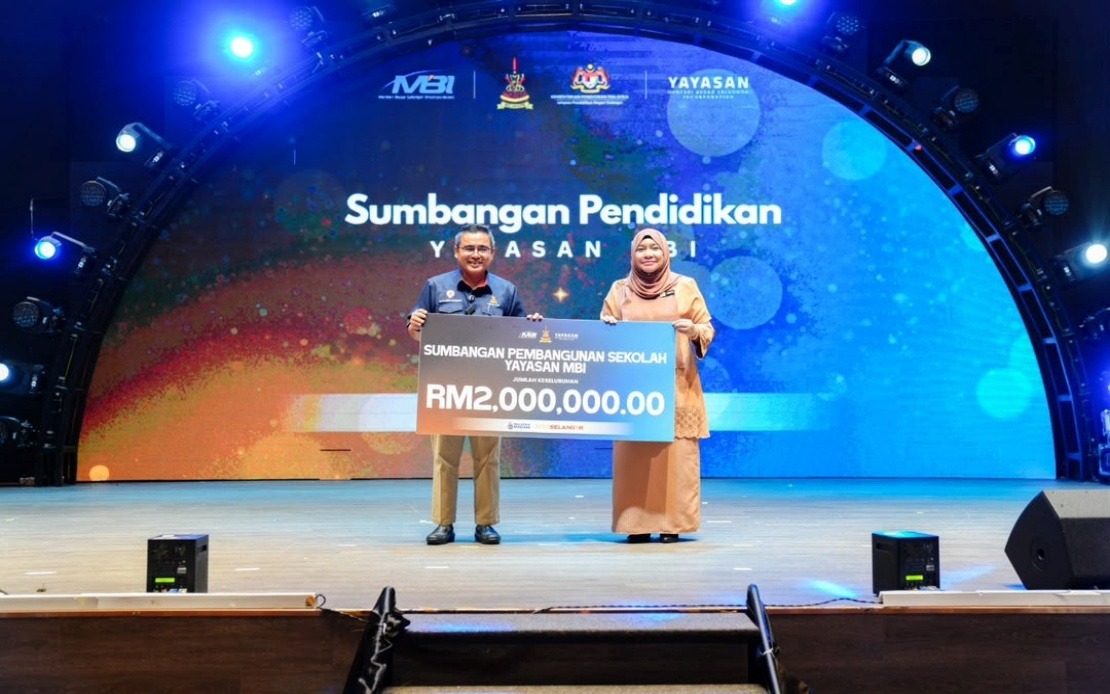
Yayasan Menteri Besar Selangor (Incorporated) has committed RM2 million through its School Development Contribution initiative, marking a significant investment in the state's educational landscape. The disbursement reflects the foundation's dedication to elevating both physical infrastructure and the overall learning environment within Selangor's schools, with benefits intended to reach educators and pupils across multiple institutions.
Ahmad Azri Zainal Nor, head of Yayasan MBI, underscored the strategic importance of education within the foundation's work, noting that approximately two-thirds of all programmatic efforts focus on this sector. This concentration of resources signals a deliberate positioning of education as a cornerstone of the foundation's mission rather than a peripheral concern. For Malaysian stakeholders monitoring state-level education spending, this allocation demonstrates how statutory bodies and foundations are stepping in to supplement government budgets in crucial areas.
The contribution targets tangible improvements in learning facilities and school infrastructure while simultaneously creating a more hospitable workplace for teachers. In the Malaysian context, where teacher retention and morale remain persistent challenges, such initiatives address not only student-facing outcomes but also the professional conditions that influence educator satisfaction and performance. By treating the school environment holistically, Yayasan MBI acknowledges that learning quality depends on the comfort and resources available to those delivering instruction.
Yayasan MBI's perspective on education transcends immediate charitable relief, instead framing educational investment as a long-term commitment to human capital development. This framing aligns with broader development economics principles and suggests a future-oriented approach to economic competitiveness. For Selangor, Malaysia's most industrialised state and economic engine, a well-educated workforce directly influences the state's ability to attract and retain high-value industries and maintain its regional leadership.
The allocation announcement occurred at the Yayasan MBI Education Aspiration 2026 event, a platform designed to forge stronger partnerships among key stakeholders and publicly acknowledge the efforts of educators contributing to the state's educational agenda. Such events serve multiple purposes: they celebrate teacher contributions often overlooked in public discourse, they signal institutional commitment to education, and they create networking opportunities that can amplify programme effectiveness through collaboration.
Yayasan MBI operates several flagship education programmes that collectively address access and quality concerns. The Back to School (BTS) Tour Programme brings learning resources directly to schools, while the Selangor People's Tuition Programme (PTRS) and Didik Kasih Programme (PDK) provide free supplementary learning support. Partnerships with Parent-Teacher Associations (PTAs) extend the foundation's reach into community-level engagement, recognising that parental involvement significantly influences educational outcomes. These varied initiatives demonstrate a multi-layered strategy rather than a single-focus approach.
The programmes collectively embody a commitment to educational accessibility, particularly for disadvantaged students who might otherwise lack exposure to tutoring and enhanced learning materials. In Malaysia's context of persistent wealth disparities and uneven resource distribution across school types and locations, foundation-led initiatives help narrow equity gaps that government systems alone may struggle to address comprehensively.
Yayasan MBI is actively strengthening its partnership with the Selangor State Education Department (JPNS), ensuring that foundation activities align with actual institutional needs rather than operating in isolation. This coordinated approach enhances programme relevance and reduces duplication of effort. For effective public-private collaboration in education, such structural partnership mechanisms are essential, creating feedback loops that help foundations direct resources toward areas where government capacity remains constrained.
Looking ahead, Yayasan MBI envisions continued development of an inclusive, quality education ecosystem aligned with Selangor's broader development aspirations. The foundation's work acknowledges that state-level economic competitiveness ultimately depends on the calibre of its educational institutions and the capabilities of its school-age population. As Malaysia competes regionally for talent and investment, state-level education initiatives become increasingly critical to maintaining comparative advantage.
For Malaysian readers, the Yayasan MBI allocation illustrates how statutory foundations operate as extensions of government education policy, particularly in supplementing infrastructure and providing direct support to schools. Selangor's approach offers potential lessons for other states considering how to leverage foundation resources to enhance their education sectors. The emphasis on partnership with government departments also suggests an emerging model where statutory bodies and education ministries collaborate more explicitly to identify and address specific gaps.
The sustained focus on teacher support and school environment improvement reflects international research confirming that educators' working conditions directly affect student outcomes. By investing in these foundational elements, Yayasan MBI positions itself within evidence-based practice rather than ad hoc charity. This grounding in educational research enhances the credibility and likely effectiveness of the foundation's broader education agenda.
As Selangor navigates demographic shifts and evolving labour market demands, education remains the critical variable determining whether the state can maintain its economic dynamism and improve social mobility. Yayasan MBI's RM2 million allocation, while substantial, represents incremental progress on a challenge requiring sustained, multi-year commitment from government, foundations, civil society, and the private sector working in coordinated fashion.

