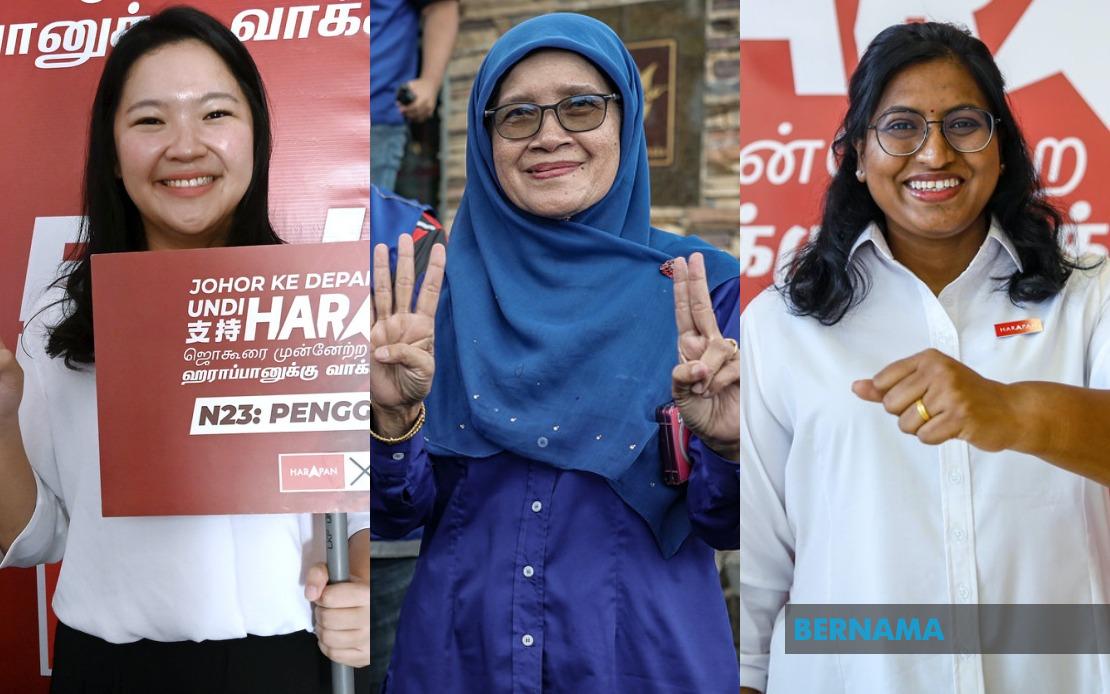
Women have demonstrated enduring political strength in Johor following the 16th State Election, with ten of the 34 female candidates who contested successfully securing seats in the State Legislative Assembly. The results reflect growing acceptance and voter confidence in women leaders across the state's diverse constituencies, despite women comprising just under 20 per cent of the overall candidate pool of 172.
Barisan Nasional dominated the women's representation with seven successful candidates, consolidating the coalition's control over the state after winning 48 of the 56 available assembly seats. Pakatan Harapan secured three female representatives, maintaining its foothold in Johor despite the broader electoral landscape favouring the ruling coalition. This gender split mirrors the overall election outcome and suggests that both major coalitions have prioritized female candidates in winnable or competitive constituencies.
Nadhirah Afiqah Abdull Rahim made her electoral debut in particularly impressive fashion, capturing the Serom seat for Barisan Nasional with a commanding majority of 9,406 votes. Her victory carries symbolic weight as the chief of Ledang Puteri UMNO, positioning her as a visible representative of the youth wing's female leadership. Nor Rashidah Ramli's triumph in Parit Raja proved especially significant, with her vote share expanding substantially compared to previous election cycles. She amassed 19,572 votes to secure a majority of 13,576—nearly tripling the 4,219-vote margin achieved in the 2022 election—demonstrating increased voter mobilization and support in that constituency.
Veteran assemblywoman Alwiyah Talib demonstrated the durability of incumbent female candidates by clinching the Endau seat for a third consecutive term, overcoming a four-way contest with a 3,041-vote majority. Similarly, Norlizah Noh's re-election as Johor Lama assemblyman produced a resounding 16,344-vote margin in a three-cornered battle, suggesting strong personal political brand recognition within her division. Fauziah Misri replicated this success in Penawar with an even more commanding 15,776-vote majority, indicating the capacity of experienced female candidates to build robust voter coalitions.
One of the election's most striking outcomes involved Chan San San's capture of the Johor Jaya seat, historically regarded as a bastion of Democratic Action Party support. Her victory with 35,971 votes represents a significant breakthrough for Barisan Nasional in territory traditionally held by opposition forces, suggesting evolving voter preferences or effective campaign strategies that transcended the usual ideological divides. Hasrunizah Hassan's successful defence of Pulai Sebatang in a direct contest against her Pakatan Harapan opponent further demonstrated incumbency advantages, with her 13,590-vote majority nearly doubling her previous election performance.
Pakatan Harapan's female contingent proved particularly interesting for its generational diversity and professional backgrounds. Felicia Poh Rui Ling, at 28 years old, marked herself as part of a younger political generation by winning the Penggaram seat in her maiden electoral bid, securing a 4,137-vote majority over her Barisan Nasional challenger in a straight fight. Chu Poh Yee retained the Mengkibol seat with a 4,213-vote majority, indicating voter satisfaction with her representation despite the coalition's overall state-level losses. Kartiyaini Jeyapalan, a lawyer from Skudai, consolidated her position in the traditionally Pakatan-friendly constituency with a substantial 15,280-vote margin, defeating candidates from three other parties in a competitive multi-cornered contest.
The representation of women candidates at roughly 20 per cent of the total field reflects ongoing incremental progress toward greater gender balance in Malaysian electoral politics, though significant disparity remains. The 138 male candidates vastly outnumbered their female counterparts, highlighting persistent structural imbalances in party candidate selection processes. However, the conversion rate of female candidates into successful office-holders—approximately 29 per cent—actually exceeded the overall election conversion rate, suggesting that parties strategically positioned women candidates in viable or safe seats rather than relegating them to unwinnable divisions.
The geographic distribution of female representation across Johor's assembly seats reveals interesting patterns about regional political dynamics. Barisan Nasional's seven female victors spread across constituencies from Serom in the north to Pulai Sebatang, demonstrating broad organizational capacity across the state. Pakatan Harapan's female contingent concentrated in traditional opposition strongholds like Penggaram, Mengkibol, and Skudai, where existing political machinery could support less-established candidates. This geographic clustering suggests different recruitment and deployment strategies between the coalitions.
For Malaysian political observers, particularly those tracking gender representation trends, the Johor results offer cautiously positive signals. The success rate of female candidates exceeding their proportion in the candidate pool indicates that voter discrimination based on gender may be diminishing in electoral decisions. However, the continued male-dominated nomination process—with women representing only 20 per cent of candidates—demonstrates that genuine progress requires parallel changes in how parties select their prospective assemblypersons. The Johor election illustrates both the potential and the limitations of women's political advancement in Malaysia's current institutional context.
Looking forward, these results establish a foundation for future discussions about accelerating women's political participation in Johor and nationally. The demonstrated capacity of female candidates to win decisively in diverse constituencies—from rural Endau to urban Johor Jaya—refutes arguments that electoral viability depends on gender. Progressive parties seeking to strengthen their competitiveness may find that expanding female candidate recruitment represents both a democratic imperative and strategic necessity, as voters across the political spectrum appear receptive to capable women leaders.

