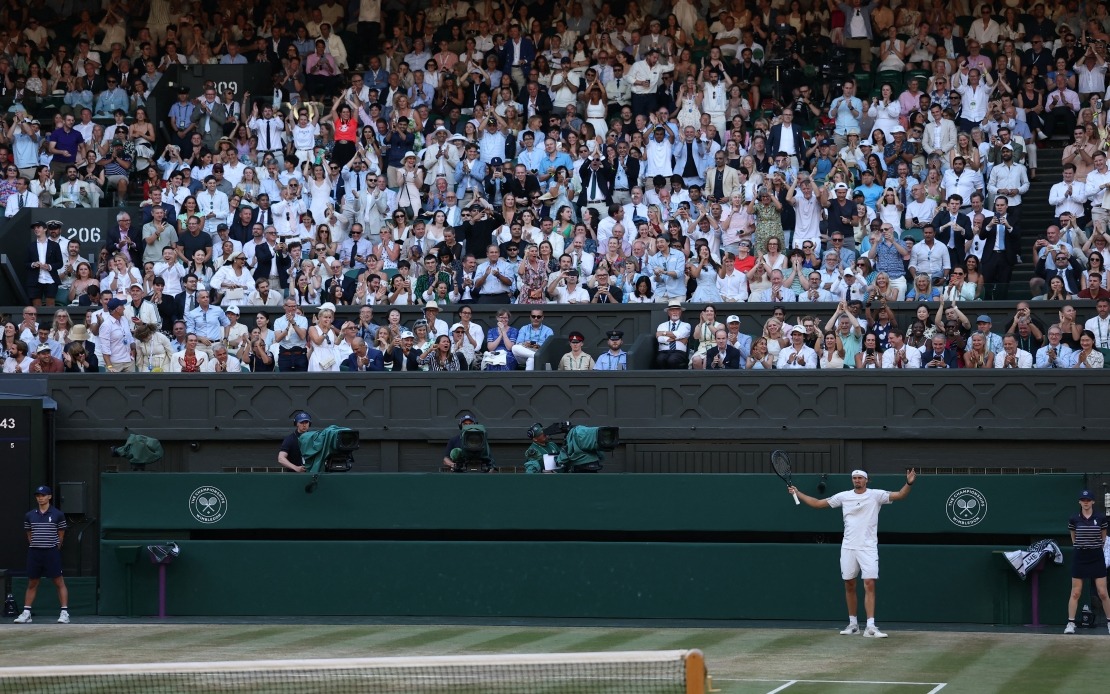
Jannik Sinner's four-set conquest of Alexander Zverev in the men's singles final provided the perfect closing chapter to a compelling fortnight at the All England Club, cementing what proved to be one of Wimbledon's most memorable championships in recent memory. The Italian's victory capped a tournament filled with dramatic turns, emotional narratives, and performances that will linger long in the memory of tennis enthusiasts worldwide, particularly given the tournament's unique blend of established excellence and unexpected triumphs.
Marketa Noskova's women's singles final victory stands as perhaps the most emotionally resonant moment of the championships. The 21-year-old first-time grand slam finalist found herself inexplicably squandering five championship points during a second-set collapse of staggering proportions, ultimately forcing the match into a deciding set before she could secure victory. The Czech player's journey echoed the ghosts of her nation's tennis past, particularly the haunting memories of Jana Novotna, another former Czech champion whose own tears on the shoulder of the Duchess of Kent remain etched in Wimbledon lore after she surrendered an apparently commanding position against Steffi Graf in the 1993 final.
What separated Noskova's narrative from Novotna's tragedy, however, was its redemptive arc. After her second-set collapse saw her squander a 5-2 lead, Noskova took a bathroom break and, upon walking past the trophies displayed in the tournament facilities, made a bold pronouncement that she would claim the biggest prize. Unlike Novotna, who endured five years of waiting before finally capturing her own grand slam crown in 1998, the young Czech seized her opportunity immediately, demonstrating a mental fortitude that defined her comeback.
British wild card Jacob Fery emerged as the unexpected hero of the championships, his improbable semi-final appearance generating enormous support from the home crowd and restoring pride to a nation that had endured a particularly disappointing tournament. The 23-year-old Wimbledon resident, ranked 114th in the world, orchestrated one of the most unlikely victories in recent memory against Feliciano Lopez Bergs, a player ranked 77 places higher. Playing under blistering heat on Court 18, Fery found himself trailing 4-1 in both the fourth and fifth sets while simultaneously battling three separate nosebleeds that threatened to derail his remarkable run.
The true measure of Fery's character emerged when faced with such adversity. He levelled the match by forcing it to a tie-break before demonstrating exceptional composure in the deciding 10-point tie-breaker while his higher-ranked opponent visibly lost his composure. His ultimate success—reaching the semi-finals as a British wild card—elevated him into a select group of only five British men this century who have advanced to the second week at Wimbledon, a statistic that underscores both his achievement and the relative scarcity of deep tournament runs for home players in recent years.
Novak Djokovic's quarter-final encounter against Felix Auger-Aliassime produced yet another age-defying performance from the 39-year-old Serbian champion, yet it came at considerable cost. The match stretched to five hours and fifteen minutes, establishing itself as the longest quarter-final in Wimbledon's entire history and concluding at 11pm, a mere eight minutes before the tournament's mandatory curfew. Beyond the extraordinary length, Djokovic's evening was marked by a familiar injury concern when he required treatment for a calf problem following the first set, alongside an intense confrontation with tournament referee Denise Parnell regarding the closure of the stadium roof before the third set.
Despite emerging victorious against the third-seeded Auger-Aliassime, Djokovic's reserves proved nearly depleted by the encounter's conclusion. The 24-time grand slam champion's well-documented ability to find reserves of mental strength and physical resilience was tested to its absolute limit, ultimately contributing to his semi-final exit at the hands of Sinner. This result suggested that even Djokovic's legendary capacity for deep tournament runs faces genuine constraints as he approaches the final stages of his professional career.
The women's semi-final between Coco Gauff and Karolina Muchova crystallised around a single tie-break of extraordinary intensity that lasted eighteen pulsating minutes. At 8-8 in the tie-break, Muchova received a time violation before subsequently hitting long, presenting Gauff with a first match point. However, the American inexplicably deposited what appeared an uncomplicated drop-shot winner directly into the net, squandering an opportunity to clinch the match immediately. Muchova subsequently appeared poised to convert her own match point, yet she dramatically lost her footing as she shaped for a volley, allowing Gauff's cross-court forehand to sail past her outstretched racket.
The momentum swings in this remarkable tie-break captured the raw intensity of elite women's tennis, where single points separate triumph from heartbreak. When Muchova finally secured her second match point, she executed flawlessly, manoeuvring the American around the court before Gauff's tired forehand surrendered under the pressure. The match encapsulated the kind of emotionally draining, point-by-point intensity that defines semi-final tennis at the world's most prestigious grass-court championship.
Serena Williams' return to professional competition as a 44-year-old wild card entry represented the tournament's most anticipated storyline, particularly given nearly four years had passed since she announced her decision to "evolve away" from the sport. Her appearance on Centre Court generated a standing ovation that underscored her enduring significance within the tennis world and popular culture more broadly. Against Ashleigh Barty's former rival, a 24-year-old Australian player named Joint, Williams demonstrated glimpses of her considerable capability, establishing an early break in the deciding set that suggested a triumphant return remained possible.
Yet the physical demands of competing at the elite level proved unforgiving. Williams gradually faded as the match progressed, with Joint demonstrating impressive composure while navigating both the power of her accomplished opponent and the intimidating nature of competing against one of sport's greatest athletes. It subsequently emerged that Williams had suffered a knee injury during the first set, a complication that ultimately precluded her participation in a planned doubles reunion with her sister Venus. While her return did not culminate in victory, Williams' presence at Wimbledon underscored her continued capacity to capture public imagination and demonstrated that elite tennis remains accessible across age ranges when talent and determination converge.

