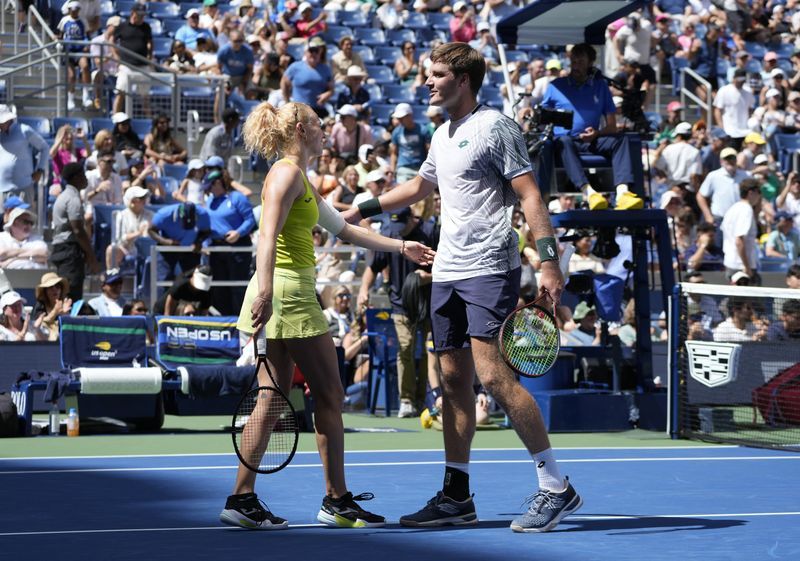
Serena Williams produced one of tennis's most celebrated comebacks on Tuesday at the US Open mixed doubles, teaming with rising star Carlos Alcaraz to dispatch Erin Routliffe and Lloyd Glasspool 5-3, 4-1 in the opening round. The 44-year-old American icon, who had not graced Arthur Ashe Stadium since her emotional 2022 retirement, received a roaring ovation that underscored her enduring place in the sport's consciousness. Her emergence also overshadowed a shocking upset in the day's fixtures: top seeds Novak Djokovic and Aryna Sabalenka were eliminated by experienced doubles specialists Henry Patten and Katerina Siniakova in a 1-4, 4-2, 10-2 result.
Williams' return to competitive tennis after more than a year away generated immediate electricity at the venue where she has won multiple singles titles. The 23-time Grand Slam champion announced her comeback only two months prior, and her presence in the mixed doubles draw attracted considerable media attention and fan interest. When she struck a backhand winner on her opening shot of the match, the stadium erupted—a moment that symbolised not merely her return to the court but the sport's recognition of her undiminished drawing power. Her emotional farewell in 2022 had been poignant, yet the possibility of further chapters in her career remained tantalising to many observers.
The chemistry between Williams and Alcaraz, separated in age by more than two decades, emerged as a notable subplot of their dominant performance. The world's current seventh-ranked player, Alcaraz, had remained sidelined since April owing to injury, making this appearance a significant milestone in his own recovery journey. Despite the layoff, the 21-year-old adapted quickly to mixed doubles format, eventually sealing the first set with a forehand winner. The pair's evident enjoyment—evident in their frequent exchanges of grins and gestures—contrasted sharply with the mechanical precision often associated with high-level tennis, creating an engaging spectacle for the packed crowd. Their co-ordination and tactical awareness, built rapidly despite limited preparation, demonstrated both players' innate court intelligence.
Williams showcased glimpses of her legendary power during the encounter, particularly when she unleashed a 120 mph ace during the seventh game that drew audible gasps from spectators. This moment encapsulated the reason her return captured imaginations across the tennis world: even at 44, with extended time away from competition, her ability to produce match-defining moments remained evident. The second set saw Williams and Alcaraz dispatch their opponents with commanding efficiency, moving into the quarter-finals where they will face Belinda Bencic and Flavio Cobolli.
The upset orchestrated by Patten and Siniakova against Djokovic and Sabalenka represented a significant competitive statement from the doubles specialists. The Serbian world number one and the Australian top-ranked woman had arrived as tournament favourites, their individual pedigrees seemingly a trump card in a mixed doubles format designed to showcase singles stars. However, Patten and Siniakova capitalised on the inherent volatility of the format itself, with Patten observing that a single poor game could swing an entire set in the compressed schedule. Their 10-2 tiebreak victory in the third set demonstrated the capacity for momentum shifts, with Siniakova punctuating the upset with an ace on match point that sealed an improbable result.
The mixed doubles redesign, now in its second year, continues to generate debate within the professional tennis community. The tournament organisers deliberately repositioned the event as a showcase match the week preceding the main singles draw, hoping to cultivate fresh enthusiasm among casual viewers and increase commercial appeal. The inaugural year proved commercially successful, with sellout crowds and participation from tennis's biggest names validating the strategic gamble. Yet this repositioning has drawn criticism from traditional doubles practitioners, who contend that the innovation marginalises the sport's established pairings and redirects attention and resources away from specialists who have devoted careers to doubles excellence.
The broader implications of Williams' participation extend beyond one mixed doubles victory. Her presence at the US Open, even in an ancillary format, carries symbolic weight in a sport where age, injury recovery, and the definition of athletic longevity remain perpetual subjects of fascination. At 44, competing at the highest professional level alongside one of tennis's brightest emerging talents, Williams embodies contemporary shifts in how elite athletes approach their careers. Her second-act narrative contests traditional retirement timelines and challenges assumptions about the inevitability of decline.
The tournament results continued to produce surprises elsewhere in the draw. Last year's champions, Italians Sara Errani and Andrea Vavassori, fell to the Russian combination of Mirra Andreeva and Andrey Rublev 1-4, 4-1, 11-9 in a closely contested encounter that mirrored the competitive intensity evident throughout the mixed doubles field. Meanwhile, married couple Gael Monfils and Elina Svitolina advanced to the semi-finals, as did the pairing of Karolina Muchova and Jakub Mensik, suggesting that the format continues to produce engaging matchups despite its departure from traditional doubles structure.
For Malaysian and Southeast Asian tennis enthusiasts, Williams' comeback carries particular resonance in a region where her influence on the sport's global expansion has been substantial. Her dominance during the 1990s and 2000s helped elevate tennis' visibility internationally, inspiring younger players across Asia to pursue the sport at competitive levels. Her return, however brief or extended, reinforces the notion that professional tennis remains accessible to individuals of determination and talent, irrespective of age-related assumptions that pervade sport generally. The US Open's mixed doubles innovation, meanwhile, offers insights into how traditional sporting formats can evolve to maintain contemporary relevance without necessarily abandoning competitive integrity.
As Williams progresses through the tournament alongside Alcaraz, observers will closely monitor whether this represents a sustained competitive chapter or a limited nostalgic interlude. Regardless of outcomes, her presence has already reshaped conversation surrounding the US Open itself, redirecting focus to the emotional and symbolic dimensions of sport that transcend raw competitive results. The mixed doubles format, whatever its critics contend, has successfully provided a vehicle for these narratives to flourish.

