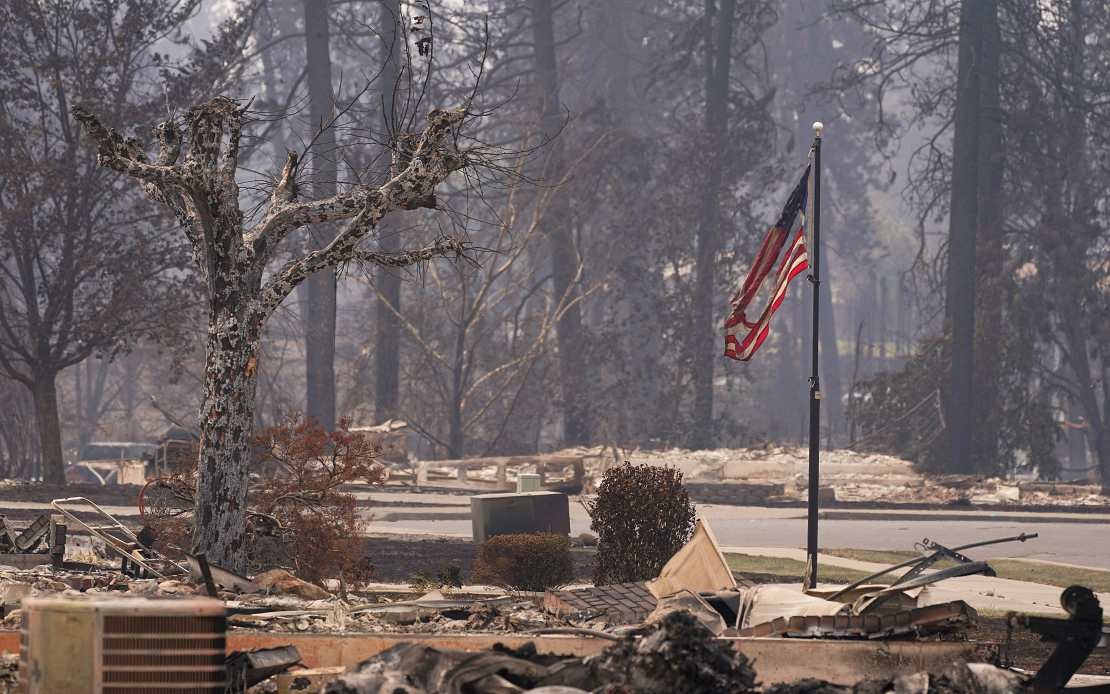
Disaster has struck Washington state as multiple wildfires sweep across the region, forcing more than 65,000 people to abandon their homes and seek safety. The American Red Cross confirmed the staggering evacuation figures on Monday as flames continue to consume vast stretches of residential and forested land, with preliminary counts indicating at least 700 homes destroyed, concentrated primarily in Spokane County.
The speed and scale of the evacuation underscore the ferocity of the fires currently threatening the Pacific Northwest. Authorities are working methodically through the aftermath, attempting to account for those displaced and verify the safety of individuals who have not yet been contacted. While Governor Bob Ferguson reported that officials have reached out to nearly everyone who requested assistance, approximately 14 people remain unaccounted for—though authorities characterise them as unreached rather than missing, suggesting they may simply be out of contact. Fortunately, the governor confirmed there have been no deaths reported thus far, providing at least one measure of relief amid the widespread devastation.
Investigators have identified a potential catalyst for at least one of the major fires. Aaron F. Farinacci, a 37-year-old man, was taken into custody on Monday afternoon and charged with first-degree arson. According to Spokane County Sheriff John Nowels, Farinacci is suspected of being responsible for the Old Trails Fire, one of several concurrent blazes threatening the region. He is being held on a $1 million bond pending further legal proceedings, a significant sum reflecting the severity of the charges and the scale of destruction linked to the fires.
The geographical extent of the fires illustrates their unprecedented nature for the region. Data from InciWeb, an interagency wildfire tracking system, reveals that fires near Spokane and Stevens counties have already charred 8,026 acres since Saturday. Disturbingly, these fires remain completely uncontained at zero percent containment, meaning crews have yet to establish any meaningful perimeter. The situation is equally dire elsewhere in the state: the Sinlahekin fire has exploded to 85,000 acres since igniting from a lightning strike on July 26, requiring the deployment of more than 820 personnel but still lacking any containment. Northwest of Leavenworth, the Little Giant Fire has scorched 51,298 acres within the Okanogan-Wenatchee National Forest, further straining state resources.
The challenge facing firefighters is compounded by the sheer number and geographic distribution of active blazes. While weather conditions appear to be shifting in favour of containment efforts, with the Spokane Complex Fire Incident Management Team reporting that crews are making some headway along fire lines, the overall situation remains precarious. The combination of uncontained fires across multiple counties, the density of populated areas in the immediate vicinity, and the scale of property destruction makes this one of the most significant wildfire events the state has experienced in recent years.
For Malaysian readers monitoring global disaster management and emergency response protocols, Washington's response offers instructive lessons. The rapid mobilisation of the American Red Cross, the coordination between county and state authorities, and the deployment of over 800 personnel to a single fire demonstrate the resource-intensive nature of modern wildfire suppression. The arrest of Farinacci and the swift investigation into suspected arson also highlight the importance of investigative capacity during active disasters—a parallel concern for Malaysian authorities managing seasonal fire risks in Peninsular Malaysia and across Borneo.
The economic and social toll extends far beyond the immediate destruction. With 65,000 people displaced, supply chains, employment, and local services face severe disruption. Schools, hospitals, and businesses across affected counties will experience cascading consequences. Insurance claims will likely reach into the hundreds of millions, and reconstruction efforts will occupy the region for months or years. The psychological impact on evacuated residents, particularly those who have lost homes, will persist long after the flames are extinguished.
Governor Ferguson's statement that authorities have "accounted for nearly everyone" reflects systematic efforts to track vulnerable populations during the mass evacuation. However, the remaining 14 people underscore the difficulty of maintaining complete situational awareness during rapid-onset disasters affecting sprawling rural and suburban areas. This challenge resonates with disaster management issues faced across Southeast Asia, where geographical dispersion and variable infrastructure often complicate evacuation and accountability operations.
The lightning-triggered origin of the Sinlahekin fire—the largest of the concurrent blazes—reminds us that not all wildfire risk stems from human negligence. Climate patterns that increase lightning frequency and reduce atmospheric moisture extend the fire season and expand the geographic area at risk. Scientists have documented how rising temperatures create conditions favourable for rapid fire spread, transforming what were once seasonal phenomena into year-round threats in some regions. This broader environmental context frames the arson investigation not as an anomaly but as one contributor to an increasingly hazardous landscape.
As crews push forward with containment efforts and weather conditions continue to favour firefighting operations, the focus will gradually shift from emergency response to recovery and investigation. The 700-home tally will likely rise as assessments continue, and the financial cost will reshape state and federal disaster relief appropriations. For those displaced, the path forward remains uncertain, dependent on insurance coverage, family resources, and the speed of reconstruction efforts. Meanwhile, the investigation into Farinacci's alleged role in igniting the Old Trails Fire will proceed through the courts, potentially shaping how Washington approaches arson prosecution and fire-related penalties.

